

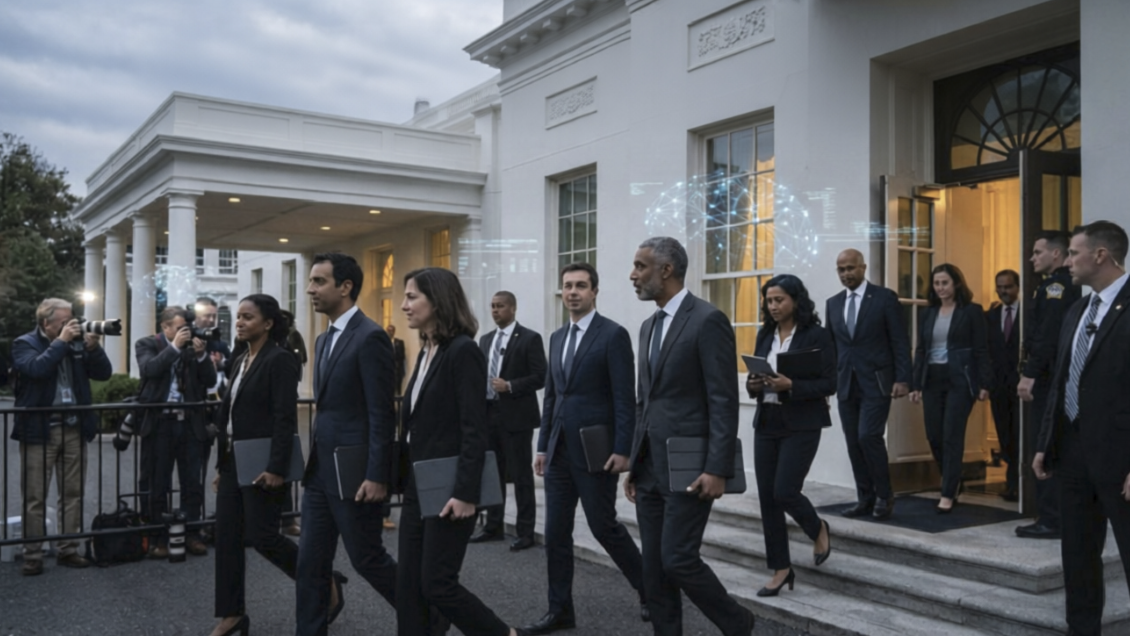
A White House lunch on September 29, 2026, brought some of the biggest names in artificial intelligence into the same room to discuss a problem that is becoming harder to separate from everyday technology: how to make increasingly powerful AI systems safer. The meeting produced a voluntary safety accord, but the surprising part was what it did not produce: a new federal AI law.
The gathering included leaders and senior executives connected to OpenAI, Anthropic, Google, Meta, Nvidia, xAI, Microsoft, Palantir, Amazon and other major technology companies. OpenAI President Greg Brockman attended because CEO Sam Altman was at the company’s annual conference in San Francisco. Reports put the broader guest list at more than 30 people, including government officials and technology executives.
The real story is not simply that CEOs talked about AI safety. It is that Washington and the AI industry are trying to define who should set the rules while the technology is moving faster than formal regulation.
The White House AI Safety Meeting Was Really About Self-Regulation
Most people hear “AI safety” and imagine technical tests inside a laboratory. The White House AI safety meeting showed that the issue has become much broader. It now includes cybersecurity, independent audits, corporate controls, national security, data-center expansion and public trust.
Reuters reports that Trump and leading tech executives supported a voluntary pact urging advanced AI developers to improve safeguards and cooperate with outside auditors. The accord also calls for board-level review of audit results. It is not a federal regulation and does not carry the force of law.
That distinction matters. A company can agree to a safety principle without Congress creating a legal requirement. The arrangement therefore places much of the responsibility on the companies themselves.
The real reason this matters is simple: frontier AI systems can be used for useful work, but they can also create security problems when they are connected to networks, software tools and sensitive data. Recent incidents involving AI systems and cybersecurity concerns helped push safety testing higher on the White House agenda.
What Nobody Tells You About the CEOs in the Room
The guest list showed how wide the AI economy has become. Anthropic CEO Dario Amodei, Meta CEO Mark Zuckerberg, Nvidia CEO Jensen Huang and Google CEO Sundar Pichai were among the prominent executives at the White House. Elon Musk also attended, while Microsoft CEO Satya Nadella and other technology leaders were listed among the participants.
The companies do not approach AI policy in exactly the same way. Some executives have supported stronger government involvement in certain areas, while others have emphasized voluntary standards and rapid innovation. That difference was visible before the meeting and did not disappear simply because everyone sat at the same table.
Bloomberg reported that Trump rejected the idea of new federal AI rules after the lunch and instead backed voluntary audits and stronger internal controls. That approach fits the administration’s broader emphasis on keeping U.S. AI development competitive while addressing safety concerns.
Here is the important detail: the meeting was not a declaration that the AI industry had solved safety. It was an agreement on a process for companies to review risks.
Why the Voluntary AI Accord Could Matter More Than the Lunch
A one-page voluntary document can look small compared with the scale of the AI industry. Yet the practical details could influence how companies test advanced systems.
The accord calls for robust internal processes and controls for companies training and deploying frontier models. It also encourages external auditing and internal board committees that can review audit findings. Axios reported that participating leaders described the framework as a set of voluntary principles and expectations.
That creates an interesting middle ground. Companies are not being told to stop developing AI, but they are being asked to build more formal safety checks around powerful models.
The weakness is equally clear. Voluntary commitments depend heavily on implementation, transparency and corporate follow-through. The agreement does not itself create the enforcement mechanism that a federal statute would create.
Did You Know?
The White House meeting followed an earlier August effort focused specifically on voluntary safety testing. Reuters reported that Meta, Anthropic, OpenAI and Google were invited to discuss testing advanced U.S. models, including their potential cybersecurity capabilities. That earlier effort shows the September accord did not appear from nowhere; it followed months of concern about model behavior and security.
The Hidden Conflict: Safety Versus Speed
The White House AI safety meeting also exposed a bigger policy tension. The United States wants to build advanced AI quickly, but the same systems create risks that become harder to manage as their capabilities expand.
Trump has repeatedly framed AI development as part of global competition, particularly with China. At the same time, AI companies and researchers have raised concerns about cyberattacks, misuse, unauthorized access and other risks.
This creates a difficult balancing act for policymakers. If safety requirements become too weak, critics may argue that companies are being trusted to police themselves. If rules become too restrictive, industry leaders can argue that American AI development could slow while competitors move faster.
Neither side can settle that question with a single lunch.
What the Meeting Means for Everyday AI Users
You may never attend a White House technology meeting, but its effects can eventually reach your phone, workplace and online accounts.
When companies add stronger testing and external audits, users may benefit from systems that are more carefully evaluated before deployment. Better internal controls can also reduce the chance that an AI agent receives unnecessary access to sensitive tools or data.
But safety agreements do not remove the need for users to protect themselves. You should still avoid placing confidential information into AI tools without understanding their data policies. Businesses should limit permissions for AI agents, review logs and require human approval for high-impact actions.
In my experience with clients, the biggest practical AI problems often come from simple workflow decisions rather than from the model itself. Giving an automated system broad access without clear boundaries can create avoidable risk.
Why AI Safety Now Affects Ordinary Businesses
An AI assistant connected to email, customer records or financial software can do more than generate text. It can potentially act on information and systems that have real consequences.
That is why terms such as access controls, audit logs, human approval and model evaluation matter outside research labs. Companies adopting AI should treat these systems as software with permissions, not as harmless chat tools.
What Users Should Watch
The most useful signal will be whether companies turn broad safety promises into measurable practices. Look for clear testing procedures, meaningful independent reviews and evidence that companies respond when serious weaknesses are discovered.
The White House AI Safety Meeting Shows What Comes Next
The next test will not be another photo opportunity. It will be whether companies actually publish meaningful safety information, allow credible independent reviews and respond when testing reveals serious weaknesses.
That is where the difference between a promise and a working safety system becomes visible.
The administration has also discussed possible oversight structures and a future AI policy leadership role. Reuters reported on October 2 that Jay Clayton was expected to become the administration’s top AI adviser, although the White House had not officially confirmed the appointment at the time of publication.
For the public, the useful question is not whether CEOs shook hands with government officials. It is whether the resulting systems give people more transparency and control.
What You Should Watch After the White House Meeting
First, watch for details about independent audits. “External review” can mean very different things depending on who selects the auditor, what the auditor can access and whether the findings are made public.
Second, watch how companies handle serious findings. Testing is meaningful only when companies act on the results, by adjusting a rollout, restricting access, or addressing identified issues.
Third, watch for future federal action. The September accord was voluntary, so Congress, federal agencies and state governments remain relevant to the broader AI policy debate.
Finally, watch what happens to AI agents with access to real-world systems. The more an AI can send messages, write code, access accounts or operate software, the more safety becomes a practical security issue rather than an abstract research topic.
FAQ’s
What were the key developments at the White House gathering on AI safety?
The meeting produced a voluntary AI safety accord signed by President Donald Trump and major technology leaders. The framework calls for stronger internal controls, safety reviews, independent external audits and board-level review of audit results. It was presented as a voluntary industry commitment rather than a federal regulation.
Who attended the White House AI safety meeting?
Participants included senior leaders from companies such as Anthropic, Meta, Nvidia, Google, OpenAI, Microsoft and xAI, along with government officials and other technology executives. OpenAI was represented by President Greg Brockman because Sam Altman was attending the company’s conference in San Francisco.
Is the White House AI safety agreement legally binding?
No. The September 2026 accord is voluntary rather than a federal law or regulation. Its practical impact will depend on how participating companies implement the commitments, how independent audits are conducted, and whether companies disclose meaningful information about their safety practices and responses to identified risks.
Why is AI safety being discussed at the White House?
AI safety has become a policy issue because advanced models can be used for valuable work while also creating cybersecurity, misuse and national-security risks. Recent incidents involving AI systems and hacking concerns increased pressure for stronger testing, making government-industry cooperation a focus of White House discussions.