

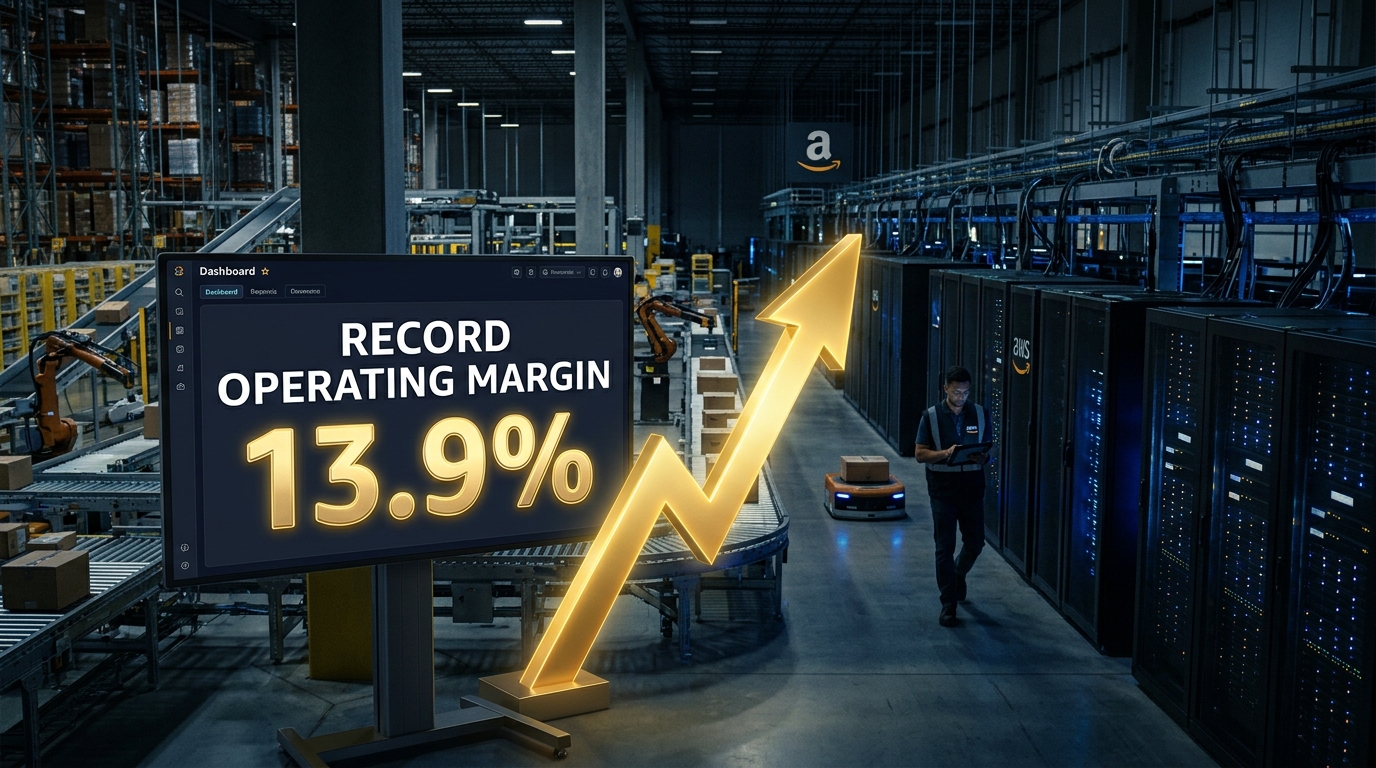
Amazon has reached an important milestone in its financial performance. Its operating margin has climbed to 13.9%, marking a significant achievement. The figure shows that the company is becoming more effective at turning its business activities into profit.
However, operating margin means more than simply making money. It reveals how efficiently a company manages its business expenses. Moreover, it helps investors understand whether revenue growth translates into stronger profitability.
Amazon’s latest margin figure has attracted attention across financial markets. Therefore, understanding this measurement can explain why investors consider it important.
What Is Operating Margin?
Operating margin measures the percentage of revenue a company keeps after paying its operating expenses. These expenses include employee salaries, shipping, technology, rent, and other business costs.
Investors use this metric to evaluate business efficiency. Typically, a rising operating margin suggests the company is managing its day-to-day expenses more efficiently.
The formula is straightforward:
Operating Margin = (Operating Income ÷ Total Revenue) × 100
For example, imagine a company generates $100 million in revenue. Its operating income reaches $15 million. Therefore, its operating margin equals 15%.
This means the company earns $15 in operating profit for every $100 in sales. The measure does not account for interest payments or taxes.
Why Amazon’s 13.9% Operating Margin Matters
Amazon reported a 13.9% operating margin for the third quarter of 2026. The company generated approximately $201.9 billion in revenue. Meanwhile, operating income reached $28.1 billion.
Amazon’s operating income increased 61% compared with the previous year’s quarter. Consequently, profitability improved considerably faster than overall revenue.
This achievement represents Amazon’s highest quarterly operating margin ever. Company management highlighted the milestone in its October 29 earnings announcement.
The result demonstrates stronger financial efficiency across Amazon’s major business operations. Moreover, it shows how different revenue streams contribute to overall profitability.
How Amazon Increased Its Operating Profitability
Several factors contributed to Amazon’s record operating margin. Its cloud computing business played an especially important role.
1. Amazon Web Services Continues Growing
Amazon Web Services (AWS) remains one of Amazon’s strongest profit generators.
AWS generated approximately $46 billion in third-quarter revenue. Its sales increased 39.3% year over year.
A key point is that AWS generated $17.8 billion in operating profit. Its operating margin reached 38.7% during the quarter.
This profitability makes AWS particularly valuable to Amazon’s overall financial performance. Additionally, demand for artificial intelligence infrastructure continues supporting cloud growth.
2. Advertising Revenue Supports Profitability
Amazon’s advertising business also contributes to its financial strength. The company generated approximately $19.6 billion in advertising revenue.
Advertising services benefit from Amazon’s large customer base. Therefore, the company can monetize shopping searches and product visibility.
Furthermore, advertising creates another revenue stream alongside retail and cloud computing. This diversification strengthens Amazon’s overall business model.
3. Retail Operations Are Becoming More Efficient
Amazon operates a massive international delivery and fulfillment network. Managing this infrastructure requires significant investment and operational spending.
However, the company continues improving delivery efficiency and inventory placement. More efficient logistics can help lower delivery costs and cut avoidable business expenses.
Meanwhile, automation helps streamline warehouse activities. These improvements can support stronger retail profitability over time.
Operating Margin vs. Net Profit Margin
Operating margin and net profit margin each show a different part of a company’s financial performance. Investors should understand this distinction before evaluating Amazon’s results.
| Financial metric | What it measures |
| Operating margin | Profit from core business operations |
| Net profit margin | Profit remaining after all expenses |
| Gross profit margin | Revenue remaining after direct production costs |
Operating margin excludes interest payments and taxes. However, net profit margin includes these expenses.
For instance, a business could have a high operating margin. Nevertheless, expensive borrowing could reduce its final net profit.
Therefore, investors should examine multiple financial indicators. No single profitability measurement provides a complete financial picture.
How Amazon Compares Across Its Business Segments
Amazon operates several businesses with different profitability levels. Its third-quarter results demonstrate these differences clearly.
AWS generated a 38.7% operating margin. North America’s operating margin reached 7.7%. Meanwhile, the International segment reported a 3.7% margin.
These differences explain why AWS contributes so significantly to Amazon’s profitability.
Although retail generates substantial revenue, cloud computing produces stronger operating margins. Consequently, AWS growth can improve Amazon’s consolidated financial performance.
However, retail remains essential for customer relationships and marketplace expansion. Advertising also benefits from Amazon’s extensive shopping ecosystem.
Does a Higher Operating Margin Make Amazon a Better Investment?
A record operating margin represents an encouraging financial development. However, investors should consider several additional factors.
First, they should examine whether profitability continues improving. One successful quarter does not guarantee permanent progress.
Second, AWS growth deserves close attention. Its performance could significantly influence Amazon’s future earnings.
Third, investors should monitor capital expenditures. Amazon continues investing heavily in artificial intelligence and cloud infrastructure.
These investments could strengthen future revenue opportunities. Nevertheless, substantial spending can pressure free cash flow.
Amazon’s latest results illustrate this important distinction. Its trailing twelve-month operating cash flow reached $168.3 billion. However, trailing twelve-month free cash flow was negative $42.4 billion.
Therefore, record operating profitability does not automatically mean stronger free cash flow.
What Amazon’s Record Operating Margin Means for the Future
Amazon’s 13.9% operating margin marks an important financial milestone. It demonstrates improving profitability despite the company’s enormous business scale.
AWS remains a major contributor to this achievement. Additionally, advertising growth and retail efficiency support its financial performance.
However, investors should monitor infrastructure spending and cash flow carefully. These factors will influence how sustainable Amazon’s profitability becomes.
Ultimately, operating margin provides valuable insight into business efficiency. Amazon’s latest record suggests its operations are becoming more profitable. The company’s next challenge is maintaining that progress while funding future growth.