

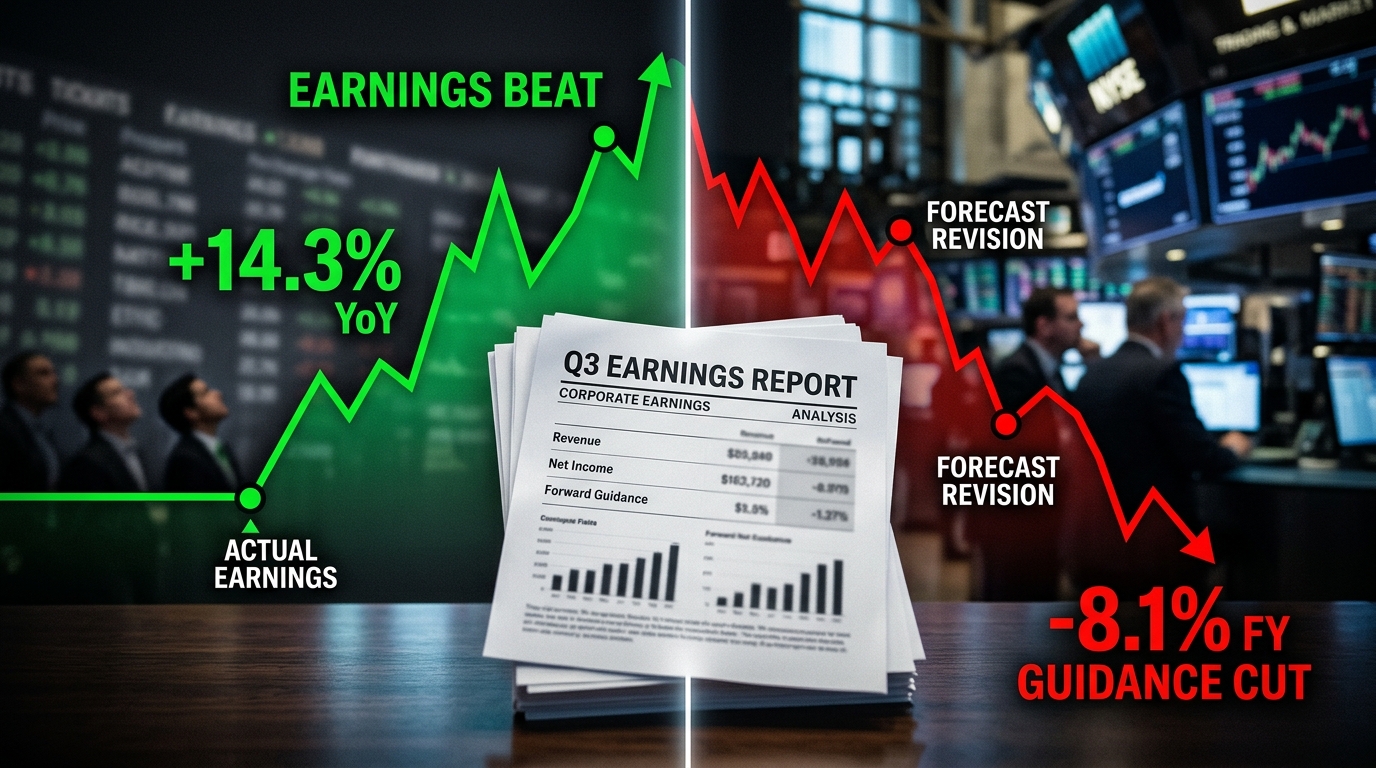
Investors often celebrate when companies report better-than-expected earnings. However, strong quarterly results do not always lead to higher stock prices. Sometimes, a company beats earnings estimates but still disappoints investors.
This situation often happens when management reduces its future financial outlook. Understanding the difference between an earnings beat and a guidance cut helps investors make smarter decisions.
What Is an Earnings Beat?
A company delivers an earnings beat when its reported results exceed analysts’ forecasts, often for earnings per share (EPS), revenue, or both.
For example, analysts might expect a company to earn $1.20 per share. However, the company reports $1.45 per share. This result represents an earnings beat.
Similarly, a company can beat revenue expectations by generating more sales than analysts predicted.
An earnings beat often signals strong business performance. Moreover, it can increase investor confidence and attract new buyers.
What Is a Guidance Cut?
A guidance cut happens when company management lowers its financial expectations for future quarters or the full year.
Companies provide guidance to help investors understand expected business performance. This guidance usually covers revenue, earnings, profit margins, or other financial targets.
For example, a company might previously expect $10 billion in annual revenue. However, management could reduce that forecast to $9 billion.
Such a reduction can worry investors. It suggests that management expects weaker business conditions ahead.
Earnings Beat vs. Guidance Cut: Key Differences
Although both terms appear during earnings season, they describe different financial situations.
An earnings beat focuses on past performance. In contrast, a guidance cut focuses on future expectations.
Here are the main differences:
- Time period: An earnings beat measures completed financial performance. A guidance cut changes future expectations.
- Financial impact: An earnings beat shows stronger-than-expected results. A guidance cut signals potential weakness.
- Investor reaction: An earnings beat can support stock prices. However, a guidance cut can create selling pressure.
- Management message: An earnings beat reflects reported results. Meanwhile, a guidance cut communicates lower expectations.
Therefore, investors should examine both figures before judging a company’s financial health.
Why Might a Share Price Drop Despite an Earnings Beat?
Even after beating expectations, a company’s stock may fall if investors are concerned about its growth prospects. Strong quarterly numbers cannot always offset disappointing forecasts.
Several factors can explain this reaction.
1. Lower Future Revenue Expectations
Management might report strong current sales but expect weaker demand ahead. Consequently, investors may reduce their growth expectations.
2. Rising Operating Costs
A company could generate higher revenue while facing increasing expenses. As a result, future profit margins might decline.
3. Weak Customer Demand
Strong quarterly results may reflect earlier customer orders. However, slowing new orders can indicate weaker upcoming performance.
4. Economic Uncertainty
Inflation, higher interest rates, and changing consumer behavior can affect future business results. Therefore, investors may react negatively to cautious management forecasts.
How Investors Should Read Earnings Reports
Investors should look beyond headline earnings numbers. A complete earnings report provides a clearer picture of business performance.
Consider these important factors:
Compare EPS With Analyst Estimates
Check whether reported earnings exceeded market expectations. Also, examine whether the company achieved genuine operating growth.
Review Revenue Growth
Revenue shows how much money a company generates through its business activities. Fast-growing revenue can indicate that an earnings beat is backed by solid business performance.
Examine Forward Guidance
Compare the latest forecast with previous management expectations. Furthermore, check whether the company expects stronger or weaker performance.
Check Profit Margins
Profit margins reveal how efficiently a company converts revenue into earnings. Declining margins can weaken an otherwise positive earnings report.
Listen to Management’s Explanation
Earnings calls often explain the reasons behind changing forecasts. Management discussions can reveal demand problems, rising costs, or operational challenges.
Can an Earnings Beat Offset a Guidance Cut?
Yes, an earnings beat can sometimes offset a guidance cut. However, the outcome depends on the size and reasons behind each development.
For example, a company might exceed quarterly earnings estimates by 15%. At the same time, management could reduce annual revenue guidance by 2%.
Investors might consider the earnings beat more important if the business remains financially strong.
However, a major guidance cut can outweigh several positive quarterly results. This becomes especially important when management identifies long-term demand problems.
Therefore, investors should evaluate the complete financial picture instead of focusing on one number.
What Should Investors Watch During Earnings Season?
Earnings season creates important opportunities to evaluate publicly traded companies. However, investors should avoid making decisions based on headlines alone.
Watch these indicators:
- Quarterly earnings growth compared with analyst estimates.
- Revenue performance across major business segments.
- Changes in annual financial guidance.
- Operating expenses and profit margins.
- Management’s comments about future demand.
- Cash flow and overall financial stability.
Additionally, compare results with previous quarters. This approach helps identify whether business performance is improving or weakening.
Final Thoughts
An earnings beat and a guidance cut represent two different financial signals. The first highlights stronger-than-expected past performance. The second warns about potentially weaker future results.
Although an earnings beat can attract investors, a guidance cut can create uncertainty. Therefore, understanding both signals is essential when analyzing stocks.
Smart investors examine earnings, revenue, profit margins, and future guidance together. This broader approach provides better insight into a company’s financial position and growth prospects.