

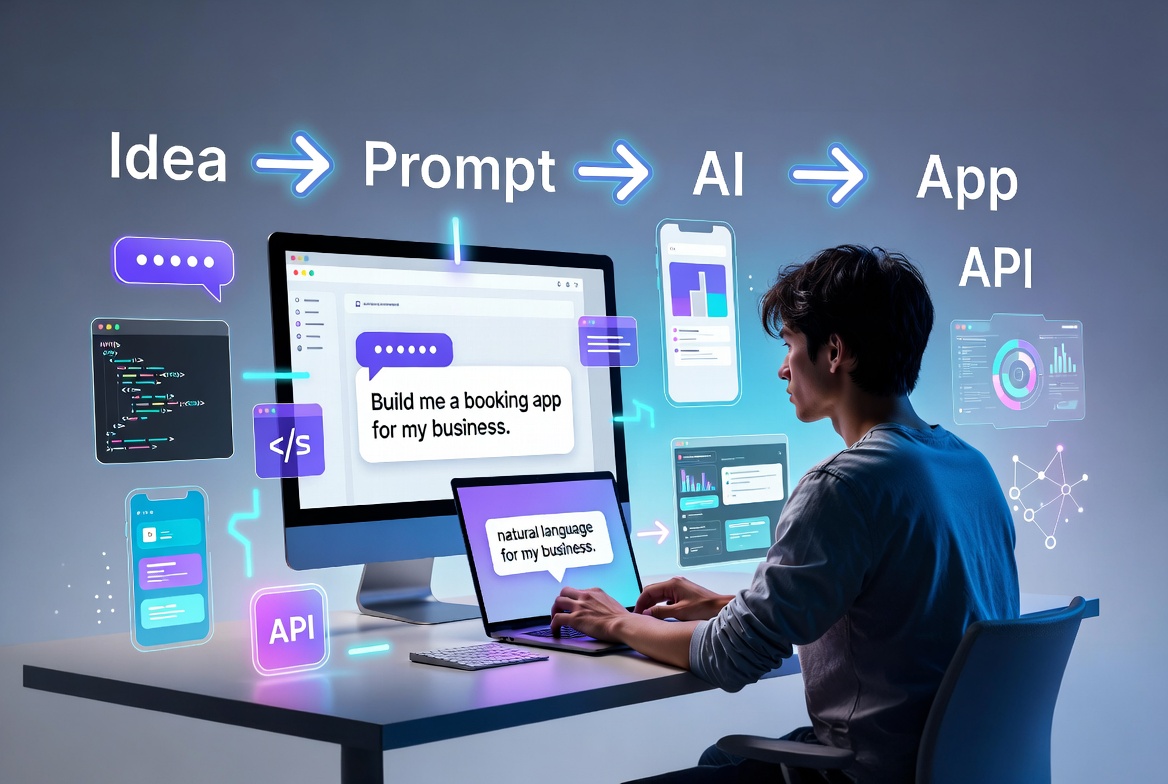
Vibe coding is transforming how people create software in 2026. The term, coined by AI researcher Andrej Karpathy in February 2025, describes a workflow where users describe what they want in plain English and let AI tools handle the actual code. Non-developers across the United States are now launching real products, automating business processes, and building web applications without writing a single line of traditional code. This shift is powered largely by tools like ChatGPT and Claude, which can generate functional, deployable code from conversational prompts.
As a tech and business writer, I’ve spent considerable time testing AI coding assistants while researching productivity tools and helping small businesses prototype simple web applications. One thing became clear almost immediately: the better the prompt, the better the result. Breaking a project into smaller, clearly defined tasks consistently produced cleaner code and fewer revisions than asking an AI to build an entire application in one go.
Understanding Vibe Coding and Why It Is Growing So Fast
Vibe coding flips the traditional development model on its head. Instead of learning syntax, frameworks, and debugging techniques first, users focus on describing the outcome they want. The AI translates those instructions into working code, allowing people with little or no programming experience to build useful software.
According to the Stack Overflow Developer Survey released in 2024, more than 76% of developers reported using or planning to use AI coding tools. Vibe coding takes this idea further, allowing anyone, marketers, entrepreneurs, teachers, freelancers, and small business owners, to create software without needing to be a developer.
Several factors are driving this rapid growth:
- Accessibility: You don’t need any coding experience to get started, Vibe coding makes software creation easy for everyone.
- Speed: Functional prototypes can often be built in hours instead of weeks.
- Cost: Many individuals and startups can reduce the need for expensive development resources during the early stages of a project.
- Iteration: Users can improve their applications simply by continuing the conversation with the AI.
Platforms such as Replit, Cursor, Bolt.new, and Lovable have built experiences around this workflow by combining powerful AI models with browser-based development environments.
Curious how non-developers are building real apps?
They’re using Vibe coding to turn ideas into functional software effortlessly. Real people with little or no technical background are shipping useful applications.
A Small Business Owner Builds a Booking System
A yoga studio owner in Austin, Texas described her ideal booking system using ChatGPT. She requested appointment scheduling, payment processing, automated reminders, and calendar integration. After several rounds of refinement, she received working code that she deployed through Replit without needing to manage servers or configure a local development environment.
A Teacher Creates an Interactive Quiz App
A high school teacher in Ohio built a custom quiz application using Claude. He explained the grading logic, subject categories, and user interface in plain English. Claude generated the HTML, CSS, and JavaScript required for the project, allowing him to launch the app before the new school term.
A Freelancer Automates Client Reporting
A marketing consultant in Chicago used ChatGPT to build a reporting dashboard that collected information from Google Sheets and generated branded PDF reports automatically. What once needed a professional developer can now be done in just a weekend, thanks to AI tools and thorough testing.
I once created a basic inventory management tool just by chatting with prompts, no complicated coding involved. The first version was functional, but several improvements were needed before it was ready for everyday use. Adding features one step at a time and testing after every change produced much more reliable results than attempting everything in a single prompt.
These examples reflect a broader pattern. A GitHub study found that developers using AI assistance completed many coding tasks significantly faster than those working without AI support. For beginners, the productivity gains can be even greater because AI removes much of the initial learning curve.
The Tools That Make Vibe Coding Possible
Several platforms have become central to the vibe coding movement.
ChatGPT and Claude
ChatGPT, developed by OpenAI, and Claude, developed by Anthropic, are among the most popular conversational AI assistants for software creation. Both support ongoing conversations, allowing users to refine applications, fix bugs, and add features through natural language.
Claude is frequently chosen for projects involving larger codebases because of its ability to handle longer conversations and more context. ChatGPT is widely appreciated for its versatility, extensive integrations, and broad developer ecosystem.
Cursor and Bolt.new
Cursor is an AI-powered code editor that enables users to modify existing projects through natural language instructions while still providing access to the underlying source code.
Bolt.new allows users to generate full-stack web applications directly in the browser without installing development tools locally, making it particularly attractive for beginners.
Replit
Replit combines cloud development, AI assistance, and hosting into a single platform. From a single interface, users can generate, tweak, run, and launch their apps, making software creation much easier and less technical than usual.
Practical Tips for Getting Started With Vibe Coding
If you’re new to vibe coding, these practices can help you build better applications more efficiently.
Start With Specific Prompts
Instead of asking the AI to “build an app,” describe exactly what you need.
For example:
Build a responsive single-page task manager where users can add tasks, assign due dates, mark tasks as complete, and save everything using browser local storage.
Specific prompts produce more accurate code and reduce unnecessary revisions.
Build Features Incrementally
Treat the AI like a collaborative developer. Begin with the core functionality before adding authentication, notifications, or integrations. Testing after each improvement makes troubleshooting much easier.
Share Complete Error Messages
If your application produces an error, paste the entire message into the AI chat. In many cases, the AI can identify the likely cause and suggest a working solution. Always test the suggested fix before deploying it.
Deploy Early
Publish working versions using platforms such as Replit, Netlify, or Vercel. Real-world usage often reveals usability issues that are difficult to identify during local testing.
Save Your Best Prompts
Maintain a document containing prompts that consistently generate high-quality results. Over time, this becomes a valuable personal library that speeds up future projects.
What Vibe Coding Cannot Do Yet
Despite its impressive capabilities, vibe coding is not a replacement for professional software engineering in every situation.
Applications that process sensitive customer information, financial transactions, healthcare records, or regulated data still require careful architecture, security reviews, and compliance testing. AI-generated code can contain security vulnerabilities, inefficient algorithms, or implementation mistakes that inexperienced users may overlook.
Authentication systems, database design, API security, scalability, accessibility, and performance optimization remain areas where experienced developers provide significant value. Even when AI generates functional code, human review is essential before deploying applications that serve real customers.
From my own testing, AI often produces a working first draft remarkably quickly, but polishing the application still requires thoughtful evaluation. Reviewing generated code, testing edge cases, and validating security assumptions consistently improved the final product.
Rather than replacing developers, vibe coding changes how software is created. It lowers the barrier to entry while allowing experienced engineers to focus more on architecture, quality assurance, and complex problem-solving.
The Future of Vibe Coding
As AI models continue to improve, vibe coding is likely to become a standard part of software development rather than a niche workflow. Entrepreneurs will be able to validate ideas faster, educators will build custom teaching tools, and small businesses will create internal software without waiting months for development resources.
At the same time, successful applications will continue to depend on careful planning, testing, and ongoing maintenance. AI accelerates development, but building reliable software still requires human judgment.
The gap between having an idea and turning it into a working application has never been smaller.
Frequently Asked Questions
1. What is vibe coding?
Vibe coding is an AI-assisted software development approach where users describe what they want in natural language, and AI generates the underlying code. Instead of writing every line manually, users refine their applications through conversation with AI tools.
2. Can someone with no programming experience build an app?
Yes. Many beginners have successfully created websites, dashboards, calculators, booking systems, and internal business tools using AI assistants. While complex software still benefits from professional developers, simple applications are increasingly accessible to non-programmers.
3. Which AI tool is best for vibe coding?
The best choice depends on your needs. ChatGPT is popular for its versatility and broad ecosystem, Claude performs well with larger codebases, Cursor is excellent for editing existing projects, and Replit offers an all-in-one environment for building and deploying applications.
4. Is AI-generated code safe to use?
Always review and test AI-produced code before launching it to ensure everything works smoothly. Although AI can produce functional software, it may also introduce security vulnerabilities, inefficient logic, or implementation errors that require human oversight.
5. Do I need to learn programming to use vibe coding?
Not necessarily. You can build many useful applications without traditional programming experience. However, learning basic concepts such as variables, databases, APIs, and debugging will help you write better prompts, understand AI-generated code, and troubleshoot issues more effectively.