

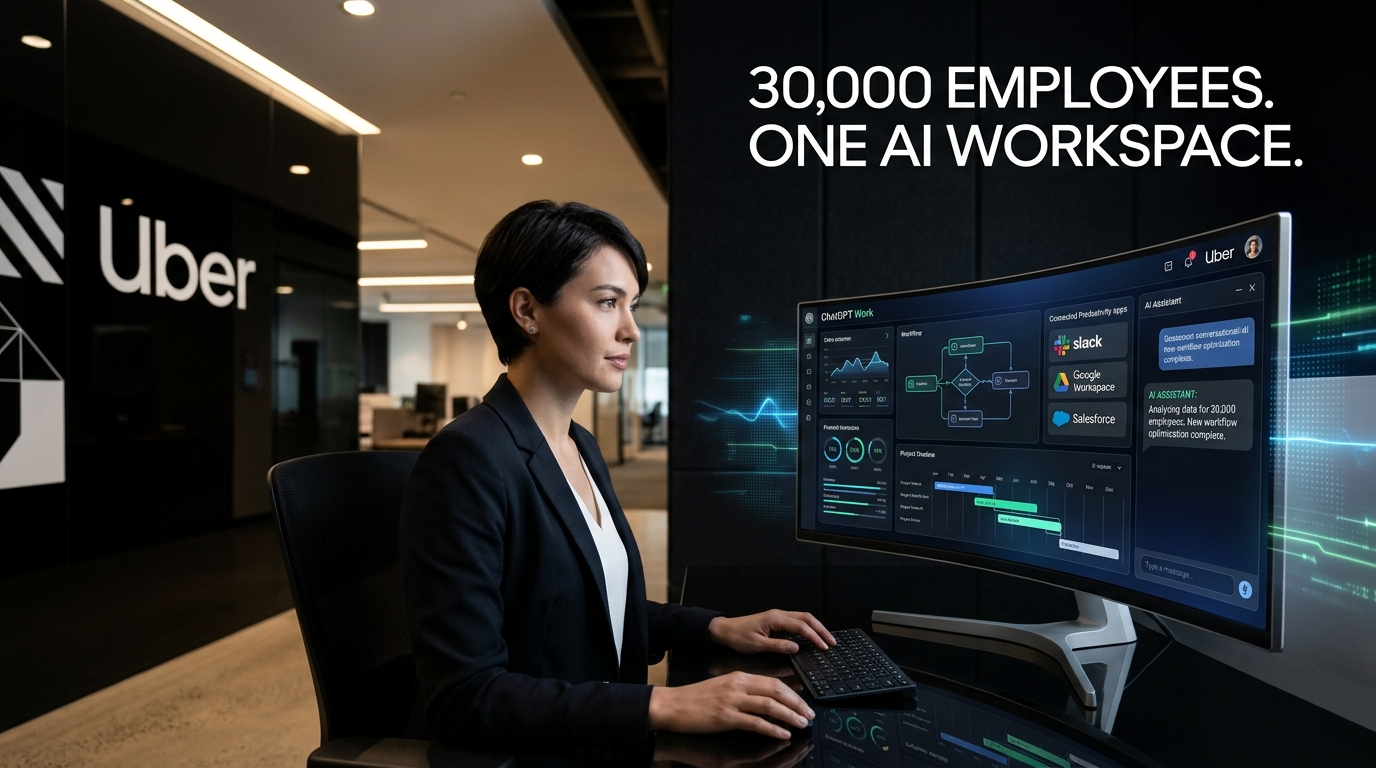
Uber’s reported move to put 30,000 employees on ChatGPT Work highlights a major shift toward AI-powered workplaces. The initiative raises important questions about productivity, employee skills, data security, and the future of office work.
As businesses compete to adopt artificial intelligence, large-scale AI deployment could become a defining workplace trend in 2026. However, its real value depends on how effectively employees use these tools.
What Is Uber’s ChatGPT Work Initiative?
ChatGPT Work is an AI workspace designed to help people complete tasks, analyze information, and create content. Depending on the available features and organizational setup, employees can use AI to support everyday work.
If Uber deploys the platform across its reported 30,000 employees, the initiative would represent a significant enterprise AI rollout. Instead of limiting AI access to technical teams, the company could make AI assistance available across multiple departments.
However, the exact scope of this reported initiative requires confirmation from an official Uber announcement. Access to an AI platform also does not necessarily mean every employee will use it in the same way.
Why Would Uber Give Employees Access to ChatGPT?
Uber operates across transportation, delivery, customer support, engineering, marketing, and business operations. These departments handle large amounts of information and repetitive tasks.
AI assistants could help employees process that information more efficiently. Consequently, broader access could support faster workflows and reduce time spent on routine activities.
1. Automating Repetitive Office Tasks
Employees regularly write emails, prepare reports, summarize documents, and organize information. AI can help produce first drafts and turn lengthy material into concise summaries.
For example, a manager could use an AI assistant to summarize a project update before a team meeting. Employees could then spend more time reviewing decisions instead of manually preparing documents.
Nevertheless, human review remains essential. AI-generated content can contain errors, missing context, or unsupported claims.
2. Helping Engineers Work More Efficiently
Software engineers can use AI tools to explain unfamiliar code, draft tests, document systems, and investigate technical problems.
At a technology-driven company like Uber, these capabilities could support engineering teams across different projects. Furthermore, AI assistance could help employees understand complex systems without starting every task from scratch.
However, developers must still test generated code and review security implications. Faster code generation does not automatically produce better software.
3. Improving Research and Decision-Making
Business teams often compare reports, investigate trends, and prepare presentations. AI can help organize these materials and identify questions that deserve further investigation.
For instance, a team could ask an AI assistant to compare several proposals against predefined requirements. Employees would still need to verify the underlying information before making important decisions.
As a result, AI may improve the preparation process without replacing professional judgment.
How Could ChatGPT Change Uber’s Workplace?
A large enterprise AI rollout could influence how employees approach daily responsibilities. However, the impact would depend on training, access permissions, and the quality of individual workflows.
Faster Workflows Across Departments
Employees could complete certain writing, research, and summarization tasks more quickly. Teams might also standardize routine processes with reusable prompts and approved AI workflows.
Consequently, departments could spend less time on repetitive preparation and more time on complex problems.
Still, not every task benefits equally from AI. Sensitive decisions and complicated operational issues may require substantial human involvement.
Better Collaboration Between Teams
AI tools can help employees turn technical information into clearer explanations for different audiences. For example, engineers could prepare accessible project summaries for marketing or customer operations teams.
This could reduce communication barriers across departments. In addition, shared AI workflows might help teams produce more consistent documentation.
However, employees must protect confidential information and follow company policies when using shared tools.
What Are the Biggest Risks of Enterprise AI Adoption?
Giving thousands of employees access to AI also introduces challenges. Companies must address these risks before expecting significant productivity gains.
Data Privacy and Security
Employees may accidentally enter customer information, confidential documents, or sensitive business details into an AI system.
Therefore, organizations need clear data-handling rules, appropriate access controls, and approved enterprise configurations. Employees must understand which information they can safely share.
Security teams should also review integrations and monitor potential misuse.
AI Accuracy and Reliability
AI assistants can generate convincing answers that contain factual mistakes. These errors can create problems when employees rely on generated information without checking it.
For this reason, companies should establish verification procedures for important tasks. Financial analysis, legal documents, technical changes, and customer-facing communications deserve particular attention.
Employee Training and Adoption
Providing access to AI does not guarantee meaningful results. Employees need practical training to identify suitable tasks, write effective instructions, and evaluate outputs.
Furthermore, organizations should explain how AI supports existing roles. Clear guidance can reduce confusion and encourage responsible experimentation.
Will AI Replace Jobs at Uber?
A large AI deployment does not automatically mean widespread job cuts. AI can assist employees with selected tasks while leaving accountability and complex decisions with people.
Nevertheless, automation may change the skills companies value. Workers who can combine domain knowledge with effective AI use may become more productive in certain roles.
Meanwhile, businesses could redesign workflows as AI capabilities improve. The effects on hiring, responsibilities, and staffing will depend on actual business decisions and measurable results.
Therefore, claims about specific job losses require credible evidence rather than assumptions based on AI access alone.
What Other Companies Can Learn From Uber
Organizations considering enterprise AI can learn several lessons from large-scale deployments.
First, businesses should identify practical problems before choosing AI tools. A clear use case makes it easier to measure whether a solution creates value.
Second, leaders should establish security policies before expanding access. Training and governance should grow alongside adoption.
Third, companies should track outcomes instead of celebrating access numbers alone. Useful metrics include task completion time, error rates, employee satisfaction, and customer outcomes.
Finally, organizations should collect employee feedback and improve workflows over time. This approach can help them distinguish genuine productivity improvements from temporary excitement.
The Future of AI-Powered Workplaces in 2026
Enterprise AI is moving beyond isolated experiments toward broader workplace integration. Companies increasingly have to decide how employees should use AI safely and effectively.
If Uber’s reported 30,000-employee rollout is confirmed, it could illustrate the scale of this transition. Its significance would depend on measurable improvements, responsible deployment, and employee experience.
Ultimately, successful AI adoption requires more than providing access to a powerful assistant. Businesses need clear goals, reliable systems, skilled employees, and strong oversight.
The companies that combine these elements will be better positioned to turn AI investment into lasting operational value.