

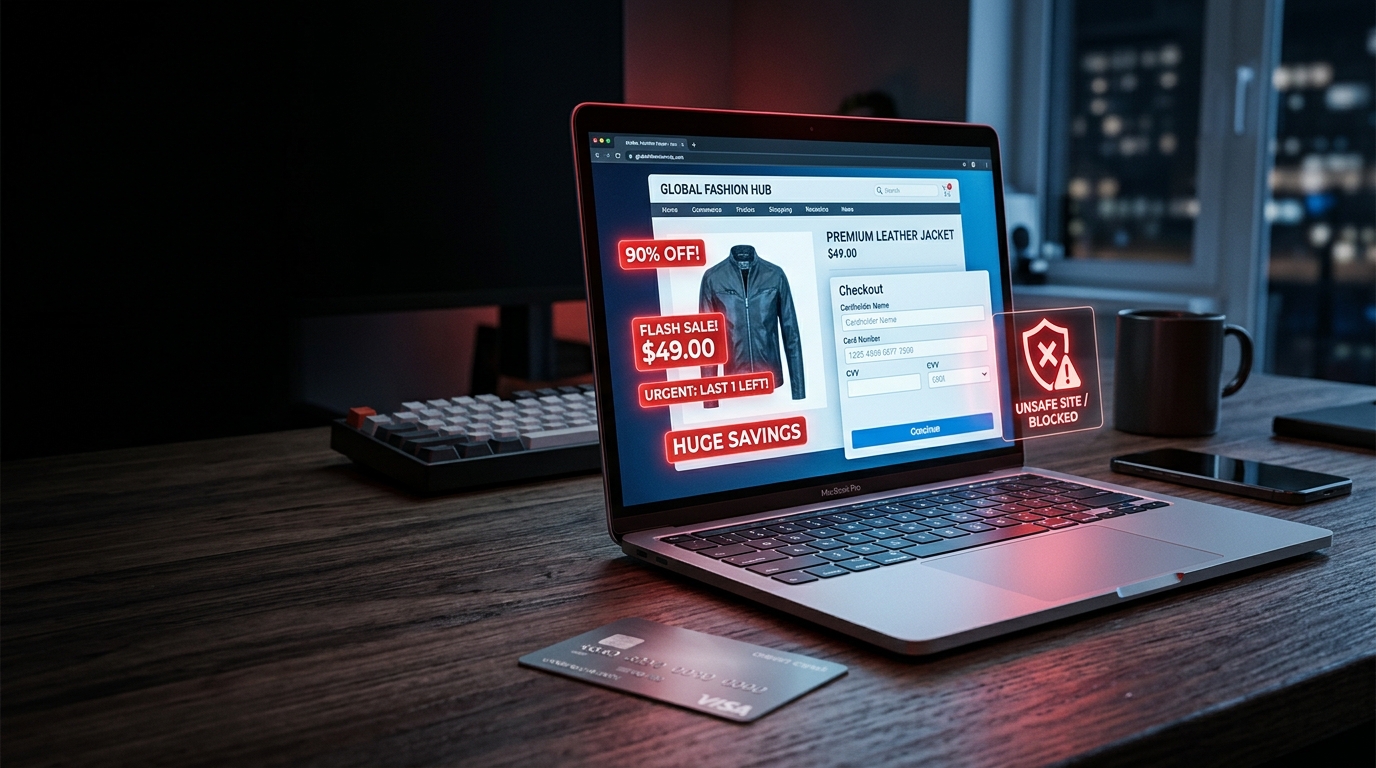
Online shopping has made it easier than ever to purchase clothes, electronics, home appliances, and everyday essentials. However, this convenience has also created opportunities for cybercriminals. Fake shopping websites are becoming increasingly convincing, making it difficult for ordinary shoppers to distinguish legitimate online stores from fraudulent ones.
These websites often copy the designs of popular retailers, advertise unbelievable discounts, and use professional-looking product images to gain customers’ trust. Their primary goal is usually to steal payment information, collect personal details, or take money without delivering the purchased products.
The good news is that you can identify many fraudulent shopping websites before making a payment. Understanding common warning signs and knowing what to check can help protect your money and personal information.
What Are Fake Shopping Websites?
Fake shopping websites are fraudulent online stores designed to deceive visitors into believing they are purchasing products from legitimate businesses.
Some websites imitate well-known brands, while others create completely fictional retail businesses. They may advertise smartphones, clothing, shoes, accessories, gaming equipment, and other popular products at unusually low prices.
Unlike genuine retailers, these websites may have no intention of delivering the products they advertise.
Scammers generally create these platforms for several reasons:
- Stealing credit and debit card information.
- Collecting personal information, including names and addresses.
- Receiving payments without shipping products.
- Capturing account passwords through fake login pages.
- Selling collected customer information to other criminals.
Not every suspicious-looking website is necessarily fraudulent. However, several warning signs appearing together should encourage you to investigate before purchasing anything.
Why Are Fake Online Shopping Stores Becoming More Convincing?
Online scammers understand how customers make purchasing decisions. They use familiar website designs, attractive product photographs, promotional banners, and limited-time offers to create a sense of urgency.
Some fraudulent stores even copy the branding of established retailers.
Several factors make these scams particularly effective.
Professional Website Designs
Modern website-building tools allow scammers to create attractive online stores without advanced technical knowledge.
A fraudulent website may include product categories, shopping carts, customer reviews, payment pages, and professional-looking logos.
Therefore, a polished appearance does not automatically mean a store is trustworthy.
Unrealistic Discounts
Scammers frequently advertise expensive products at prices significantly below their normal market value.
For example, a website might advertise a premium smartphone for $199 when established retailers sell the same model for several times that amount.
These offers encourage customers to purchase quickly without checking the seller.
Fake Customer Reviews
Customer reviews help shoppers evaluate products and retailers. Unfortunately, scammers sometimes publish fabricated testimonials to make their stores appear reliable.
A website showing hundreds of five-star reviews should not automatically receive your trust.
Social Media Advertisements
Fraudulent shopping stores also use advertisements on Facebook, Instagram, TikTok, and other platforms.
A sponsored advertisement does not guarantee that the advertised business is legitimate. Always investigate the actual website before providing payment information.
10 Warning Signs of a Fake Shopping Website
Recognizing suspicious behavior before entering card details is one of the most effective ways to avoid online shopping scams.
Here are ten important warning signs to investigate.
1. Deals That Seem Suspiciously Cheap
Extremely low prices are among the most common warning signs.
Scammers use unrealistic discounts to attract customers who want to save money. They may advertise popular electronics, designer clothing, or expensive accessories at prices that legitimate retailers cannot reasonably offer.
Before purchasing, compare the advertised price with several established stores.
If a product costs $1,000 elsewhere but appears for $150 on an unfamiliar website, investigate the seller carefully.
2. Missing Contact Information
Legitimate online businesses generally provide ways for customers to contact their support teams.
Look for:
- A physical business address.
- A working customer support email.
- A telephone number.
- A contact page.
- Clear information about the company operating the store.
Be cautious when a website provides only a contact form or an unfamiliar email address.
You can also search the business name and address independently to determine whether the information appears genuine.
3. Suspicious Website Addresses
A website’s domain name can reveal important clues about its legitimacy.
Scammers sometimes create addresses that resemble popular retailers by adding extra words, changing letters, or using unusual domain variations.
For example, a fraudulent website might use a domain that looks similar to an established brand but includes additional characters.
Before sharing personal details or payment information, make sure the site’s full web address is legitimate.
4. No Clear Return or Refund Policy
Reliable retailers generally explain how customers can return products, request refunds, and resolve delivery problems.
Fake shopping websites may have missing, confusing, or copied policies.
Pay attention to details such as:
- Return eligibility.
- Refund processing times.
- Shipping costs.
- Product replacement conditions.
- Customer support procedures.
If the website provides no meaningful explanation of these policies, consider shopping elsewhere.
5. Poor Grammar and Spelling Mistakes
Professional businesses usually review their website content before publishing it.
Fake shopping websites sometimes contain awkward sentences, inconsistent product descriptions, spelling mistakes, and poorly written policies.
These problems do not prove that a website is fraudulent, particularly when a small business operates internationally. However, numerous language errors combined with other suspicious signs deserve attention.
6. Limited or Suspicious Payment Options
Payment methods can reveal whether a shopping website deserves your trust.
Be especially cautious if an unfamiliar retailer accepts only:
- Cryptocurrency.
- Direct bank transfers.
- Gift cards.
- Payments through unusual third-party services.
These methods can make it difficult to recover money after a fraudulent transaction.
Where available, consider using a credit card or a reputable payment service that offers buyer protection.
7. Recently Created Website Domain
A newly registered domain is not automatically suspicious. Many legitimate businesses launch new websites every day.
However, a recently created domain combined with enormous discounts, missing company information, and suspicious advertisements can indicate a potential scam.
A WHOIS search can provide details about when and how a website’s domain was registered.
Check the registration date, registrar details, and available ownership information. Remember that privacy-protected registration is common and does not independently establish fraud.
8. Copied Product Images and Descriptions
Scammers frequently copy product photographs and descriptions from legitimate retailers.
You might notice identical images appearing across several unrelated shopping websites.
Reverse image search tools can help investigate suspicious product photographs. Search for the same image to see whether it originally appeared on an established retailer’s website.
Copied images alone do not prove fraud, but they can help identify misleading stores.
9. No Independent Customer Feedback
Customer testimonials displayed directly on a website are easy to manipulate.
Instead, search for the retailer’s name on independent review platforms, consumer forums, and search engines.
Look for repeated complaints involving:
- Orders that never arrived.
- Unauthorized payment charges.
- Fake tracking numbers.
- Unresponsive customer support.
- Refund requests that were ignored.
Be careful with extremely positive reviews that use similar wording or appear within a very short period.
10. Suspicious Checkout Pages
The checkout process deserves particular attention because this is where customers share sensitive information.
Before entering card details, check whether the payment page belongs to the expected retailer or a recognizable payment provider.
Be cautious if the checkout page unexpectedly redirects you to an unfamiliar domain, requests unnecessary personal information, or displays unusual payment instructions.
Never provide your banking password, PIN, or one-time verification code to a shopping website.
How to Check Whether an Online Shopping Website Is Legitimate
Recognizing warning signs is important, but performing a few additional checks can provide stronger protection.
Step 1: Examine the Website Address
Carefully inspect the domain name.
Check for misspellings, unnecessary characters, unusual domain variations, and misleading brand names.
Do not rely on a website’s logo or appearance to confirm its identity.
Step 2: Check HTTPS and the Security Certificate
Look for HTTPS in the website address and a valid security certificate.
HTTPS helps protect data sent between your browser and the site by encrypting it. However, it does not prove that the business itself is legitimate.
Scammers can also obtain HTTPS certificates.
Treat encryption as a basic security requirement rather than proof of trustworthiness.
Step 3: Search for Independent Reviews
Search the website’s name alongside terms such as:
- Scam.
- Customer complaints.
- Refund problems.
- Reviews.
- Fraud reports.
Check multiple independent sources instead of trusting testimonials published by the retailer.
Step 4: Verify the Business Information
Investigate the company’s address, contact details, and business identity.
If the website claims to represent an established brand, visit that brand’s official website independently to confirm whether the online store is authorized.
Step 5: Investigate Suspicious Links
You can use security services such as Google Safe Browsing to investigate potentially dangerous website addresses.
VirusTotal also allows users to check URLs against multiple security detection services.
However, a clean result does not guarantee that a website is safe. Newly created fraudulent websites may not have been identified yet.
Step 6: Review the Checkout Process
Before submitting payment information, examine the complete checkout page.
Confirm that the amount, currency, retailer identity, and payment method are correct.
If anything looks unusual, stop the transaction.
What Should You Do If You Have Already Entered Your Card Details?
If you accidentally entered your payment information on a fraudulent shopping website, act quickly.
The sooner you respond, the better your chances of limiting potential financial damage.
Contact Your Bank Immediately
Call your bank using the official telephone number on your card or banking application.
Explain that you may have entered your card details on a fraudulent website.
Your bank can advise whether the card should be blocked, replaced, or monitored for suspicious transactions.
Monitor Your Bank Statements
Review recent transactions for unfamiliar purchases or unexpected charges.
Report suspicious activity immediately rather than waiting for the next billing statement.
Change Compromised Passwords
If you created an account using a password that you also use elsewhere, change that password immediately.
Use unique passwords for different websites and enable multifactor authentication wherever possible.
Save Evidence of the Transaction
Keep screenshots of the website, order confirmation, payment receipt, emails, and any communication with the seller.
This information may help your bank, payment provider, or relevant authorities investigate the incident.
Report the Fraud
Report the incident to your bank, payment provider, and the appropriate consumer protection or cybercrime authority in your country.
If you are in Pakistan, you can also consult the National Cyber Crime Investigation Agency (NCCIA) for guidance on reporting cybercrime.
How to Shop Online More Safely
Avoiding fraudulent shopping websites does not require advanced cybersecurity knowledge.
A few consistent habits can significantly reduce your exposure to online shopping scams.
Use trusted retailers: Purchase from established businesses or sellers with independently verifiable reputations.
Enable transaction notifications: Banking alerts can help you identify unauthorized transactions quickly.
Use strong passwords: Create unique passwords for shopping accounts and enable multifactor authentication.
Avoid clicking suspicious advertisements: Instead of following unfamiliar promotional links, visit the retailer’s official website directly.
Check payment protection: Understand your bank’s dispute procedures and the buyer protection offered by your payment provider.
Avoid unnecessary personal information: A retailer should not need your banking password, PIN, or unrelated sensitive information to process an ordinary purchase.
Be careful with urgent offers: Limited-time discounts should never pressure you into skipping basic security checks.
Final Thoughts
Fake shopping websites are designed to exploit customer trust, attractive discounts, and the convenience of online payments. Although some fraudulent stores look surprisingly professional, they often reveal warning signs when you examine their contact information, domain names, customer feedback, return policies, and checkout processes.
The most important rule is simple: never let an attractive discount rush you into sharing your card details.
Take a few minutes to investigate an unfamiliar retailer before purchasing anything. A careful check today can prevent financial losses and protect your personal information tomorrow.
Frequently Asked Questions
Are Fake Shopping Websites Always Easy to Recognize?
No. Some fraudulent websites copy legitimate retailers’ designs, product descriptions, and branding. They may also use HTTPS and display fake customer reviews. Checking independent business information, domain details, and payment methods provides additional protection.
Does HTTPS Mean an Online Shopping Website Is Safe?
No. HTTPS encrypts information transferred between your browser and the website, but it does not verify the retailer’s honesty. Fraudulent websites can also use HTTPS certificates.
Can Fake Shopping Websites Steal Credit Card Information?
Yes. Some fraudulent websites collect card numbers, expiration dates, and security codes through fake checkout pages. Others redirect customers to deceptive payment services.
Is It Safe to Purchase Products Through Social Media Advertisements?
Not always. Social media advertisements can promote both legitimate businesses and fraudulent stores. Investigate the retailer independently before making a purchase.
Which Payment Option Offers the Best Protection When Shopping Online?
Credit cards and reputable payment services may provide useful dispute or buyer protection options, depending on the provider and transaction. Avoid unfamiliar payment methods that offer little opportunity to recover your money.
What Should I Do If a Fake Shopping Website Has My Personal Information?
Contact your bank if payment information was involved, change any compromised passwords, monitor your financial accounts, and report suspicious activity. Be especially alert for follow-up phishing messages.