


AI chatbots for local businesses have evolved from a useful competitive advantage into a practical business necessity. As customer expectations continue to rise and labor costs increase, more local businesses are using AI-powered chatbots to improve customer communication, generate leads, and provide faster support.
According to industry research from Tidio, many consumers now prefer receiving quick answers from a chatbot rather than waiting for a human representative for simple questions. As a result, businesses of all sizes are investing in conversational AI to improve customer experiences while reducing operational workload.
Whether you run a restaurant, medical practice, salon, retail store, or service-based company, AI chatbots can help you respond to customers 24/7, automate repetitive tasks, and create more opportunities for growth.
This guide explains what AI chatbots are, how they work, why local businesses are adopting them, and how you can successfully implement one in 2026.
What Are AI Chatbots?
A Simple Explanation of AI Chatbots and How They Work
An AI chatbot is a computer program powered by artificial intelligence designed to mimic human-like conversations with users. Unlike traditional website chat widgets that rely on pre-written responses, modern AI chatbots can understand context, interpret user intent, and provide relevant answers in real time.
These chatbots can be deployed on:
- Business websites
- Facebook Messenger
- WhatsApp Business
- Instagram Direct Messages
- Mobile applications
- Customer support portals
Customers can ask questions naturally, and the chatbot responds in a conversational way that feels much closer to interacting with a real person.
Traditional Chatbots vs AI-Powered Chatbots
Traditional chatbots operate using predefined decision trees. They only respond correctly when users follow expected paths.
For example:
Customer:
“What are your business hours?”
Traditional Bot:
“We are open from 9 AM to 5 PM.”
However, if the customer asks:
“Are you open late tonight?”
A traditional chatbot may fail to understand the request.
AI chatbots use advanced language understanding and learning technology to identify when questions are about things like business hours. This allows them to provide accurate responses even when customers phrase questions differently.
Why Businesses Are Rapidly Adopting AI Chatbots in 2026
The worldwide market for chatbots is growing quickly because AI technology is becoming cheaper and simpler to set up.
Several factors are driving adoption:
- Rising customer expectations
- Growing demand for instant support
- Increased labor costs
- Better AI accuracy
- No-code chatbot builders
- Integration with popular business software
What once required a large technology budget can now be implemented by small local businesses with minimal technical knowledge.
For a deeper understanding of how chatbots work and their business applications, IBM provides a clear overview of chatbot technology and its real-world use cases.
Why Local Businesses Need AI Chatbots
24/7 Customer Support Without Additional Staffing Costs
Customers often search for information outside normal business hours.
A bakery may receive questions about custom cake orders at midnight. A dental clinic may receive appointment inquiries early in the morning.
AI chatbots allow businesses to answer these questions instantly without hiring additional staff.
Instead of losing potential customers after hours, businesses can continue engaging visitors around the clock.
Faster Response Times That Keep Customers Engaged
Modern consumers expect quick answers.
When customers visit a website and cannot immediately find the information they need, many leave and visit a competitor.
AI chatbots provide immediate responses, helping businesses keep visitors engaged and reducing missed opportunities.
Reducing Staff Workload and Operational Pressure
Many customer inquiries are repetitive.
Examples include:
- What are your opening hours?
- Do you offer same-day service?
- What are your prices?
- Do you accept walk-ins?
- How can I book an appointment?
By automating these common questions, employees can focus on tasks that require human expertise and personal interaction.
Delivering a Better Customer Experience
Customers appreciate speed and convenience.
When a chatbot quickly provides accurate information, customers experience less frustration and more confidence in the business.
This improved experience can contribute to stronger customer satisfaction, better online reviews, and increased repeat business.
Boosting Lead Generation Through Automated Conversations
A major advantage of AI chatbots is their skill in helping businesses find and connect with new customers.
A chatbot can:
- Collect contact information
- Qualify prospects
- Schedule consultations
- Answer pre-sales questions
- Route leads to sales teams
Rather than acting as a simple support tool, a chatbot becomes a 24/7 digital assistant helping convert visitors into customers.
Which Local Businesses Gain the Most from Using AI Chatbots
Restaurants and Food Service Businesses
Restaurants can use chatbots to:
- Share menus
- Handle reservations
- Answer allergy-related questions
- Provide operating hours
- Promote special offers
This reduces the number of phone calls staff must manage during busy periods.
Clinics, Medical Offices, and Healthcare Providers
Healthcare organizations frequently receive routine questions regarding:
- Appointment availability
- Insurance coverage
- Office hours
- Patient preparation instructions
AI chatbots can automate many of these interactions while allowing medical staff to focus on patient care.
Real Estate Agencies and Property Management Firms
Real estate businesses can use chatbots to:
- Qualify potential buyers
- Schedule property viewings
- Share listing information
- Capture leads after business hours
This ensures opportunities are not lost when agents are unavailable.
Salons, Spas, and Beauty Service Providers
Chatbots help beauty businesses automate:
- Appointment bookings
- Service pricing inquiries
- Staff availability
- Promotion announcements
Customers get immediate answers without having to wait for a phone call back.
Retail Stores and Service-Based Businesses
Retail stores can use AI chatbots to:
- Check inventory availability
- Recommend products
- Handle return requests
- Explain promotions
- Track orders
This improves customer convenien ce while reducing support volume.
How AI Chatbots Work: A Simple Breakdown
Step One: The Customer Asks a Question
The interaction starts when a customer reaches out by sending a message via a website, social media channel, or messaging app, initiating the communication.
Questions may range from simple inquiries to more complex service-related requests.
If you want to improve how you use AI in daily work, these practical examples in Top ChatGPT Prompts for Work and Daily Tasks can help you get better results from automation.
Step Two: The Chatbot Analyzes the Request Using AI
Modern AI chatbots use several technologies working together:
- Natural Language Processing (NLP)
- Intent recognition
- Machine learning models
- Large language models (LLMs)
The system analyzes keywords, context, customer intent, and sometimes sentiment before generating a response.
Expertise Insight
A common misconception is that all AI chatbots perform equally well.
In reality, performance depends heavily on:
- Training quality
- Business-specific instructions
- Access to accurate company information
- CRM integration
- Booking system integration
- Knowledge base configuration
A properly configured chatbot with access to relevant business data typically performs significantly better than a generic chatbot using only public information.
Step Three: The Chatbot Provides an Answer or Takes Action
After understanding the request, the chatbot can:
- Provide information
- Share links
- Recommend products
- Schedule appointments
- Collect lead information
- Initiate workflows
The response happens almost instantly, creating a smooth customer experience.
Step Four: Complex Issues Are Escalated to a Human Agent
Not every conversation should remain automated.
Certain situations require human judgment, including:
- Billing disputes
- Refund requests
- Sensitive complaints
- Complex service questions
Effective chatbot systems include escalation workflows that transfer conversations to human representatives while preserving conversation history.
This prevents customers from repeating information and improves service quality.
Real-World Experience Using AI Chatbots
As a technology and business writer, I have spoken with multiple local business owners who implemented AI chatbots to improve customer communication.
One service-based company discovered that a large percentage of after-hours inquiries involved pricing questions. After updating their chatbot to answer those questions automatically, staff spent significantly less time responding to repetitive messages the following week.
In another example, a local business owner noticed an increase in appointment inquiries after adding chatbot automation to both their website and social media channels. The chatbot ensured that potential customers received immediate responses even when staff members were unavailable.
These examples highlight an important lesson: chatbot success is rarely about the software alone. Businesses achieve the best results when they regularly review conversations, update responses, and align chatbot behavior with customer needs.
Step-by-Step Guide to Setting Up an AI Chatbot for Your Local Business
Step 1: Identify Your Most Common Customer Questions
Before choosing software, review:
- Customer emails
- Website inquiries
- Social media messages
- Phone call logs
Identify the questions your team answers repeatedly.
These questions should form the foundation of your chatbot’s knowledge base.
Step 2: Choose the Right Chatbot Platform for Your Business
Not all chatbot platforms are built for the same purpose.
Before making a decision, consider:
- Your budget
- Technical expertise
- Business size
- Customer volume
- Integration requirements
- Growth plans
A small local business may only need a simple no-code chatbot, while a larger organization may require advanced automation connected to CRM software and customer databases.
Questions to ask before choosing a platform:
- Does it support website integration?
- Can it connect with WhatsApp and Facebook Messenger?
- Does it offer AI-powered responses?
- Can it transfer conversations to human agents?
- Does it provide analytics and reporting?
Choosing the right platform from the beginning can save time, money, and frustration later.
Step 3: Build Natural and Effective Conversation Flows
Many businesses make the mistake of creating chatbot conversations that feel robotic.
The goal is to make interactions simple and helpful.
Good chatbot conversations should:
- Use clear language
- Avoid technical jargon
- Guide users naturally
- Provide quick answers
- Offer easy access to human support
For example:
Instead of:
“Please select Option 1, Option 2, Option 3, or Option 4.”
Try:
“How can I help you today? Are you looking for pricing, booking information, or support?”
Simple conversational language creates a much better customer experience.
Step 4: Connect the Chatbot to Your Website and Social Media Channels

Customers interact with businesses across multiple platforms.
Your chatbot should be available wherever customers are most active.
Common integration channels include:
- Business website
- Facebook Messenger
- Instagram Direct Messages
- WhatsApp Business
- Google Business Profile messaging
- Mobile apps
The more touchpoints your chatbot covers, the more opportunities you create for customer engagement and lead generation.
Step 5: Test, Monitor, and Continuously Improve
Launching a chatbot is only the beginning.
The most successful businesses treat chatbot optimization as an ongoing process.
Before launch:
- Test frequently asked questions
- Check booking workflows
- Verify lead capture forms
- Review fallback responses
After launch:
- Analyze chat transcripts
- Identify unanswered questions
- Improve conversation flows
- Update outdated information
A chatbot that receives regular updates often performs better over time because it learns from real customer interactions.
Best AI Chatbot Tools for Local Businesses in 2026
ChatGPT-Powered Bots
Businesses seeking advanced conversational capabilities often choose ChatGPT-powered solutions.
Advantages include:
- Natural responses
- Better context understanding
- Flexible conversations
- Advanced customer support capabilities
These solutions work particularly well for businesses that receive diverse customer inquiries.
For small businesses looking to reduce costs, here are some useful options you can explore in AI Tools That Are Actually Free and Not Just Free Trials.
Tidio
Tidio remains one of the most popular chatbot solutions for small businesses.
Key benefits include:
- Easy setup
- No-code interface
- Live chat functionality
- Affordable pricing
- Pre-built automation templates
For businesses new to automation, Tidio offers an accessible starting point.
Intercom
Intercom combines AI chatbots with customer communication tools.
Features include:
- CRM integration
- Customer segmentation
- Automated workflows
- Personalized messaging
It is particularly useful for growing businesses that need both customer support and sales automation.
Zendesk AI
Zendesk AI is designed for organizations that handle larger volumes of customer support requests.
Strengths include:
- Ticket management
- AI-powered support automation
- Knowledge base integration
- Agent productivity tools
Businesses with dedicated support teams often benefit from its advanced capabilities.
Drift
Drift focuses heavily on sales and lead generation.
Its chatbot tools help businesses:
- Qualify leads
- Book meetings
- Route prospects
- Accelerate sales conversations
Service-based businesses often use Drift to improve conversion rates and shorten sales cycles.
Common Mistakes Local Businesses Make With AI Chatbots
Creating Overcomplicated Chatbot Flows
A chatbot should simplify the customer journey, not complicate it.
Businesses sometimes build lengthy conversation trees with dozens of options.
The result is often confusion and frustration.
The best chatbot experiences are typically straightforward and focused on helping users reach their goals quickly.
Failing to Update Responses Regularly
Business information changes.
Prices change.
Services evolve.
Promotions end.
If chatbot content is not updated regularly, customers may receive outdated information that damages trust.
Scheduling regular content reviews helps keep responses accurate and relevant.
Ignoring Customer Interaction Data
Every chatbot conversation contains valuable insights.
Businesses can learn:
- What customers ask most often
- Which services generate interest
- Where customers become confused
- Which questions remain unanswered
Reviewing these insights can improve both chatbot performance and overall business operations.
Attempting to Replace Human Support Completely
One of the biggest mistakes businesses make is expecting chatbots to solve every customer issue.
AI works best when it complements human support rather than replacing it entirely.
Customers facing sensitive issues, complaints, or complex requests often prefer speaking with a real person.
Providing easy access to human assistance creates a healthier balance between automation and customer care.
Real Benefits Local Businesses Can Expect From AI Chatbots
Generating More Qualified Leads
Chatbots can collect customer information automatically and identify prospects who are ready to buy.
Rather than relying solely on contact forms, businesses can engage visitors in real-time conversations that encourage action.
Many businesses report improvements in lead generation after implementing well-configured chatbots, although results vary depending on industry, website traffic, and implementation quality.
Improving Customer Satisfaction
Fast responses often lead to better customer experiences.
When customers receive immediate answers to common questions, they spend less time waiting and more time moving toward their desired outcome.
Businesses that implement chatbot support frequently report positive changes in customer satisfaction metrics, especially when automation is combined with human support options.
Streamlining Appointment Scheduling
Appointment-based businesses can automate:
- Bookings
- Rescheduling
- Cancellations
- Confirmation messages
- Reminder notifications
This reduces administrative workload while improving convenience for customers.
Healthcare clinics, salons, consultants, and service providers often see significant efficiency gains from booking automation.
Creating New Sales Opportunities
Modern AI chatbots can proactively engage visitors.
For example:
If someone spends several minutes viewing a service page, the chatbot can initiate a conversation and offer assistance.
These interactions help businesses capture opportunities that might otherwise be lost.
Challenges and Limitations of AI Chatbots
AI Cannot Handle Every Situation
Despite impressive advances in artificial intelligence, chatbots still have limitations.
Situations involving:
- Emotional complaints
- Legal issues
- Complex negotiations
- Highly customized requests
often require human judgment and empathy.
Businesses ought to create chatbot systems with practical expectations, rather than believing that automation can address every issue.
Ongoing Maintenance Is Required
Some business owners assume chatbots work perfectly after setup.
In reality, successful chatbot programs require:
- Regular monitoring
- Content updates
- Workflow improvements
- Performance reviews
Without ongoing maintenance, chatbot accuracy can gradually decline.
Human Escalation Remains Essential
Customers should consistently have direct access to human assistance.
Best practices include automatic escalation triggers such as:
- “Refund”
- “Complaint”
- “Urgent”
- “Manager”
- “Cancel Service”
This ensures customers receive appropriate assistance when automation reaches its limits.
The Future of AI Chatbots for Local Businesses
The Rise of Voice-Enabled AI Assistants
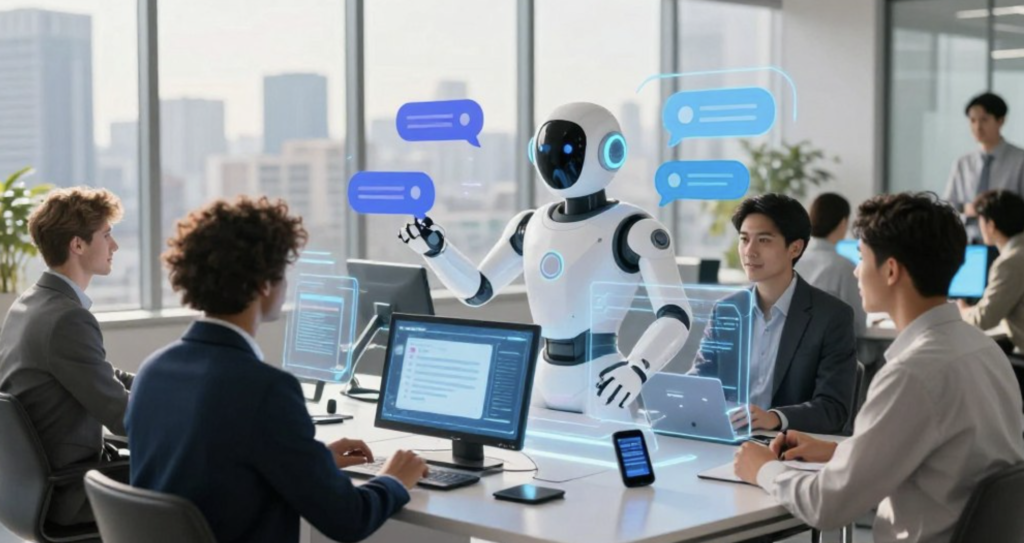
AI chatbots are moving beyond text-based communication. In 2026 and beyond, voice-enabled assistants will become more common, especially for businesses that rely on phone calls such as healthcare clinics, automotive services, and home repair companies.
Customers can speak their requests instead of typing, and the AI system will respond immediately or direct the call to the right person. This reduces friction and improves accessibility for users who prefer voice interaction.
Hyper-Personalized Customer Experiences
One of the biggest shifts in chatbot technology is personalization.
Modern AI systems can analyze:
- Past purchases
- Browsing behavior
- Service history
- Customer preferences
This allows chatbots to deliver tailored recommendations instead of generic replies.
For example, a returning customer may be greeted by name and offered services based on their previous interactions. Offering tailored interactions enables small local businesses to foster deeper, more meaningful connections with their customers.
Deeper Integration With CRM and Business Tools
AI chatbots are becoming deeply connected with business ecosystems.
In 2026, most advanced systems integrate with tools like:
- CRM platforms (HubSpot, Salesforce)
- Email marketing tools
- Booking systems
- Inventory databases
- Payment systems
This means chatbots are no longer just support tools—they act as automated assistants that can update records, schedule appointments, and trigger follow-ups without human intervention.
If you want to explore more powerful tools that improve productivity at work, you can also check 9 AI Tools That Will Make You Feel Like a Genius at Work in 2026.
Predictive Customer Support
The next evolution of AI chatbots is predictive support.
Instead of reacting to customer questions, AI systems will identify patterns and anticipate issues before they happen.
For example:
- Detecting potential service delays
- Identifying customers at risk of leaving
- Suggesting solutions before complaints are made
This proactive approach can significantly improve customer retention and satisfaction.
Real Benefits Summary
AI chatbots provide several key advantages for local businesses:
- 24/7 customer support
- Faster response times
- Reduced operational workload
- Improved lead generation
- Better customer experience
- Increased appointment efficiency
However, the most important success factor is not the technology itself—it is how well the chatbot is configured, trained, and maintained.
Real-World Insight (Experience)
As a business and tech writer working with local service providers, I’ve observed a consistent pattern. Businesses that treat chatbots as a “set-and-forget” tool often see limited results. However, those that actively review conversations and refine responses every few weeks tend to see significantly better engagement.
In one case, a small service business improved its customer response time dramatically simply by updating its chatbot to handle the top 15 repetitive questions more accurately. Another business saw more consistent appointment bookings after integrating chatbot responses with their scheduling system and adjusting conversational tone to match customer expectations.
These examples show that success depends less on the tool and more on ongoing optimization.
Conclusion
AI chatbots for local businesses are no longer optional in a competitive digital environment. They help businesses automate communication, capture leads, and improve customer satisfaction while reducing manual workload.
The key takeaway is simple:
Businesses that combine automation with human support, regular updates, and clear communication strategies will gain the most value.
Rather than replacing human staff, AI chatbots support small teams by enhancing their efficiency, allowing them to function and serve customers as effectively as much larger organizations.
Frequently Asked Questions (FAQ’s)
1. Do small local businesses find AI chatbots costly to implement?
Not necessarily. Many chatbot platforms offer free or low-cost plans starting under $50 per month. More advanced systems with CRM and automation features may cost more, but most small businesses can start with affordable solutions and scale gradually as their needs grow.
2. Can AI chatbots completely replace customer service staff?
No. AI chatbots are best used to handle repetitive and simple tasks. Complex issues, emotional complaints, and sensitive situations still require human support. The most effective systems combine automation with human assistance for better customer satisfaction.
3. How quickly can a business see results from a chatbot?
The majority of businesses see better response times and increased engagement within just a few weeks. More measurable results like lead generation or appointment growth typically appear within 30 to 90 days, depending on traffic and setup quality.
4. Do customers prefer talking to chatbots?
For quick questions like business hours, pricing, or availability, many customers prefer instant chatbot responses. However, for complex or emotional issues, most customers still prefer speaking with a human representative.
5. What is the biggest mistake businesses make with chatbots?
The most common mistake is poor setup. Many businesses set up chatbots but neglect to update their content, refine their responses, or regularly assess how well they are performing. A chatbot only performs well when it is regularly optimized based on real customer interactions.