

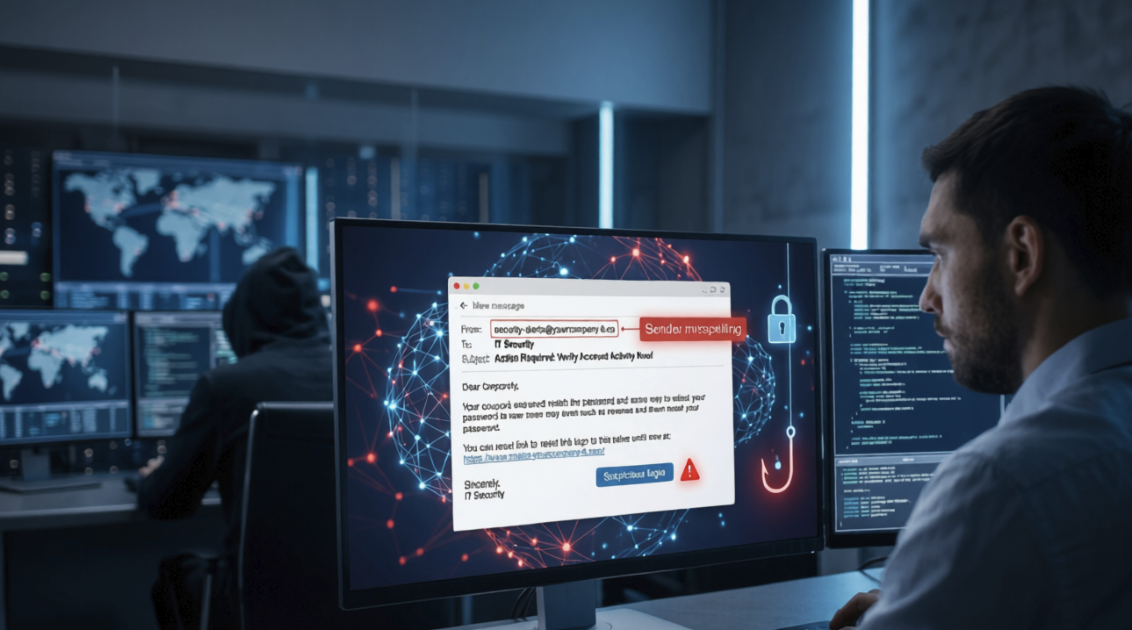
Phishing emails have always relied on one simple trick: make a message look convincing enough that someone clicks, replies, downloads a file, or shares sensitive information. Artificial intelligence is now making that deception faster, more personalized, and harder to recognize.
Instead of writing every phishing message manually, attackers can use AI to improve grammar, imitate communication styles, translate messages, and generate convincing variations at scale. This changes the threat because traditional warning signs, such as spelling mistakes and awkward language, are becoming less reliable.
How AI Is Changing Phishing Attacks
Traditional phishing campaigns often required attackers to create messages manually. They might copy the branding of a bank, write a fake password-reset notice, or send a generic business email.
AI can automate much of this process. Attackers can generate large numbers of messages while changing the wording, tone, and context between emails.
For example, one message may appear to come from a company’s IT department, while another may look like a delivery notification. AI can help produce both versions quickly.
The biggest change is not simply better grammar. It is the ability to create convincing communication at scale.
Why AI-Generated Phishing Emails Look More Convincing
Human-written phishing emails frequently contain obvious mistakes. Poor grammar, strange sentence structures, incorrect punctuation, and unnatural expressions can make fraudulent messages easier to identify.
AI reduces many of these weaknesses.
Modern language models can produce professional-looking text with appropriate formatting and natural sentence structures. They can also rewrite messages for different audiences and communication styles.
This means employees can no longer depend on poor writing as a primary warning sign.
A polished email can still be fraudulent.
AI Can Personalize Phishing Messages
Personalization makes phishing significantly more convincing.
Attackers may gather publicly available information about a target from company websites, social media profiles, professional networks, or previously exposed data. AI can then help organize that information and produce messages that appear relevant to the recipient.
For example, a generic message might say:
“Please review the attached document.”
A more personalized fraudulent message could reference a department, project, meeting, or business process familiar to the recipient.
The important security lesson is that familiar information does not prove that an email is legitimate.
AI Makes Multilingual Phishing Easier
Language barriers have historically created problems for attackers targeting international organizations. Poor translations can immediately make a fraudulent message suspicious.
AI translation and writing tools reduce this problem.
Attackers can produce convincing messages in multiple languages and adapt expressions to different audiences. This makes phishing campaigns easier to distribute across countries and regions.
For multinational businesses, this creates an additional challenge because security teams must consider threats across many languages and communication styles.
AI Can Imitate Different Writing Styles
Another concern is style imitation.
Organizations communicate through predictable patterns. Executives may have recognizable writing habits, while departments may use standard terminology in emails.
AI can help attackers create messages that resemble familiar communication.
A fraudulent message pretending to be an executive might use a short and urgent style. A fake IT message might use technical terminology. A fraudulent invoice email could use formal business language.
The result is a message that feels more believable because its wording matches the expected context.
AI Enables Phishing at Massive Scale
A major benefit that AI offers to cybercriminals is the ability to act swiftly.
A human attacker can write only a limited number of customized messages manually. Automated systems can generate thousands of variations.
Attackers can modify subject lines, wording, language, and formatting to create many versions of essentially the same campaign.
This also makes detection more difficult. Security systems looking for identical or highly repetitive messages may encounter numerous variations instead.
Why Traditional Phishing Warning Signs Are Becoming Less Useful
For years, security awareness training emphasized several common warning signs:
- Spelling mistakes
- Poor grammar
- Strange formatting
- Generic greetings
- Unusual wording
- Obvious translation errors
These indicators remain useful, but they should no longer be treated as proof that a message is safe.
AI-generated phishing emails can be grammatically correct and professionally written.
Instead, users should pay greater attention to what an email is asking them to do.
An unexpected request to transfer money, reveal credentials, open an attachment, or bypass normal procedures deserves additional verification regardless of how professional the email looks.
How Businesses Can Defend Against AI-Powered Phishing
Organizations need security controls that do not depend entirely on employees recognizing suspicious writing.
Email security systems can analyze sender information, domains, authentication records, links, attachments, and unusual communication patterns.
Organizations should also implement strong email authentication technologies such as SPF, DKIM, and DMARC. These technologies can help reduce certain types of email impersonation and improve domain protection.
Multi-factor authentication is equally important. If an employee accidentally provides a password to an attacker, MFA can provide another layer of protection.
However, organizations should use phishing-resistant authentication where possible because attackers increasingly attempt to bypass basic authentication protections.
Employee Training Needs to Change
Security awareness training should evolve alongside AI-generated threats.
Employees should learn to question unusual requests even when the message looks perfectly professional.
A useful rule is simple: verify high-risk requests through a separate trusted channel.
If an email supposedly comes from an executive requesting an urgent payment, the employee can confirm the request through an established phone number or internal communication system.
The same principle applies to password resets, sensitive documents, account changes, and financial transactions.
AI Is Also Becoming a Defensive Tool
The same technology creating better phishing messages can also help defenders.
Security teams can use AI to analyze suspicious emails, identify unusual communication patterns, summarize threats, and assist with incident investigation.
AI can help security professionals process large volumes of email data more quickly. It can also support automated detection systems that look beyond simple keywords.
This creates an ongoing technology race between attackers and defenders.
The Future of AI-Powered Phishing
With AI, phishing attacks are expected to become more tailored to individuals and more flexible in their approach.
Future attacks may combine information from multiple sources and automatically adjust messages according to a target’s role, organization, language, and previous interactions.
For this reason, cybersecurity cannot depend on identifying a single suspicious phrase or grammatical mistake.
The strongest defense combines security technology, employee awareness, strong authentication, email protection, and reliable verification procedures.
AI has not eliminated the basic principles of phishing. It has simply made fraudulent communication easier to produce and harder to dismiss based on appearance alone. As AI-generated messages become more convincing, organizations and individuals must focus less on whether an email sounds professional and more on whether the request is expected, authenticated, and independently verified.