

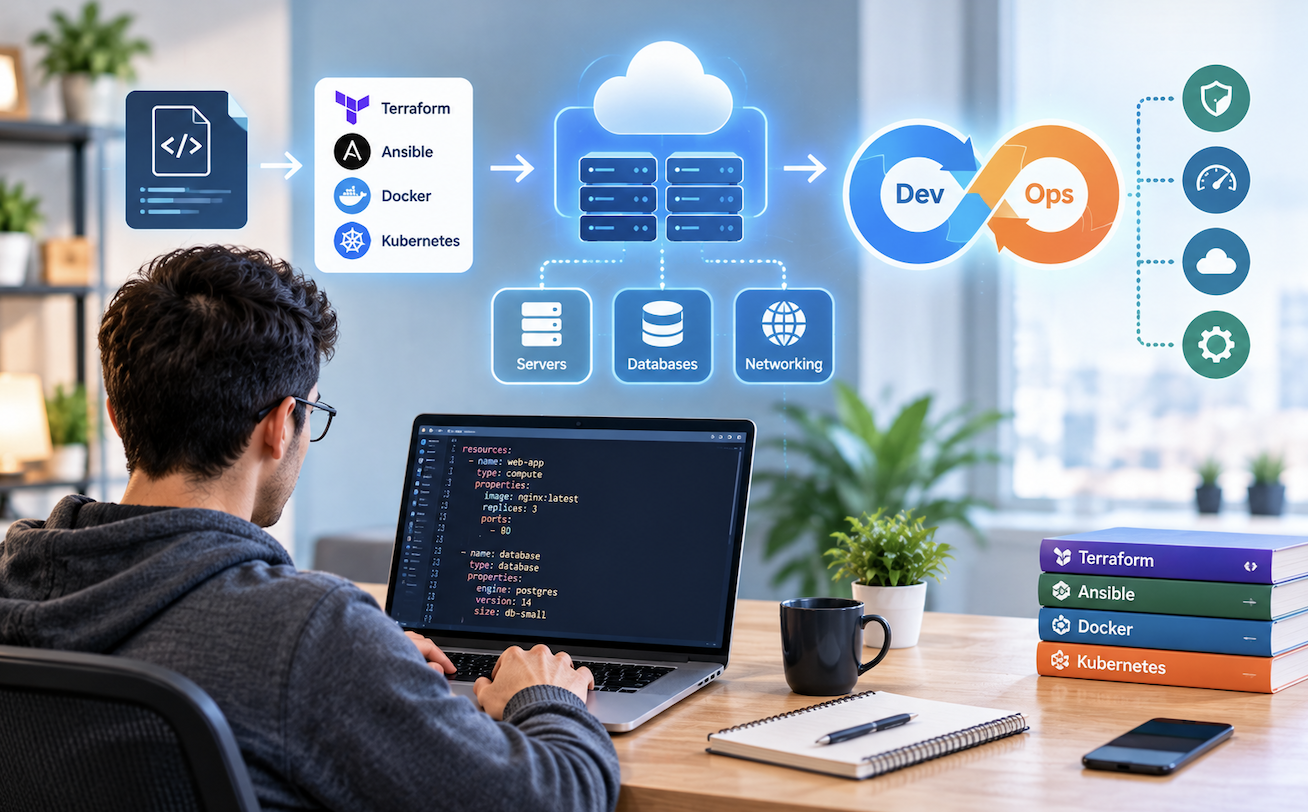
Setting up servers used to mean an engineer manually clicking through configuration screens or typing commands directly into a terminal, a process prone to human error and nearly impossible to replicate exactly the same way twice. Infrastructure as code replaced this manual approach with something closer to how software itself gets built: writing configuration as version-controlled code that can be reviewed, tested, and deployed consistently every single time.
This shift has become foundational to how modern engineering teams manage infrastructure at scale, offering reliability and speed that manual configuration methods simply couldn’t match once systems grew beyond a handful of servers.
Defining What Infrastructure as Code Actually Means
Infrastructure as code involves defining and managing computing infrastructure, servers, networks, storage, and related configuration, through machine-readable script files rather than through manual, interactive configuration processes. These configuration files describe exactly what infrastructure should exist and how it should be configured, and specialized tools read these files to automatically create or update the actual infrastructure to match.
This approach treats infrastructure configuration with the same rigor traditionally reserved for application code: stored in version control, reviewed by teammates before changes get applied, and tested before deployment to production systems. The result is infrastructure that can be recreated identically and reliably, whether that means rebuilding a crashed server or replicating an entire environment for testing purposes.
Core Principles Behind This Approach
- Infrastructure gets defined through code rather than manual, interactive configuration
- Configuration files live in version control alongside application source code
- Changes go through review processes similar to standard application code changes
- The same configuration reliably produces identical infrastructure every time it runs
Why Manual Server Configuration Became Genuinely Unsustainable
Manually configuring servers introduces a persistent risk of human error, since even an experienced engineer can accidentally skip a step, mistype a setting, or forget a configuration detail when repeating a setup process across multiple servers. These small inconsistencies accumulate over time, eventually producing what engineers commonly call configuration drift, where servers that started identical gradually diverge in subtle, hard-to-track ways.
This drift creates genuine operational headaches, since troubleshooting a problem becomes considerably harder when nobody can confidently say exactly how a given server is actually configured without manually auditing it directly. Recreating an environment for testing or disaster recovery purposes also becomes unreliable, since manual configuration rarely produces a perfectly identical replica of the original system.
- Human error during manual configuration introduces persistent, accumulating risk
- Configuration drift causes servers to gradually diverge from their original intended state
- Troubleshooting grows considerably harder without confident knowledge of actual server configuration
- Recreating environments reliably for testing or recovery purposes becomes genuinely difficult
How Version Control Transforms Infrastructure Management
Storing infrastructure configuration in the same version control systems used for application code brings substantial, practical benefits that manual configuration never offered. Every change gets recorded with a clear history showing exactly what changed, when it changed, and who made that specific change, creating an accountable audit trail that proves invaluable when troubleshooting an unexpected problem.
This version history also enables straightforward rollbacks when a change introduces an unexpected problem, since reverting to a previous, known-working configuration becomes a matter of restoring an earlier version of the code rather than manually trying to remember and reverse whatever specific changes were made directly on a live, production server.
- Every infrastructure change gets recorded with a clear, complete audit trail
- Rollbacks to a previous known-working state become straightforward and reliable
- Team members can review proposed infrastructure changes before they get applied
- Historical context helps explain why specific configuration decisions were originally made
A Practical Example Showing This Approach in Action
Consider an engineering team responsible for maintaining a web application that runs across a dozen servers spread across three different geographic regions. Before adopting infrastructure as code, adding a new region meant an engineer manually configuring each server by hand, a process that took days and frequently introduced small inconsistencies compared to the original regions already running.
After adopting infrastructure as code, the team maintains a single set of configuration files describing exactly how their servers should be set up. Adding a new region becomes a matter of running their existing configuration against the new location, producing servers that are configuration-identical to their existing regions within minutes rather than days, with the confidence that comes from knowing the exact same tested, reviewed code created every single instance.
Common Tools Teams Use to Implement This Approach
Several established tools have emerged as popular choices for implementing infrastructure as code, each with different strengths suited to different needs and existing technology environments. Some tools focus specifically on provisioning cloud infrastructure, creating servers, networks, and storage, while others specialize in configuring software and settings on servers that already exist.
Choosing between these tools typically depends on a team’s existing cloud provider, the complexity of their infrastructure needs, and familiarity with the specific programming or configuration language each tool uses. Many mature engineering organizations end up using a combination of tools, each handling the specific part of infrastructure management it’s best suited for within their broader technology stack.
- Provisioning tools focused on creating cloud infrastructure resources like servers and networks
- Configuration management tools focused on setting up software on existing servers
- Tool choice often depends on existing cloud provider and team familiarity
- Many organizations combine multiple tools for different aspects of infrastructure management
How This Approach Enables Reliable Disaster Recovery
When infrastructure exists as version-controlled code rather than manually configured systems, disaster recovery becomes considerably more reliable and predictable. If a server or even an entire data center fails unexpectedly, a team can run their existing infrastructure code against a different location, recreating their entire environment reliably rather than scrambling to manually reconstruct a complex system from memory or incomplete documentation during an active, stressful crisis.
This capability has proven particularly valuable for organizations required to demonstrate disaster recovery readiness for regulatory or business continuity purposes, since infrastructure as code provides concrete, testable evidence that a recovery process actually works as intended, rather than relying on untested documentation that might prove inaccurate or incomplete precisely when it matters most.
- Recreating failed infrastructure becomes a matter of running existing, tested code
- Recovery processes can be tested regularly rather than only during an actual emergency
- Regulatory disaster recovery requirements become easier to demonstrably satisfy
- Recovery time decreases substantially compared to manual reconstruction efforts
Testing Infrastructure Changes Before They Reach Production
Treating infrastructure as code opens the door to testing practices previously difficult or impossible with manual configuration approaches. Teams can validate proposed infrastructure changes in an isolated testing environment before applying those same changes to production systems that real customers actually depend on for their daily operations.
Automated testing tools can check infrastructure code for common mistakes, security misconfigurations, or deviations from established best practices before that code ever gets applied to any real environment. This proactive validation catches many potential problems considerably earlier in the process than manual configuration approaches ever could, where mistakes often only became apparent after they had already caused a real, live problem for actual users.
- Proposed infrastructure changes can be tested in isolation before reaching production
- Automated tools catch common configuration mistakes before deployment occurs
- Security misconfigurations get identified earlier than with manual configuration approaches
- Testing practices from software development translate meaningfully to infrastructure management
Cultural Shifts Required Alongside Technical Adoption
Adopting infrastructure as code successfully requires more than simply learning new tools; it often demands a genuine cultural shift within engineering teams accustomed to treating infrastructure changes as quick, informal adjustments made directly on live systems. Building habits around code review, testing, and version control for infrastructure changes takes deliberate reinforcement, particularly for experienced engineers who have spent years working comfortably with manual configuration approaches.
Organizations that successfully make this transition often find that the discipline required for infrastructure as code gradually improves broader engineering practices as well, since the same rigor applied to infrastructure changes tends to reinforce good habits around application code changes too. This cultural reinforcement represents an underappreciated benefit that extends well beyond the direct, immediate technical advantages infrastructure as code provides on its own.
- Successful adoption requires genuine cultural change, not just new tooling
- Building review and testing habits for infrastructure changes takes deliberate reinforcement
- This discipline often reinforces broader good engineering practices across a team
- Cultural benefits extend beyond the direct technical advantages of the approach itself
How Smaller Teams Can Adopt These Practices Incrementally
Smaller engineering teams sometimes assume infrastructure as code only makes sense for large organizations managing hundreds of servers, but the underlying principles scale down effectively even for teams managing just a handful of systems. Starting with a single, well-contained piece of infrastructure, such as a database configuration or a single application server, allows a small team to build genuine confidence and practical experience before expanding the approach more broadly across their entire technical footprint.
This incremental adoption path avoids the common mistake of attempting a complete, all-at-once migration that can overwhelm a small team’s available time and expertise. Gradually expanding coverage, prioritizing the infrastructure components most prone to configuration drift or most critical to business operations, tends to produce more sustainable, lasting adoption than an ambitious but ultimately abandoned complete overhaul attempted too quickly.
- Infrastructure as code principles scale down effectively for smaller teams too
- Starting with one well-contained piece of infrastructure builds practical confidence
- Incremental adoption avoids overwhelming a small team’s limited available time
- Prioritizing critical or drift-prone infrastructure first produces more sustainable results
How Infrastructure as Code Supports Multi-Environment Consistency
Development teams typically maintain several distinct environments, including development, staging, and production, each intended to closely mirror the others so that code tested in staging behaves predictably once deployed to production. Maintaining this consistency manually across multiple environments has historically proven genuinely difficult, since subtle configuration differences between environments frequently cause problems that only surface after deployment to production, when the stakes of an unexpected issue are considerably higher.
Infrastructure as code addresses this challenge directly by allowing teams to apply identical configuration definitions across multiple environments, with only deliberate, clearly documented differences, such as scaling parameters appropriate for lower-traffic staging environments, distinguishing one environment from another. This approach considerably reduces the frustrating category of bugs that only manifest in production due to environment-specific configuration drift that manual processes struggled to prevent consistently.
- Maintaining consistency across development, staging, and production has traditionally proven difficult
- Configuration differences between environments frequently cause production-only bugs
- Infrastructure as code allows applying identical definitions across multiple environments
- This approach considerably reduces environment-specific configuration drift issues
Challenges Teams Encounter When Adopting This Approach
Learning to write and maintain infrastructure code requires genuine skill development for engineers accustomed to manual, interactive configuration methods, representing a real learning curve that teams need to budget time and patience for during their transition. Existing infrastructure that wasn’t originally built using this approach also requires a careful, sometimes lengthy migration process to bring under proper code-based management.
Managing infrastructure code itself introduces its own complexity as systems grow larger, sometimes requiring dedicated tooling and processes to keep configuration files organized, understandable, and maintainable as a team and its infrastructure both continue expanding over time. Teams that neglect this organizational discipline can eventually find their infrastructure code itself becoming as unwieldy and difficult to manage as the manually configured systems it originally replaced.
- Learning to write infrastructure code requires genuine, dedicated skill development
- Migrating existing manually configured systems requires a careful, often lengthy process
- Growing infrastructure code bases need organizational discipline to remain genuinely maintainable
- Neglecting this discipline can eventually recreate the same complexity problems being solved
Final Thoughts
Infrastructure as code has fundamentally changed how modern engineering teams build, manage, and recover computing infrastructure, replacing error-prone manual processes with reliable, version-controlled, and thoroughly testable configuration. For teams managing infrastructure at any meaningful scale, this approach has moved from a nice-to-have advantage toward something closer to an essential practice for maintaining reliable, consistent systems over time.
Frequently Asked Questions
1. Do small businesses with just a few servers really need infrastructure as code?
The benefits scale with complexity, so very small setups may see less immediate value, though even small teams often find the reliability and documentation benefits worthwhile as they grow.
2. How long does it typically take a team to learn infrastructure as code?
This varies by team and tool complexity, though most engineers become reasonably comfortable within a few weeks of hands-on practice, with deeper mastery developing over several months.
3. Can infrastructure as code work across multiple different cloud providers?
Some tools support multiple cloud providers within a single framework, though this can add complexity, and many teams choose tools optimized for their specific primary cloud provider instead.
4. Does using infrastructure as code eliminate all risk of configuration mistakes?
No single approach eliminates all risk entirely, though it significantly reduces common human errors and provides better mechanisms for catching and correcting mistakes before they cause real problems.
5. Is infrastructure as code only relevant for cloud-based infrastructure?
While most commonly associated with cloud infrastructure, similar principles can apply to on-premises infrastructure too, though tooling and practical implementation details differ somewhat between the two environments.
6. What happens if infrastructure code and actual running infrastructure fall out of sync?
This scenario, sometimes called configuration drift even within an infrastructure-as-code approach, typically gets addressed through regular automated checks that detect and correct any discrepancies found.
7. Can infrastructure as code help teams reduce cloud computing costs?
Yes, since it makes it easier to consistently apply cost-saving configurations, identify unused resources, and avoid the accumulation of forgotten infrastructure that manual approaches often leave behind.
8. Do infrastructure as code practices apply equally to networking and security configuration?
Yes, many teams extend the same principles to firewall rules, network configuration, and security policies, gaining the same auditability and consistency benefits across their entire technical stack.