

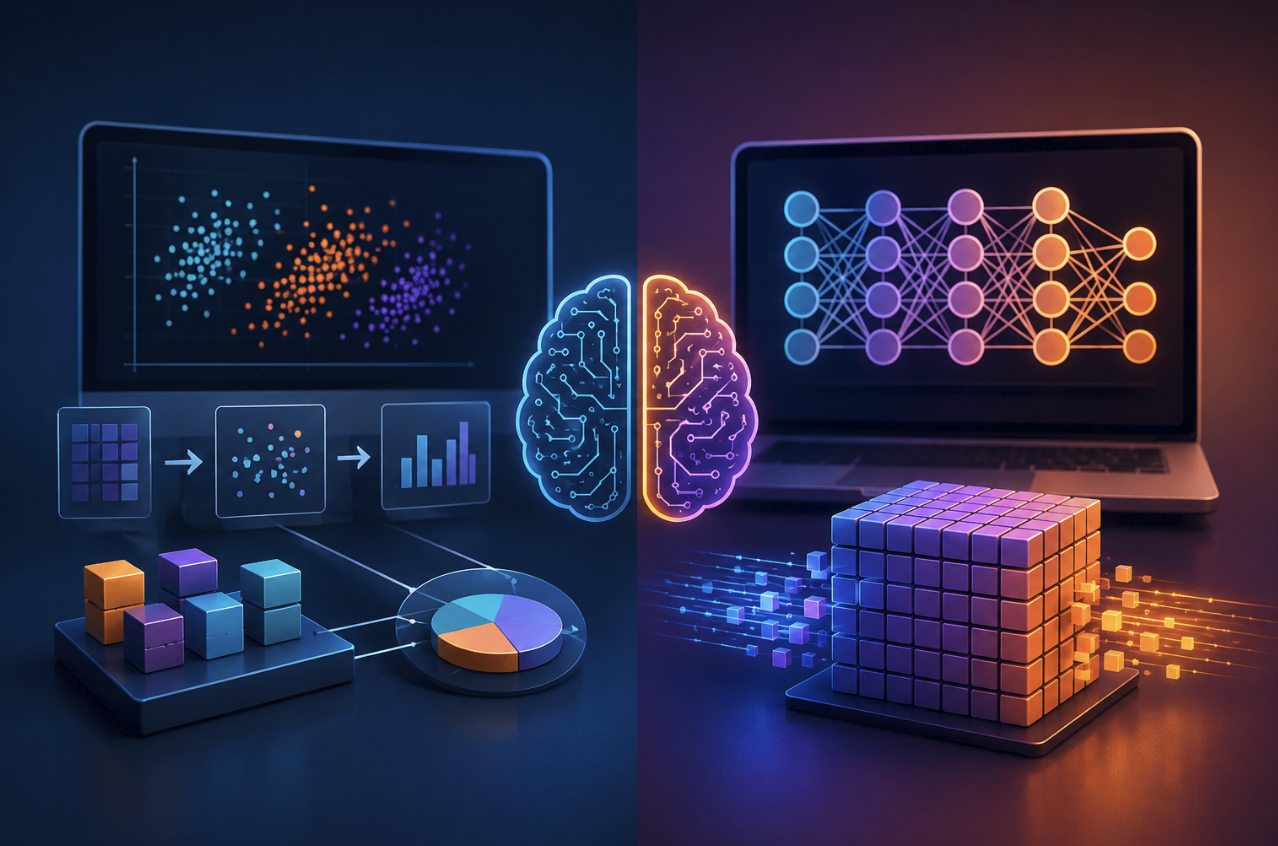
Artificial intelligence (AI) has transformed the way we work, communicate, shop, and even receive healthcare. Behind many of today’s smartest technologies are two closely related concepts: machine learning and deep learning. Although these terms are often used interchangeably, they are not the same.
If you’ve ever wondered why ChatGPT can generate human-like text, how Netflix recommends movies, or how self-driving cars recognize pedestrians, you’ve already encountered machine learning or deep learning in action.
Understanding the difference between these technologies doesn’t require a computer science degree. Once you know the basics, it becomes much easier to see why companies choose one approach over the other for different tasks.
In this guide, you’ll learn what machine learning and deep learning are, how they work, where they’re used, their advantages and limitations, and how to determine which approach is better suited for a specific problem.
What Is Artificial Intelligence?
Before comparing machine learning and deep learning, it’s helpful to understand the broader concept.
Artificial Intelligence, or AI, involves computer systems built to carry out tasks that usually need human thinking and decision-making. These tasks include:
- Learning from data
- Recognizing speech
- Understanding language
- Solving problems
- Making predictions
- Identifying images
- Playing games
- Driving vehicles
Think of AI as the umbrella term.
Under AI comes Machine Learning (ML).
Under Machine Learning comes Deep Learning (DL).
This means every deep learning model is a type of machine learning, but not every machine learning model uses deep learning.
What Is Machine Learning?
Machine learning is a branch of AI that enables computers to learn patterns from data instead of relying solely on explicit programming.
Instead of writing instructions for every possible situation, developers train machine learning models using examples. The model analyzes the data, identifies relationships, and improves its predictions over time.
For example, imagine you want a system to identify spam emails.
Rather than programming thousands of spam rules manually, you provide the model with thousands of examples of spam and legitimate emails. Over time, it learns to recognize common patterns and classify future emails accurately.
Common machine learning techniques include:
- Supervised learning
- Unsupervised learning
- Semi-supervised learning
- Reinforcement learning
Machine learning works particularly well when structured, labeled data is available.
What Is Deep Learning?
Deep learning is a specialized branch of machine learning that uses artificial neural networks inspired by the structure of the human brain.
These neural networks contain multiple processing layers, allowing them to learn increasingly complex patterns from large amounts of data.
Unlike traditional machine learning, deep learning often learns useful features automatically instead of requiring humans to define them.
For example, when identifying cats in photos:
A traditional machine learning model might require engineers to specify features such as:
- Ear shape
- Fur color
- Whiskers
- Eye position
A deep learning model automatically learns these features by analyzing millions of images.
Because of this ability, deep learning excels at handling complex tasks involving images, speech, video, and natural language.
How Machine Learning and Deep Learning Differ
Although both approaches involve learning from data, they differ in several important ways.
Data Requirements
Machine learning can often produce good results using smaller datasets.
Deep learning usually requires massive amounts of training data to achieve high accuracy.
Feature Engineering
Traditional machine learning relies heavily on manually selecting useful features.
Deep learning automatically discovers important features through its neural network architecture.
Training Time
Machine learning models generally train faster.
Deep learning models can require hours, days, or even weeks of training, depending on the size of the model and dataset.
Hardware Requirements
Many machine learning models run efficiently on standard computers.
Deep learning often benefits from specialized hardware such as GPUs or AI accelerators because of its computational demands.
Problem Complexity
Machine learning performs well on structured data and straightforward prediction tasks.
Deep learning excels at tackling intricate challenges related to images, voice recognition, sound, videos, and natural language understanding.
Types of Machine Learning
Machine learning includes several learning approaches.
Supervised Learning
It trains on labeled data, where the correct outcomes are pre-identified, enabling the model to learn effectively.
Examples include:
- Email spam detection
- Credit scoring
- House price prediction
- Disease diagnosis
Unsupervised Learning
The model identifies hidden patterns without labeled answers.
Applications include:
- Customer segmentation
- Fraud detection
- Market analysis
Reinforcement Learning
The model learns by interacting with an environment and receiving rewards or penalties.
Examples include:
- Robotics
- Video games
- Autonomous vehicles
- Resource optimization
How Deep Learning Works
Deep learning models consist of many interconnected layers called neural networks.
Each layer extracts increasingly advanced information.
For example, when recognizing a face:
- The first layer identifies edges.
- The next layer recognizes shapes.
- Higher layers identify eyes, noses, and mouths.
- The final layer recognizes the complete face.
This layered learning process enables deep learning to solve tasks that were once considered extremely difficult for computers.
Real-World Applications of Machine Learning
Machine learning powers many everyday technologies.
Some common examples include:
Email Spam Filters
Services like Gmail classify unwanted messages using machine learning algorithms.
Product Recommendations
Online stores recommend products based on your browsing history and purchasing behavior.
Fraud Detection
Banks monitor unusual transactions to detect potential fraud.
Search Engines
Search engines analyze billions of pages to deliver relevant search results.
Predictive Analytics
Businesses forecast sales, customer demand, and inventory requirements using machine learning models.
Real-World Applications of Deep Learning
Deep learning has enabled breakthroughs across numerous industries.
Voice Assistants
Virtual assistants understand spoken commands using deep neural networks.
Self-Driving Cars
Autonomous vehicles recognize roads, traffic signs, pedestrians, and other vehicles in real time.
Medical Imaging
Hospitals use deep learning to assist in detecting diseases from X-rays, MRIs, and CT scans.
Language Translation
Modern translation systems produce increasingly accurate translations between languages.
AI Chatbots
Advanced conversational AI systems use deep learning to understand context and generate natural responses.
Facial Recognition
Security systems identify individuals by analyzing facial features.
Advantages of Machine Learning
Machine learning offers several important benefits.
These include:
- Faster model training
- Lower hardware requirements
- Easier implementation
- Effective on structured datasets
- Lower development costs
- Easier interpretation of results
In many business contexts, machine learning provides trustworthy outcomes without requiring the advanced complexity of deep learning methods.
Advantages of Deep Learning
Deep learning shines when handling large-scale, complex data.
Key advantages include:
- Automatic feature extraction
- Exceptional accuracy for image and speech recognition
- Better performance with massive datasets
- Continuous improvement with additional data
- Ability to process unstructured information
These strengths make deep learning the preferred choice for many cutting-edge AI applications.
Challenges of Both Technologies
Neither approach is perfect.
Machine Learning Challenges
- Requires feature engineering
- Performance may plateau on highly complex tasks
- Less effective for unstructured data
Deep Learning Challenges
- Needs large datasets
- Requires powerful hardware
- Longer training times
- Higher energy consumption
- However, its decision-making process can be hard to decipher due to its “black box” nature, making it less transparent.
Choosing the right approach depends on the specific problem rather than assuming one is always better.
Which One Should You Choose?
The answer depends on your goals.
Choose machine learning if:
- You have structured data.
- Your dataset is relatively small.
- You need faster training.
- Explainability is important.
- Hardware resources are limited.
Choose deep learning if:
- You’re working with images, audio, or video.
- You have millions of training examples.
- High accuracy is essential.
- Powerful computing resources are available.
- You’re building advanced AI applications such as speech recognition or computer vision.
Many organizations actually combine both approaches depending on the project.
The Future of Machine Learning and Deep Learning
AI continues to evolve rapidly, and both machine learning and deep learning are becoming more capable every year.
Businesses are increasingly using these technologies to automate repetitive tasks, personalize customer experiences, improve healthcare, strengthen cybersecurity, and support scientific research.
At the same time, researchers are working to make AI models more efficient, transparent, and easier to deploy on everyday devices. As computing power grows and more high-quality data becomes available, both machine learning and deep learning are expected to play an even larger role across industries.
Rather than competing technologies, they are complementary tools that help solve different types of problems.
Final Thoughts
Machine learning and deep learning are closely connected, but they are designed for different challenges. Machine learning is often the better choice for structured data, smaller datasets, and projects that require faster training and greater interpretability. Deep learning, on the other hand, excels at solving complex tasks involving images, speech, natural language, and other forms of unstructured data.
Understanding the strengths and limitations of each approach helps you choose the right technology for your needs. As AI continues to advance, both machine learning and deep learning will remain essential building blocks behind the intelligent systems that shape our daily lives.
Frequently Asked Questions
1. What is the main difference between machine learning and deep learning?
Machine learning uses algorithms that often require manual feature selection, while deep learning uses multi-layered neural networks that automatically learn features from large amounts of data.
2. Is deep learning a type of machine learning?
Yes. Deep learning is a specialized subset of machine learning that relies on artificial neural networks with multiple processing layers.
3. Which approach is preferable: machine learning or deep learning? Which is better, machine learning or deep learning?
Neither is universally better. Machine learning is often ideal for structured data and smaller projects, while deep learning is better suited for complex tasks such as image recognition, speech processing, and natural language understanding.
4. Does deep learning require more data?
Yes. Deep learning models generally perform best when trained on large datasets, whereas many machine learning algorithms can achieve good results with smaller amounts of data.
5. Where is machine learning used in everyday life?
Machine learning powers spam filters, recommendation systems, fraud detection, predictive analytics, search engines, and many business intelligence applications.
6. Can beginners learn machine learning before deep learning?
Absolutely. Learning the fundamentals of machine learning first provides a strong foundation for understanding deep learning concepts, neural networks, and more advanced AI techniques later on.