

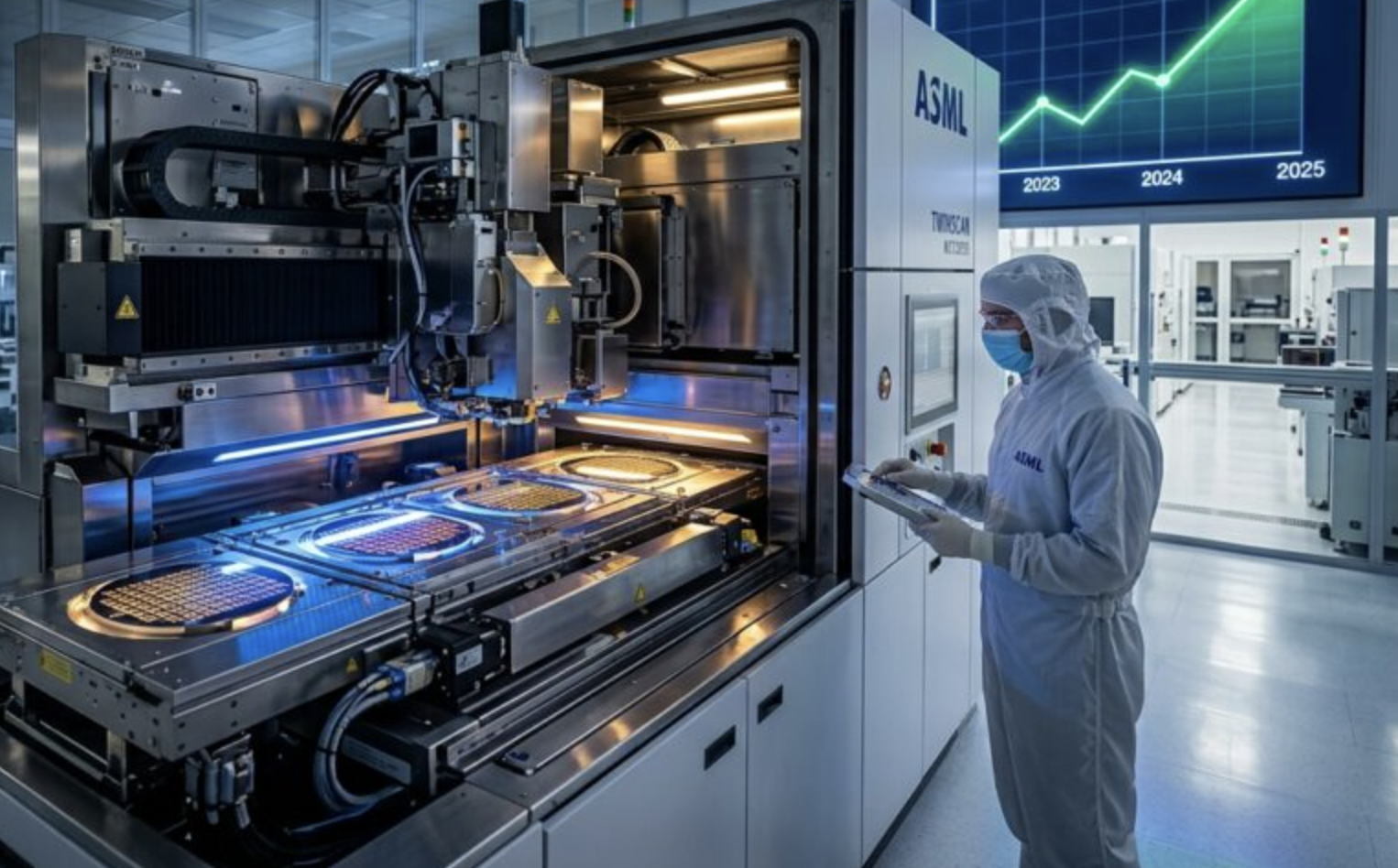
ASML reported strong third-quarter revenue of €11.66 billion, highlighting continued demand for advanced semiconductor manufacturing equipment. The Dutch technology company also raised its full-year revenue guidance, reflecting confidence in the semiconductor industry’s growth prospects. Consequently, investors are watching ASML closely as artificial intelligence drives demand for powerful chips.
The company’s performance matters because chipmakers depend on its advanced lithography systems. These machines help manufacturers produce increasingly sophisticated semiconductors. Moreover, rising AI investment has strengthened the need for advanced manufacturing capacity.
ASML Q3 Revenue Reached €11.66 Billion
ASML’s reported quarterly revenue of €11.66 billion demonstrates its importance in the global semiconductor supply chain. Its lithography technology enables chipmakers to manufacture complex, smaller semiconductor components. Therefore, demand for ASML equipment often reflects broader investment trends across the chip industry.
However, quarterly revenue alone does not explain the company’s performance. Investors also examine orders, profitability, customer spending, and management’s outlook. Together, these indicators help reveal whether current demand can support future growth.
ASML benefits from several long-term technology trends. Artificial intelligence requires powerful processors and specialized accelerators. Meanwhile, cloud providers continue expanding data centers to handle increasingly demanding workloads.
As a result, semiconductor manufacturers are investing in production capacity and advanced process technologies. ASML supplies essential equipment for many of these manufacturing efforts.
Why Artificial Intelligence Is Supporting ASML’s Growth
Growing demand for AI is helping fuel investment across the semiconductor industry. Companies are building AI infrastructure to support chatbots, generative models, enterprise automation, and advanced computing services.
These applications require sophisticated chips that can process enormous amounts of data. Consequently, semiconductor manufacturers need advanced production equipment to meet evolving performance requirements.
ASML occupies a particularly important position in this market. Its extreme ultraviolet lithography systems, known as EUV, help manufacturers create extremely small circuit patterns. This technology supports the production of advanced chips used in high-performance computing.
Furthermore, ASML’s customers include leading semiconductor manufacturers. Their investment decisions can significantly influence the company’s equipment sales and future revenue.
Nevertheless, AI demand does not guarantee uninterrupted growth. Chipmakers need to match their production levels to what customers are actually buying. If spending slows, equipment orders could weaken.
What Higher Full-Year Guidance Means
Raising full-year revenue guidance signals that management expects stronger or more favorable financial performance than previously anticipated. It can reflect improved demand, better execution, or increased confidence in future equipment deliveries.
For investors, this adjustment provides an important signal about ASML’s business outlook. However, guidance represents management’s expectations rather than a guaranteed financial result.
Several factors can influence the company’s final performance. These include customer investment plans, production schedules, export restrictions, and global economic conditions.
Additionally, semiconductor equipment orders can fluctuate significantly between quarters. Large manufacturing projects often involve lengthy planning and delivery schedules. Therefore, investors should evaluate guidance alongside order intake and management commentary.
A stronger outlook can support investor confidence. Still, the sustainability of growth depends on whether customers continue investing in advanced manufacturing technology.
EUV Lithography Gives ASML a Competitive Advantage
ASML stands apart from many equipment makers because of its role in advanced lithography. Its EUV systems enable chipmakers to produce intricate circuit designs required for leading-edge processors.
Developing these machines requires specialized engineering, precision optics, and complex manufacturing processes. Consequently, competing with ASML in EUV technology presents substantial technical and financial challenges.
This competitive position gives the company strategic importance. Major chipmakers rely on advanced lithography to improve performance, efficiency, and transistor density.
Meanwhile, semiconductor manufacturers continue exploring more advanced production techniques. As chip designs become increasingly complex, lithography remains a critical part of the manufacturing process.
However, ASML also faces challenges. Its systems are expensive, and customers must justify substantial capital investments. Export controls and geopolitical tensions can also affect access to important markets.
Key Risks Investors Should Watch
Despite its strong revenue and improved guidance, ASML faces several risks that could influence future results.
1. Semiconductor Industry Cycles
The semiconductor industry experiences periods of rapid investment followed by slower spending. During downturns, chipmakers may postpone equipment purchases. Consequently, ASML’s revenue and orders can become less predictable.
2. Export Restrictions and Geopolitical Tensions
Government restrictions can limit the equipment that ASML sells to certain markets. Changes in international trade policies may affect customer access and future sales opportunities.
3. High Equipment Costs
ASML’s advanced systems require significant customer investment. If chipmakers reduce capital spending, equipment demand could weaken even when long-term technology trends remain positive.
4. Valuation and Investor Expectations
Strong business performance does not automatically make a stock attractively priced. Investors must compare ASML’s market valuation with its expected earnings growth, cash flow, and business risks.
Therefore, financial results and guidance should be considered alongside the stock’s current valuation.
What ASML’s Results Mean for the Semiconductor Industry
ASML’s €11.66 billion quarterly revenue highlights the scale of investment flowing through the semiconductor supply chain. Its improved full-year outlook also points to management’s confidence in the business environment.
More broadly, advanced chips remain essential to AI infrastructure, cloud computing, smartphones, and high-performance systems. These markets could support continued demand for sophisticated manufacturing equipment.
Nevertheless, future growth will depend on customer spending and the broader economic environment. Semiconductor companies must generate sufficient returns to justify expensive factory expansions.
For investors, ASML provides an important perspective on the industry’s direction. Its results can help explain how technology demand translates into equipment spending.
Conclusion
ASML’s reported Q3 revenue of €11.66 billion and higher full-year guidance highlight its strategic role in semiconductor manufacturing. AI investment and demand for advanced chips offer important growth opportunities.
However, export controls, industry cycles, and customer spending remain significant risks. Investors should monitor future earnings, order trends, and management guidance before drawing conclusions about the company’s long-term prospects.
Ultimately, ASML’s performance offers valuable insight into the infrastructure powering the next generation of computing.