

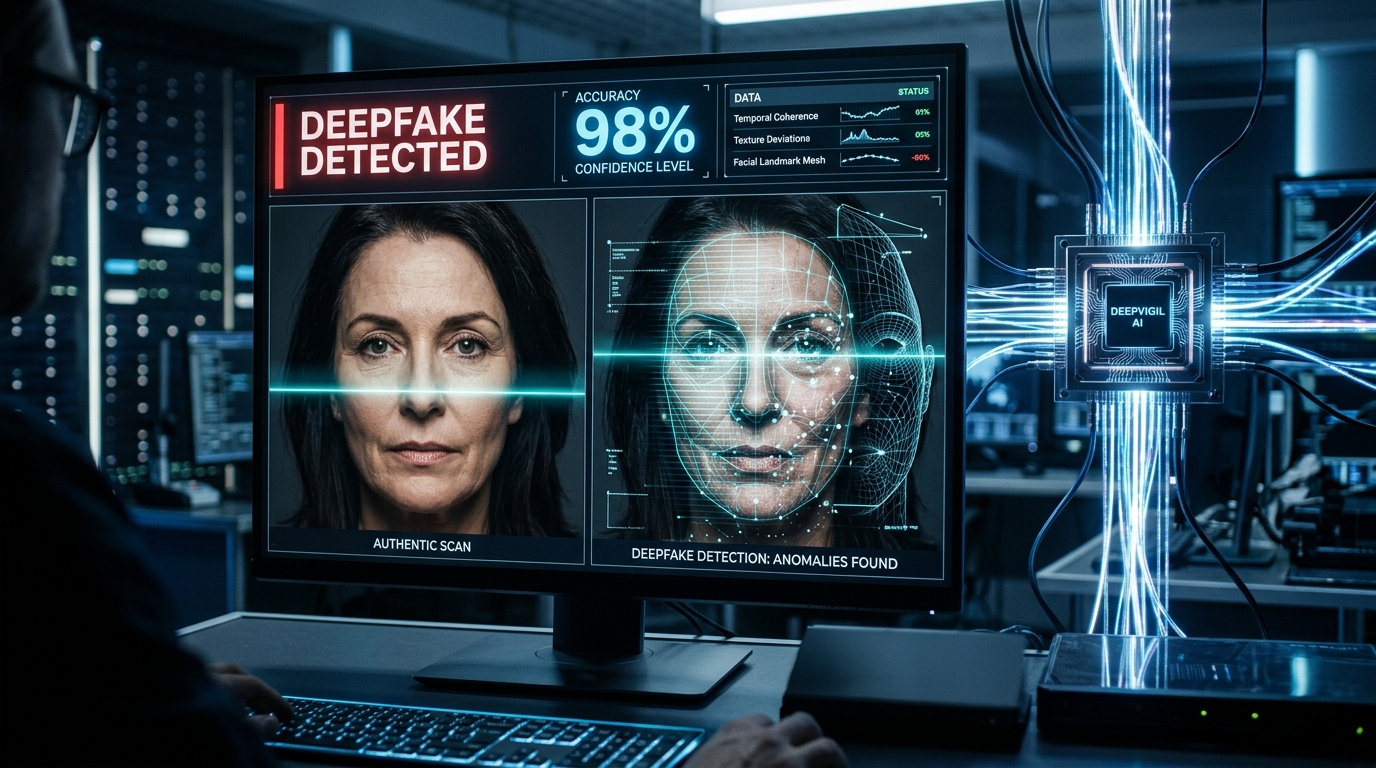
Deepfakes are becoming harder to identify as artificial intelligence improves. However, a new approach could make detection faster and more accurate.
Researchers are exploring light-powered AI systems that can spot deepfakes with impressive accuracy. These systems use light-based computing to process visual information.
Rather than depending entirely on conventional processors, these systems use light to carry out some types of calculations. This approach can help them process visual content, such as photos and video footage, more quickly.
How Light-Powered AI Works
Light-powered AI uses photons to process information. Photons can travel quickly and carry large amounts of data.
Therefore, optical systems can perform specific calculations without depending entirely on electronic circuits. This approach can reduce processing delays.
When detecting deepfakes, the system examines subtle visual patterns. These patterns can reveal whether content came from a real camera or an AI generator.
For instance, subtle irregularities in a face may be difficult for a person to spot. Light-based AI can identify these differences during analysis.
Why Deepfake Detection Needs Better Technology
Deepfake technology has developed rapidly in recent years. Modern AI tools can create realistic faces, voices, and videos within minutes.
Consequently, traditional detection methods face increasing challenges. A detector trained on older deepfakes may struggle with newer generation techniques.
Furthermore, deepfake creators can modify files to hide obvious signs of manipulation. This makes reliable detection increasingly important.
Businesses, governments, media organizations, and individuals all face potential risks. False information can damage reputations and influence important decisions.
How 98 Percent Accuracy Could Change Detection
An accuracy rate near 98 percent would represent a major improvement for many detection applications.
However, accuracy alone does not guarantee perfect results. Detection systems can still produce false positives or miss sophisticated manipulations.
Even so, high accuracy could make automated screening much more practical.
For instance, social platforms could scan uploaded videos before publishing them. News organizations could also verify suspicious footage faster.
Additionally, cybersecurity teams could use these systems when investigating manipulated digital evidence.
The Role of Optical Computing in AI
Traditional AI systems usually depend heavily on electronic processors. Optical computing takes a different approach.
Instead, it uses light to perform selected computational operations. This method can offer high-speed data processing for certain workloads.
Moreover, optical systems can potentially consume less energy during specific tasks. That advantage could become increasingly valuable as AI workloads grow.
However, optical computing still faces technical and manufacturing challenges. Researchers must improve reliability, scalability, and integration with existing hardware.
Can Light-Powered AI Detect Every Deepfake?
No detection system can guarantee perfect results.
Deepfake generators continue evolving, so detection technology must evolve as well. A model that works today may become less effective tomorrow.
Therefore, researchers need continuously updated training data. They also need testing against different generation methods.
The strongest systems may eventually combine optical processing with conventional AI models. This hybrid approach could provide greater flexibility and accuracy.
Where Could This Technology Be Used?
Light-powered deepfake detection could support several industries.
Social media platforms could use it to identify manipulated content. Meanwhile, banks could use detection tools to protect video-based identity checks.
Journalists could verify suspicious recordings before publishing them. Law enforcement agencies could also examine digital evidence more efficiently.
Furthermore, businesses could use deepfake detection during remote meetings and online interviews.
As synthetic media becomes more common, these applications could become increasingly important.
The Future of Light-Powered AI
Light-powered AI represents an interesting direction for artificial intelligence hardware. It combines optical computing with machine learning for specialized tasks.
Deepfake detection is particularly suitable because visual data requires significant processing power.
As optical technology improves, researchers could develop smaller and faster systems. Eventually, these systems may operate directly inside cameras, smartphones, or security platforms.
However, widespread adoption will depend on cost, reliability, and real-world performance.
Final Thoughts
Light-powered AI could provide a powerful new method for detecting deepfakes. Its ability to process visual information using light offers several potential advantages.
A reported accuracy of 98 percent shows why this technology is attracting attention. Still, researchers must continue testing these systems against increasingly realistic AI-generated content.
Ultimately, combining optical computing with advanced machine learning could make digital media verification faster and more reliable.