

Imagine opening a popular website during a major sale, watching a live event online, or using an application that millions of people access at the same time. Every click, search, login, image request, and transaction creates work for the application’s servers.
If all those requests were sent to a single server, that server could quickly become overloaded.
This is where load balancing becomes important.
Load balancing is a technology used to distribute incoming network or application traffic across multiple servers. Instead of asking one machine to handle everything, a load balancer helps spread the workload across several available servers.
The result can be better performance, improved reliability, and greater ability to handle sudden increases in traffic.
For small websites, load balancing may not always be necessary. However, for large applications, cloud platforms, online stores, streaming services, financial platforms, and other high-traffic systems, it can be an essential part of the infrastructure.
What Is Load Balancing?
Load balancing is the process of distributing incoming requests across multiple servers or computing resources.
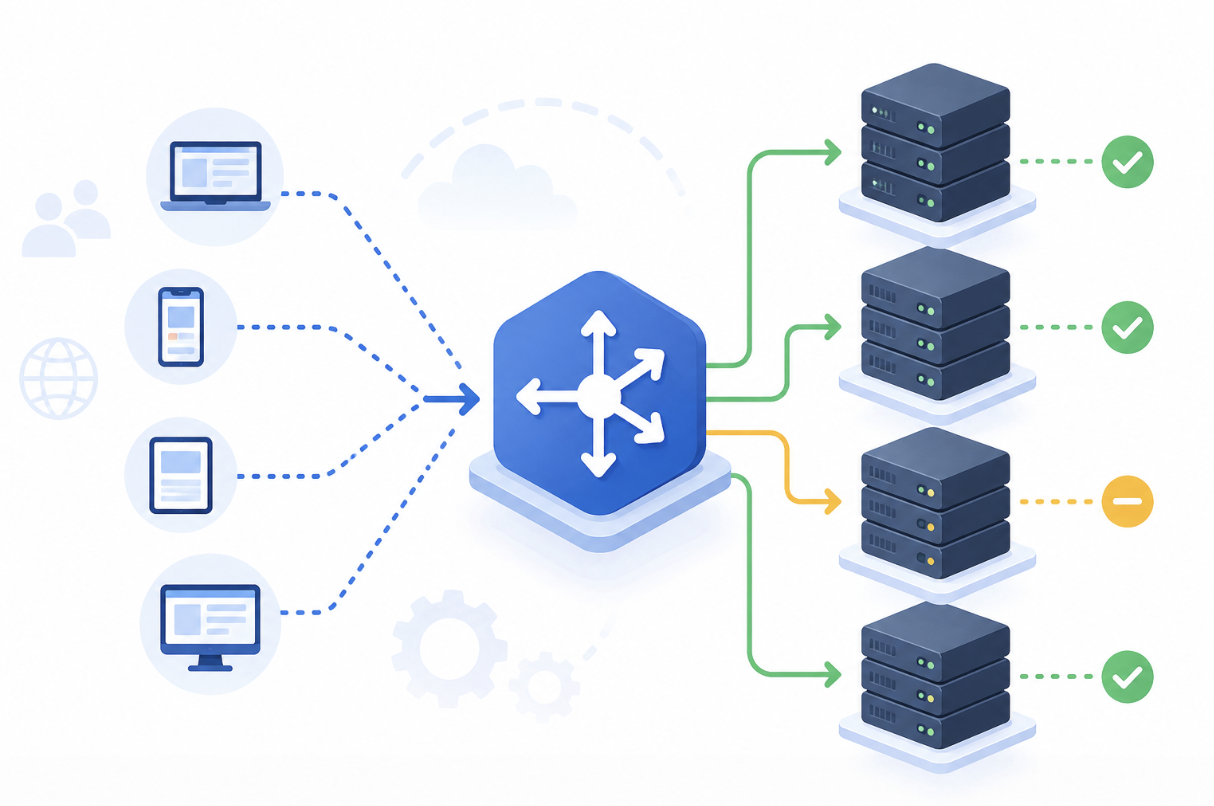
A device or software component called a load balancer typically sits between users and the servers that provide an application.
Instead of a user directly connecting to a particular application server, the request can first reach the load balancer. The load balancer then determines which available server should handle that request.
A simple setup might look like this:
Users -> Load Balancer -> Server 1, Server 2, Server 3
If Server 1 is already handling a large number of requests, the load balancer can direct another request toward Server 2 or Server 3, depending on its configuration.
This approach prevents one server from becoming an unnecessary bottleneck while other servers remain underused.
Why Do Large Apps Need Load Balancing?
Large applications can receive enormous amounts of traffic.
A single server has limits. It has a finite amount of processing power, memory, network capacity, and storage performance. When demand exceeds those limits, users may experience slow loading, failed requests, or service interruptions.
Load balancing helps applications distribute that demand.
For example, suppose an online shopping platform has three application servers.
Without load balancing, a large number of users might accidentally or intentionally send most requests toward one server.
With a load balancer, incoming traffic can be distributed among all three servers.
This allows the application to use its available infrastructure more efficiently.
Load balancing also becomes particularly useful when applications need to remain available even when individual servers experience problems.
How Does a Load Balancer Work?
The basic process is relatively straightforward.
Step 1: A User Sends a Request
A user opens an application or website and requests something from the server.
Step 2: The Request Reaches the Load Balancer
Instead of going directly to an application server, the request is received by the load balancer.
Step 3: The Load Balancer Selects a Server
The load balancer examines its configuration and available servers before deciding where to send the request.
It may consider factors such as current connections, server health, response time, or a configured balancing algorithm.
Step 4: The Server Processes the Request
The selected server handles the request and produces the appropriate response.
Step 5: The Response Returns to the User
The response is delivered back through the network to the user’s application or browser.
This entire process can happen extremely quickly.
Common Load Balancing Methods
Load balancers can use different algorithms to decide where requests should go.
Round Robin
Round robin distributes requests across servers in sequence.
For example:
Server 1 -> Server 2 -> Server 3 -> Server 1
This is simple and works well when servers have similar capabilities and requests require roughly similar amounts of processing.
Weighted Round Robin
Weighted round robin gives some servers more traffic than others.
For example, a more powerful server could receive a higher share of requests, while a smaller server receives fewer.
This can be useful when the available servers have different capacities.
Least Connections
The least-connections method directs new requests toward the server currently handling the fewest active connections.
This can be useful when connections remain active for different lengths of time.
IP Hash
IP hashing uses information from a client’s IP address to determine which server should receive a request.
This approach can help maintain a degree of consistency in where requests are sent, although modern application architectures often use other mechanisms for maintaining user session state.
What Is Health Checking?
A load balancer needs to know whether the servers behind it are actually working.
This is where health checks come in.
A load balancer can periodically send a request to a server or check a particular service endpoint. If the server responds appropriately, it can remain in the pool of available resources.
If a server stops responding correctly, the load balancer can temporarily stop sending new traffic to it.
For example, imagine an application has four servers:
- Server A: Healthy
- Server B: Healthy
- Server C: Unavailable
- Server D: Healthy
The load balancer can continue directing traffic to A, B, and D while avoiding C.
This does not magically fix the failed server, but it can help prevent that failure from affecting every incoming request.
Load Balancing and Scalability
One of the biggest reasons large applications use load balancing is scalability.
Scalability means an application can handle increasing demand by adding or adjusting resources.
Suppose an application initially operates with two servers. As the number of users grows, the company might add several more servers.
Instead of redesigning how users connect to the application every time a new server is added, the load balancer can distribute traffic across the expanded server pool.
This makes it easier to build systems that can grow with demand.
In cloud environments, load balancing can also work alongside automated scaling systems. New application instances can be created when demand rises and removed when demand falls, depending on the architecture.
Load Balancing and High Availability
Performance is only part of the story.
Large applications also need high availability, meaning they should remain accessible when individual components experience problems.
Consider an application running on five servers.
If one server fails and the load balancer continues sending users to it, those requests could fail.
However, if the load balancer detects the problem and removes the unhealthy server from the active pool, traffic can continue flowing toward the remaining servers.
This creates a level of redundancy.
It is important to remember that a load balancer itself can also become a point of failure if the architecture is poorly designed. Large systems therefore often use redundant load-balancing infrastructure rather than depending on a single component.
Types of Load Balancers
Load balancing can be implemented at different levels.
Hardware Load Balancers
Hardware load balancers are dedicated physical devices designed to handle traffic distribution.
They can provide high performance but may require greater investment and specialized infrastructure.
Software Load Balancers
Software load balancers run on servers or virtual machines.
They can provide flexibility and can often be configured to fit different application requirements.
Cloud Load Balancers
Cloud providers offer managed load-balancing services that can distribute traffic across cloud resources.
These services can make it easier for organizations to build scalable applications without managing every piece of load-balancing infrastructure themselves.
Application Load Balancers
Application-level load balancers can make routing decisions based on information such as HTTP headers, URLs, cookies, or other application-layer details.
For example, traffic requesting /images could potentially be routed differently from traffic requesting /api.
Load Balancing vs. Failover
Load balancing and failover are related but not identical.
Load balancing focuses primarily on distributing traffic across available resources.
Failover focuses on maintaining service when a primary system becomes unavailable.
A well-designed infrastructure can use both.
For example, several servers may share incoming traffic under normal conditions. If one fails, the load balancer can stop sending new requests to that server and allow the remaining servers to handle the workload.
This combination improves both resource utilization and resilience.
Benefits of Load Balancing
Load balancing can provide several important benefits to large applications.
Better Performance
Distributing traffic can prevent individual servers from becoming overloaded.
Improved Reliability
If one server fails, other servers may continue serving users.
Easier Scaling
Organizations can add additional servers as demand increases.
Better Resource Utilization
Instead of leaving some servers idle while another struggles with excessive traffic, load balancing can distribute work more effectively.
Greater Flexibility
Load balancing can support different infrastructure designs, including traditional data centers, hybrid environments, and cloud-based applications.
Challenges of Load Balancing
Although load balancing offers major advantages, implementing it correctly requires planning.
Configuration Complexity
Large applications may have many services, servers, databases, and network components. Configuring traffic rules correctly can become complicated.
Session Management
Some applications rely on user sessions. If requests from the same user move between servers, the application needs a suitable way to maintain session information.
Modern architectures often solve this through shared session storage or stateless application design rather than relying entirely on a user’s connection staying with one server.
Monitoring
Administrators need to monitor traffic, server health, response times, errors, and other performance indicators.
Security
Load balancers can become an important part of an application’s security architecture. They may work alongside encryption, access controls, firewalls, web application firewalls, and other security systems.
Load Balancing in Real-World Applications
Load balancing is common in systems that need to handle large or unpredictable amounts of traffic.
E-Commerce
Online stores may experience huge traffic spikes during promotions, holidays, or major sales.
Streaming Services
Video and media platforms need infrastructure capable of serving large numbers of simultaneous users.
Banking and Financial Platforms
Financial applications need reliable infrastructure because users depend on them for important transactions and account access.
Gaming Platforms
Online games may need to distribute connections across multiple servers and regions to support large player populations.
Cloud Applications
Cloud-based software can use load balancing to distribute traffic among multiple application instances.
The specific architecture varies, but the underlying principle remains similar: avoid relying on a single resource when demand requires multiple resources.
Load Balancing and Modern Cloud Architecture
Cloud computing has made load balancing even more important.
Applications can now run across multiple virtual machines, containers, availability zones, and geographic regions.
A load-balancing layer can help route users toward suitable resources.
For example, a global application may use different infrastructure locations to serve users in different regions.
More advanced architectures can combine load balancing with:
- Auto-scaling
- Content delivery networks
- Container orchestration
- Microservices
- Caching
- Monitoring systems
- Disaster recovery
Together, these technologies can help organizations build applications capable of handling large and changing workloads.
Conclusion
Load balancing is one of the technologies that helps large applications remain fast, reliable, and scalable.
Instead of sending every request to a single server, a load balancer distributes traffic across multiple resources. It can also monitor server health and redirect traffic when individual servers become unavailable.
For growing applications, this approach provides an important foundation for handling increased demand without relying on one machine to do everything.
From online shopping platforms and streaming services to cloud applications and financial systems, load balancing plays a behind-the-scenes role in keeping modern digital services running smoothly.
The key idea is simple: when an application has more work than one server can reliably handle, distributing that work across multiple servers can make the entire system more resilient and scalable.
Frequently Asked Questions
1. What is load balancing in simple terms?
Load balancing is a method of distributing incoming traffic across multiple servers so that one server does not have to handle all the work.
2. What does a load balancer do?
A load balancer receives incoming requests and determines which available server should handle each request according to configured rules and algorithms.
3. Why is load balancing important?
Load balancing can improve application performance, support scalability, increase availability, and help prevent individual servers from becoming overloaded.
4. What are the consequences if a server experiences a failure while operating behind a load balancing system?
If health checks detect that a server is unavailable or unhealthy, the load balancer can stop directing new traffic to that server and send requests to other healthy servers.
5. What is the difference between a load balancer and a server?
A server typically provides application functionality or processes requests. A load balancer distributes requests among multiple servers instead of handling the application’s entire workload itself.
6. Is load balancing only used in cloud computing?
No. Load balancing can be used in traditional data centers, private infrastructure, hybrid environments, and public cloud systems. The underlying concept is useful anywhere traffic needs to be distributed across multiple resources.