

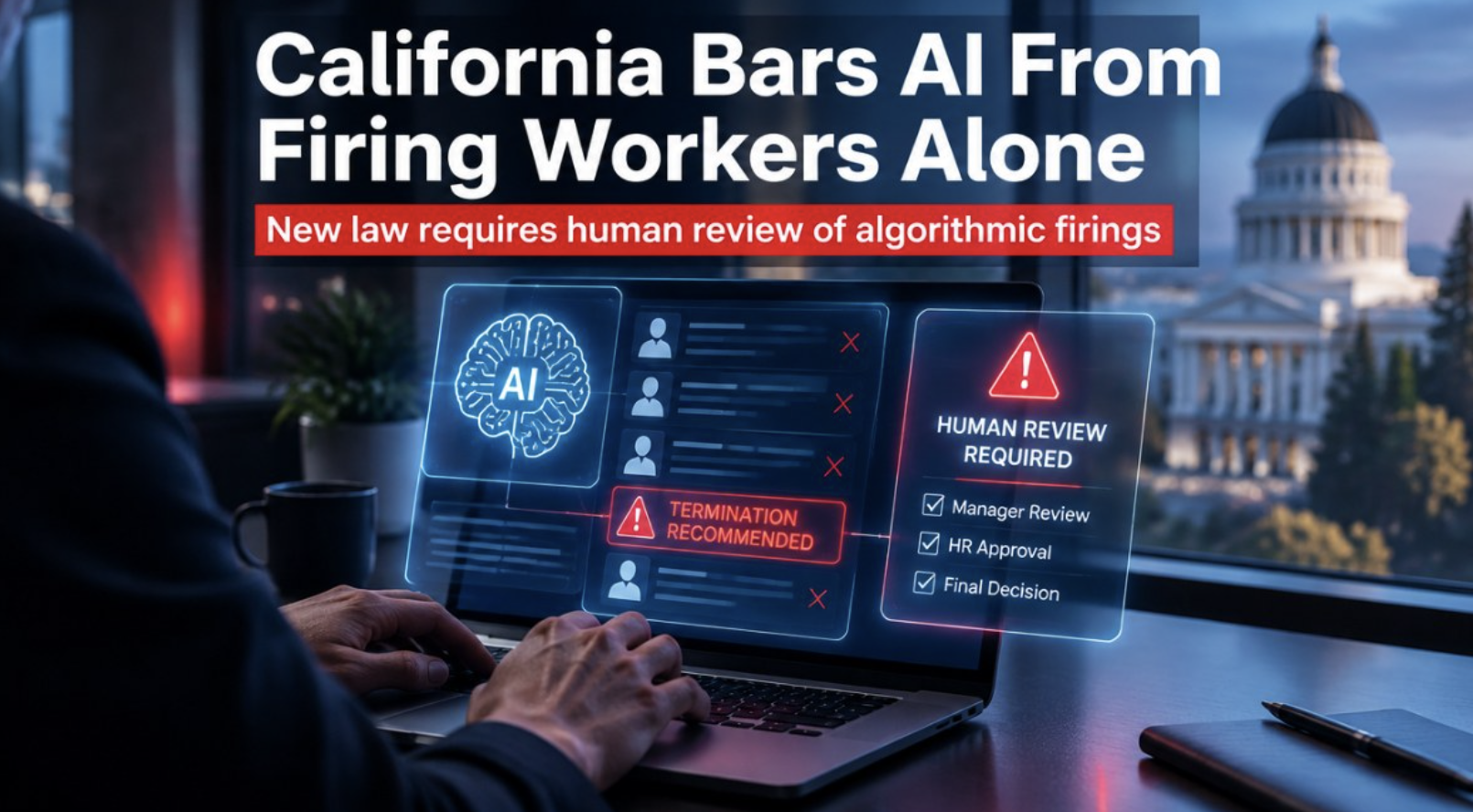
California has just drawn a hard line around one of the most controversial uses of workplace AI: a machine cannot be the only thing deciding whether you keep your job. Governor Gavin Newsom signed SB 947, the No Robo Bosses Act, on September 30, 2026, making California the first U.S. state to prohibit employers from relying solely on automated decision-making systems to fire or discipline workers. The law takes effect July 1, 2027.
California AI-only firings are banned, but AI itself is not
The first surprise is what SB 947 does not do. It does not stop companies from using AI to analyze performance, flag policy violations, or support managers. Instead, it prevents an automated decision-making system, or ADS, from being the sole basis for firing or discipline.
When an employer uses an ADS to assist with a termination or disciplinary decision, the law requires human oversight and verification. If the system plays the primary role, the human reviewer must corroborate the decision using other information rather than simply approving whatever the software recommends.
That could include managerial evaluations, peer reviews, personnel records, or other relevant evidence. In practical terms, clicking “approve” on an AI recommendation should not be enough. A manager must have a basis for the decision, not simply a human signature attached to an automated result.
The real reason California AI-only firings became a political issue
Employers increasingly use automated systems to monitor productivity, manage schedules, and flag workers for attention. Supporters argue these tools can produce errors, bias, and bad judgments when treated as final decision-makers.
The California governor’s office said the new workplace laws are designed to keep people at the center of decisions involving AI and automated technology. SB 947 specifically targets disciplinary and termination decisions, while other measures address AI-related layoffs and workplace surveillance.
Here is what experts quietly admit: human review is only useful if it is real. A manager who never checks the evidence and simply accepts an algorithm’s recommendation could undermine the purpose of the law.
For workers, the important question may no longer be “Does my employer use AI?” It may become “How much power does that AI actually have?”
SB 947 creates a paper trail employees can see
Another major change is transparency. When automated decision-making systems are used in covered firing or disciplinary decisions, affected workers must be informed that the system was used.
The law also requires disclosures about information used by the system and provides a human point of contact for the affected worker. That gives employees a clearer path to understand a decision that might otherwise look like an unexplained computer verdict.
SB 947 does not give employees a right to overturn every decision. It does push employers toward greater accountability.
Did You Know?
SB 947 is a revised version of a similar “No Robo Bosses Act” that Newsom vetoed in 2025. The 2026 version is narrower and focuses on preventing employers from relying solely on automated systems for firing and discipline.
The biggest catch is that the law starts in 2027
If you work or manage a business in California, do not assume the new rule is already controlling every workplace decision. SB 947 becomes operative on July 1, 2027. That gives employers time to review AI tools, update policies, train managers, and create procedures for human verification.
California employers should map where automated systems influence discipline and termination, then identify which decisions require extra evidence and who will review them.
In my experience with clients, the hardest part of technology compliance is often not the software itself. It is proving that people follow a consistent process around the software. SB 947 makes that process much more important.
California AI-only firings could become a national warning
California often sets technology and employment rules that companies later consider beyond the state. SB 947 could pressure nationwide employers to build one standard process rather than separate systems for California workers.
The law signals where workplace AI regulation may be heading: not stopping automation, but limiting its power over high-impact decisions that affect income and careers.
The enforcement structure matters too. SB 947 can be enforced by the California labor commissioner, the state attorney general, or local prosecutors. The legislation does not create a private right of action for employees.
For companies, the safest takeaway is straightforward: use AI as evidence, not as the final boss. That could change how employers document every workplace decision.
What should workers and employers do now?
Workers should ask whether AI played a primary role in a disciplinary or termination decision and request the information the law requires after it takes effect.
Employers should inventory automated systems, document human-review procedures, and train managers to evaluate independent evidence.
Conclusion
California’s SB 947 reflects a clear boundary for workplace automation: AI can support employment decisions, but it should not make the final call on its own. By requiring meaningful human involvement before an employee is fired, the law aims to preserve accountability and give workers a chance to challenge decisions that affect their livelihoods.
California did not declare war on workplace AI. It declared that a machine cannot be the only voice deciding whether a person loses a job.
FAQ’s
Are California AI-only firings banned?
Yes. California AI-only firings are prohibited when an automated decision-making system is the sole basis for termination or discipline. SB 947 still allows employers to use AI as a supporting tool, but human oversight and verification are required when AI assists with these decisions. The law becomes operative July 1, 2027.
When does SB 947 take effect?
SB 947 takes effect July 1, 2027. Until then, employers should not treat the law as an immediate operating requirement, but they can use the transition period to review automated decision systems, update policies, train managers, and establish documentation procedures for human verification and employee notices.
What does SB 947 mean for California workers?
SB 947 gives workers more transparency when automated decision-making systems play a major role in disciplinary or termination decisions. Employees must receive required notice and information about the system’s use and the personal data considered. The goal is to prevent an unexplained algorithmic decision from becoming the final word on employment.