

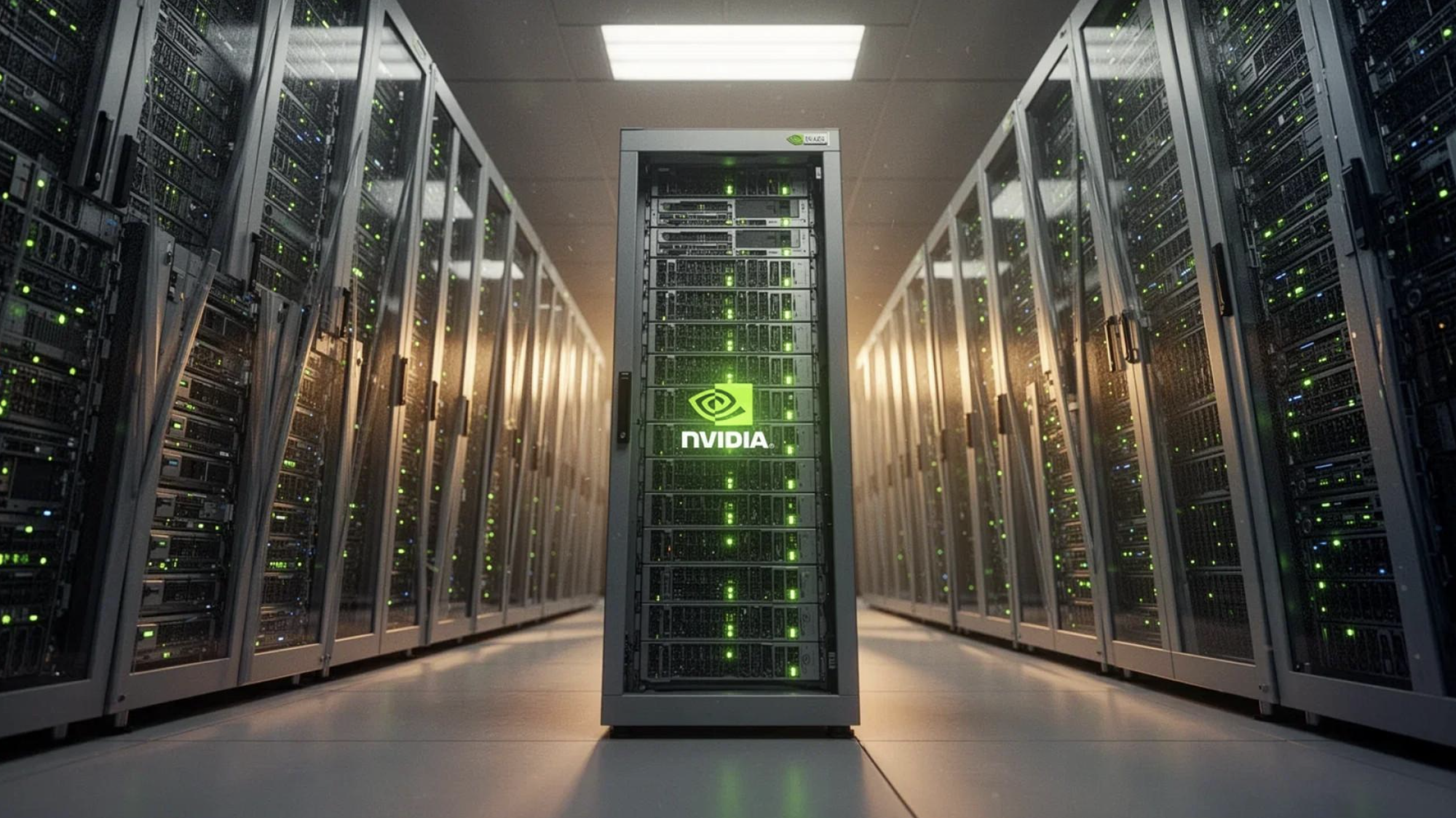
Nvidia could stop supplying advanced AI chips to a customer developing unsafe artificial intelligence, CEO Jensen Huang said in October 2026. That statement matters because the company supplies computing hardware that helps power much of the AI industry. Yet Huang’s position is more complicated than a simple promise to ban dangerous developers.
In an interview with Bloomberg’s Emily Chang in London, Huang said Nvidia would consider ending a customer relationship in such a situation, but it would speak with the customer first. He also argued that concerns about AI risks can be overstated and that technology itself can help keep advanced systems under control.
Source: Bloomberg
Here is the surprising part: the company selling the computing power behind AI development may also have a role in deciding when a customer’s behavior becomes unacceptable.
Nvidia’s AI Chip Power Gives It More Influence Than Most People Realize
AI safety is often seen as the job of developers, regulators, and research labs. But the companies supplying the computing infrastructure can also influence what happens next.
Nvidia makes graphics processing units, or GPUs, that accelerate the training and operation of AI models. These chips help developers build chatbots, coding assistants, autonomous agents, scientific tools, and other advanced systems.
That position gives Nvidia significant commercial influence. If a developer loses access to essential computing hardware, training larger models or expanding a service can become more difficult and expensive.
However, Nvidia’s influence has limits. Its chips are general-purpose products used for legitimate activities across research, healthcare, education, business, and entertainment. A chip cannot automatically reveal whether a customer intends to develop a useful assistant or a system designed to cause harm.
This creates a difficult question: how can a hardware supplier identify irresponsible use without treating every customer as a potential threat?
Huang’s answer suggests that communication would come before a cutoff. That distinction matters because a responsible response should consider evidence, the customer’s explanation, and the seriousness of the risk rather than relying on suspicion alone.
The Real Reason Huang Wants Conversations Before Cutting Off AI Customers
Huang did not announce an immediate ban on a named AI company. He described a hypothetical situation and said Nvidia would talk with the customer before deciding what to do.
That qualification changes the meaning of his statement.
A developer might create a dangerous system through deliberate misuse, weak security practices, inadequate testing, or an unexpected failure. Those situations require different responses. A company intentionally building harmful capabilities presents a different challenge from a research team discovering an unforeseen vulnerability and trying to fix it.
A conversation could help Nvidia understand the circumstances, request stronger safeguards, or encourage a customer to correct a serious problem. In some cases, ending the business relationship might still be necessary.
But there is an unanswered question: what exactly would Nvidia classify as unsafe AI?
There is no single technical definition that covers every risk. A model that produces misleading medical advice presents one type of danger. An autonomous agent that can execute financial transactions or access sensitive computer systems presents another.
Clear criteria would make enforcement more credible. Customers should understand the relevant rules, what evidence could trigger action, and whether they can challenge a decision.
Without those details, the promise is meaningful but not a complete safety policy.
Why general-purpose chips make enforcement difficult
AI hardware supports many different applications. Nvidia cannot determine every future use simply by examining a chip order.
A practical system would need to combine contractual requirements, credible risk assessments, compliance checks, and appropriate investigations. It would also have to tell the difference between routine research and work that poses a serious, avoidable risk.
Nvidia’s AI Safety Plan Relies on Containment as Well as Limits
Here is what many people overlook: Huang believes AI technology can help monitor and contain other AI systems.
Containment means placing boundaries around what a system can access or do. Monitoring means observing its behavior, detecting suspicious activity, and identifying failures before they cause greater damage.
For example, an AI agent used by a business might be allowed to search company documents but prohibited from sending confidential files outside the organization. A separate approval step could prevent it from transferring money, deleting important records, or changing security settings without authorization.
These controls become especially important as AI systems move beyond answering questions and begin taking actions independently.
Nvidia has also announced support for AI safety research in the United Kingdom. Reuters reported on October 14, 2026, that the company committed $250 million in computing resources over five years to support research into AI safety, including testing agentic systems.
That investment supports research, but it does not prove that every AI risk has been solved. Safety techniques need testing under realistic conditions, and monitoring systems can miss unusual behavior or produce false alarms.
Did You Know? Nvidia’s announced UK commitment is computing resources rather than simply a cash donation. Access to advanced computing can help researchers test AI systems and evaluate safeguards at a scale that might otherwise be difficult to afford.
The key lesson is that restrictions and technical safeguards work best together. Cutting off a customer may reduce one immediate risk, while stronger testing and containment can help prevent similar problems across many systems.
The Biggest Risk Is That AI Companies Grow Faster Than Their Safeguards
Huang has described safety concerns as part of the growing pains of a rapidly expanding industry. He has also argued that some public fears are overstated.
That view highlights a genuine tension. AI developers want to release useful products quickly, while customers, workers, and governments need confidence that those products will behave responsibly.
The problem is not limited to dramatic scenarios involving highly advanced AI. Everyday failures can have serious consequences. An automated system might expose private information, make an incorrect decision at scale, or follow malicious instructions hidden inside a document.
Companies can reduce these risks through independent evaluations, access controls, human oversight, incident reporting, and carefully limited permissions. They also need a way to disable systems quickly when something goes wrong.
In my experience as a technology content writer, the most useful way to assess an AI safety claim is to look beyond the announcement and ask what measurable safeguards support it. A strong statement matters, but implementation, testing, and accountability matter more.
Nvidia’s position also raises a governance issue. If a powerful supplier can restrict access to essential computing resources, its decisions may affect competition and research. Consistent standards and transparent procedures would help reduce arbitrary enforcement.
Governments still have a role here. Companies understand their products, but public authorities can establish legal obligations and investigate harms that cross organizational boundaries.
What Nvidia’s Decision Means for Businesses Using AI
The story is relevant even if your business never buys an advanced AI chip directly. Many organizations depend on cloud platforms and software providers that rely on large computing systems.
If suppliers tighten their safety requirements, businesses could face additional checks, revised contracts, or restrictions on certain uses. Companies can take responsible steps by recording how they use AI and establishing firm rules for handling sensitive information and automated decisions.
Start with three practical measures. First, identify which AI tools access confidential information. Second, restrict their permissions to what they actually need. Third, establish a process for reviewing incidents and disabling unsafe functions.
These steps do not eliminate every risk, but they make problems easier to detect and manage.
The bottom line is that Nvidia’s statement signals a willingness to consider commercial consequences for unsafe AI development, not an automatic policy to remove every questionable customer. Huang emphasized conversation first, while the exact decision-making standards remain a crucial unanswered detail.
One action you can take today: review the permissions of one AI tool your business uses and remove any access it does not need.
Would you trust a major AI hardware supplier to decide when a developer has crossed the line on safety, or should that decision belong primarily to independent regulators?
Frequently Asked Questions
1. What might lead Nvidia to stop providing chips to an AI developer?
Nvidia could consider stopping supply if a customer developed AI software that posed serious safety concerns. CEO Jensen Huang described this as a hypothetical possibility and said the company would speak with the customer first. He did not announce a blanket ban or identify a specific customer facing this action.
2. How does Nvidia help make artificial intelligence safer?
Nvidia supports AI development infrastructure and has announced computing resources for UK AI safety research. Technical safeguards can include controlled permissions, monitoring, testing, and containment. These measures help identify harmful behavior and limit potential damage, although they cannot eliminate every risk or replace responsible development and appropriate oversight.
3. Does Nvidia’s statement mean all unsafe AI projects will be banned?
No. Huang’s comments do not establish a universal ban on every project considered unsafe. He described a hypothetical situation in which Nvidia might stop supplying a customer after discussing the issue. The criteria, investigation process, and possible appeal arrangements would determine how such a policy worked in practice.