

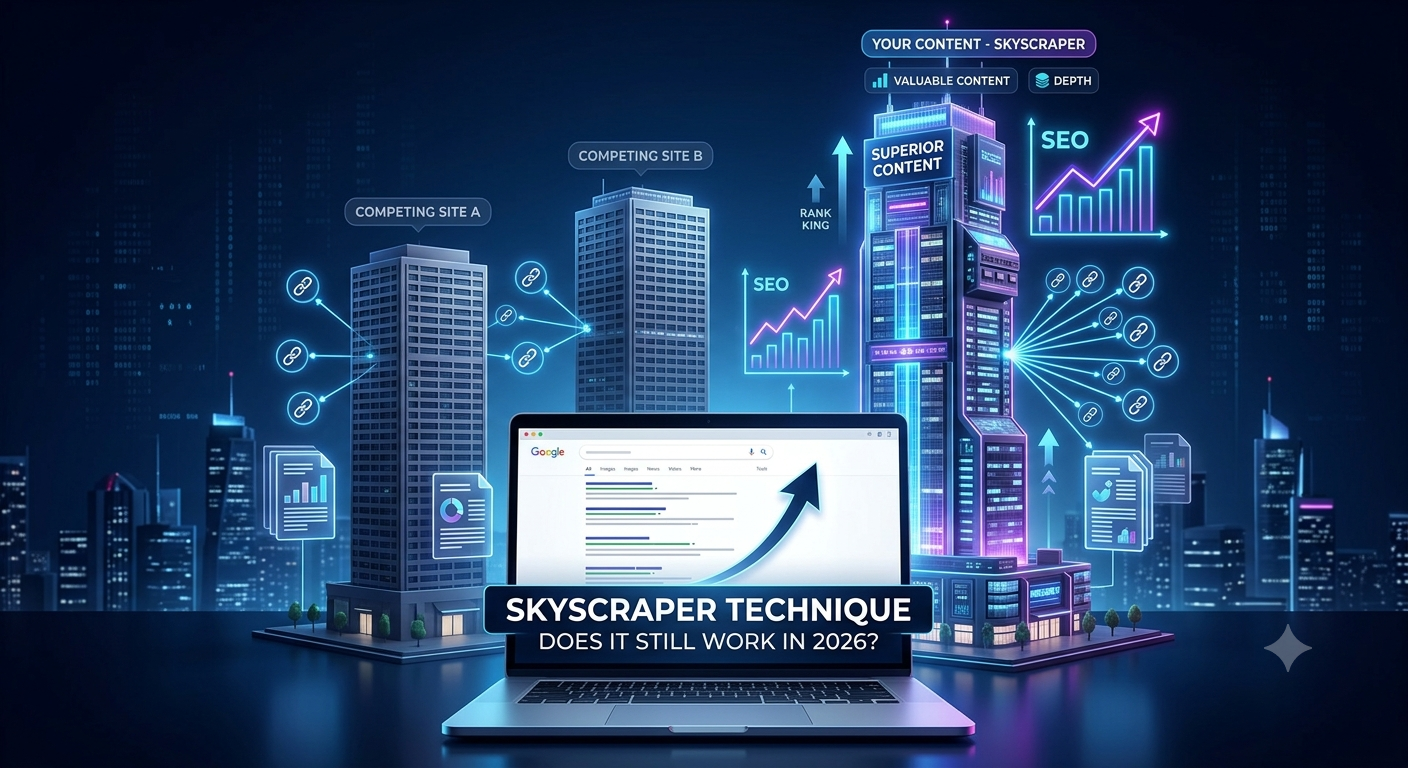
Getting a website to rank on Google is more difficult than simply publishing a good article. Thousands of websites compete for the same keywords, and search engines have become much better at understanding content quality, relevance, usefulness, and user intent.
One SEO strategy that has remained popular for years is the Skyscraper Technique.
The basic idea is simple: find content that already performs well, create something significantly better, and promote it to websites that may want to link to your improved resource.
But SEO has changed significantly.
Google now focuses heavily on helpful content, user experience, relevance, originality, and overall website quality. So does the Skyscraper Technique still work in 2026?
Yes—but not in its old, simplistic form.
The modern version requires more than making an article longer or adding more words. You need to create something genuinely more useful and give people a real reason to reference it.
Let’s explore how it works.
What Is the Skyscraper Technique?
The Skyscraper Technique is a content marketing and link-building strategy popularized by SEO practitioner Brian Dean.
The concept is based on a simple comparison.
Imagine there are several buildings in a city. If the tallest building gets the most attention, you could build something even taller to attract more attention.
In SEO, the “building” is a piece of content.
You:
- Find popular content in your niche.
- Analyze why it performs well.
- Create something substantially better.
- Promote your content to relevant websites and audiences.
- Try to earn backlinks and visibility.
The goal is not simply to copy existing content.
The goal is to create a stronger resource that provides additional value.
How Does the Skyscraper Technique Work?
The traditional process has three main stages.
Step 1: Find Successful Content
Start by identifying content that already performs well for your target topic.
Look for:
- Articles with many backlinks
- Frequently referenced resources
- Popular guides
- Comprehensive tutorials
- Content ranking on the first page
- Frequently shared resources
The purpose is to understand what people already find valuable.
You are not trying to copy the article. You are researching the competitive landscape.
Step 2: Make Something Better
This is the most important part.
Your article needs a meaningful improvement.
You could make it better by:
- Adding original research
- Including updated statistics
- Providing real examples
- Improving explanations
- Adding useful visuals
- Creating practical templates
- Covering missing questions
- Improving readability
- Updating outdated information
- Adding expert insights
Simply increasing an article from 1,500 words to 3,000 words does not automatically make it better.
Better beats longer.
Step 3: Promote Your Content
After publishing, you need to get the resource in front of the right people.
Potential promotion methods include:
- Email outreach
- Social media
- Industry communities
- Newsletter promotion
- Expert outreach
- Digital PR
- Resource-page outreach
The goal is to reach people who may genuinely find your content useful enough to reference.
Why Did the Skyscraper Technique Become Popular?
The technique became popular because it connects content creation with link building.
Backlinks remain an important part of SEO, although their value depends heavily on context, relevance, quality, and how naturally they are earned.
A useful resource can attract links because other publishers want to reference it.
For example, imagine you publish a detailed guide about website security.
Your guide contains:
- Original research
- Clear explanations
- Useful statistics
- Expert commentary
- Practical checklists
A cybersecurity blogger may link to your guide when discussing website security because it provides useful supporting information.
That is much more valuable than simply asking hundreds of unrelated websites for backlinks.
Does the Skyscraper Technique Still Work in 2026?
Yes, but the strategy needs to evolve.
The old approach was often interpreted as:
Find a long article → make yours longer → build backlinks.
That approach is no longer enough.
Modern SEO rewards content that satisfies search intent and provides genuine value.
A 5,000-word article will not automatically outrank a 1,500-word article if the shorter article answers the user’s question better.
The modern Skyscraper Technique should therefore focus on:
- Search intent
- Originality
- Accuracy
- Experience
- Relevance
- Useful examples
- Strong content structure
- Original insights
- Credible sources
- Helpful user experience
Why Longer Content Does Not Automatically Win
One of the biggest misconceptions about the Skyscraper Technique is that longer content is always better.
It isn’t.
Imagine someone searches:
“How to reset a Wi-Fi router.”
They probably want a simple step-by-step guide.
Giving them a 6,000-word article about the history of wireless networking would make the experience worse, not better.
Content should be as detailed as necessary—not as long as possible.
Before creating content, ask:
What does the searcher actually need?
Then provide it efficiently.
The Importance of Search Intent
Search intent is one of the most important factors when creating modern Skyscraper content.
Searchers usually have a specific goal.
They might want to:
- Learn something
- Compare products
- Find a solution
- Buy something
- Complete a task
- Research a topic
Your content should match that goal.
For example, if someone searches:
“best budget laptops 2026”
they probably want comparisons, specifications, prices, and recommendations.
A general article about laptop history would not satisfy the search intent.
Add Something Competitors Don’t Have
The strongest Skyscraper content has a unique reason to exist.
Before writing, examine competing pages and ask:
What is missing?
You might discover that competitors lack:
- Practical examples
- Updated data
- Original screenshots
- Expert quotes
- Case studies
- Downloadable resources
- Step-by-step instructions
- Comparison tables
- Real-world experience
These gaps give you opportunities.
Instead of simply rewriting existing information, fill the gaps.
Original Research Can Make Content More Linkable
Original research is particularly powerful.
For example, you could conduct:
- Customer surveys
- Industry surveys
- Small experiments
- Data analysis
- Product comparisons
- Original testing
Other websites may reference your research because they cannot find the same information elsewhere.
That gives your content a stronger reason to earn backlinks.
Use Data Carefully
Statistics can make content more useful, but outdated or poorly sourced data can hurt credibility.
When using statistics:
- Check the publication date.
- Prefer reliable sources.
- Verify the original source.
- Avoid unsupported claims.
- Explain what the data means.
Do not add statistics simply to make an article look authoritative.
Every fact should support the reader.
Make Your Content Easier to Use
A better article is not only more informative.
It is easier to consume.
Use:
- Short paragraphs
- Descriptive headings
- Bullet points
- Tables where appropriate
- Examples
- Clear explanations
- Useful summaries
Readers ought to be able to glance through the page and swiftly locate the information they’re looking for.
Build Links Naturally
Link building is often where the Skyscraper Technique becomes misunderstood.
You should not send thousands of identical emails asking websites to link to your article.
Instead, identify pages where your resource genuinely adds value.
For example, if a website already links to an outdated guide and your new resource provides updated information, you can politely explain why your resource may be useful.
A simple outreach message could say:
I noticed your article references an older resource about website security. We recently published an updated guide covering newer threats and practical security steps. It may be useful for your readers.
Keep outreach relevant and personalized.
Don’t Target Every Website
More backlinks do not automatically mean better SEO.
A relevant backlink from a respected website in your industry can be more valuable than many unrelated links.
Focus on websites that:
- Cover your topic
- Have a relevant audience
- Publish legitimate content
- Provide editorial value
- Would naturally benefit from your resource
Relevance matters.
Can AI Be Used for the Skyscraper Technique?
AI can help with research, organization, brainstorming, and editing.
For example, AI can help you:
- Generate content ideas
- Organize an outline
- Identify questions to cover
- Summarize research
- Improve readability
- Find potential content gaps
But simply asking AI to rewrite a competitor’s article is not a strong Skyscraper strategy.
The result may lack:
- Original experience
- Unique research
- Expert perspective
- Differentiation
- First-hand insights
Use AI as a productivity tool, not as a substitute for originality.
Common Skyscraper Technique Mistakes
Making Content Longer Instead of Better
Word count should support the topic, not become the goal.
Copying Competitors
Your content should provide new value rather than simply rearranging existing information.
Ignoring Search Intent
Even excellent information can fail if it doesn’t answer the user’s actual question.
Sending Mass Outreach Emails
Generic outreach can damage your reputation and waste time.
Chasing Low-Quality Backlinks
Focus on relevant, trustworthy opportunities.
Forgetting Existing Content
Before creating something new, check whether your own website already has an article that could be updated or expanded.
A Modern Skyscraper Technique Workflow
Here is a practical process you can use in 2026.
Step 1: Choose a Specific Topic
Pick a topic that has search demand and fits your website.
Step 2: Analyze the SERP
Study the pages currently ranking.
Look at:
- Content depth
- Search intent
- Topics covered
- Missing information
- User questions
- Content formats
Step 3: Find Content Gaps
Create a list of information competitors fail to explain well.
Step 4: Add Unique Value
Include original examples, research, data, visuals, or practical experience.
Step 5: Create a Better Resource
Build a clear, useful, well-structured article.
Step 6: Optimize for Search Intent
Make sure the page answers the main query directly.
Step 7: Promote It
Use relevant outreach, communities, social platforms, newsletters, and digital PR.
Step 8: Update It
Monitor the topic and refresh the article when information changes.
How Long Does It Take to See Results?
There is no guaranteed timeframe.
SEO results depend on:
- Competition
- Website authority
- Content quality
- Search intent
- Backlink profile
- Internal linking
- Topic demand
- Technical SEO
- Search engine changes
Some pages may gain visibility relatively quickly, while others can take months.
The Skyscraper Technique should be treated as a long-term SEO strategy rather than a guaranteed shortcut.
Is the Skyscraper Technique Right for Every Website?
Not necessarily.
It works best when your topic has:
- Existing competing content
- A clear audience
- Linkable resources
- Search demand
- Opportunities for improvement
For some topics, creating a useful product page, tool, calculator, original study, or simple answer may be more effective than writing a huge guide.
The best content strategy depends on the search intent and business goal.
Final Thoughts
The Skyscraper Technique is not dead in 2026.
The key difference now lies in the way you apply this strategy.
The old idea of simply making a competitor’s article longer is not enough. Modern Skyscraper content needs to be genuinely useful, accurate, original, relevant, and better suited to the searcher’s needs.
Instead of asking:
“How can I make this article longer?”
ask:
“How can I make this the most useful resource for this specific search?”
This shift in perspective is what truly amplifies the effectiveness of the approach.
Create something worth referencing, promote it to the right people, earn relevant links, and continue improving it over time. That is the modern version of the Skyscraper Technique.
FAQ’s
1. What is the Skyscraper Technique in SEO?
The Skyscraper Technique is a content and link-building strategy where you find successful content, create a substantially better resource, and promote it to relevant websites and audiences in the hope of earning backlinks and visibility.
2. Does the Skyscraper Technique still work in 2026?
Yes, but simply making content longer is not enough. The modern approach focuses on search intent, originality, useful information, credible sources, practical experience, and genuine content improvements.
3. Is the Skyscraper Technique only about backlinks?
No. Backlinks are an important part of the traditional strategy, but high-quality Skyscraper content can also improve topical authority, visibility, user engagement, and brand awareness.
4. How can I make Skyscraper content better than competitors?
Look for gaps in competing content and add something genuinely useful, such as original research, expert insights, updated information, practical examples, better explanations, useful visuals, or downloadable resources.
Can AI help with the Skyscraper Technique?
Yes. AI can help with research, outlining, brainstorming, and editing, but your final content should contain original value and should not simply rewrite or copy competitors’ content.