

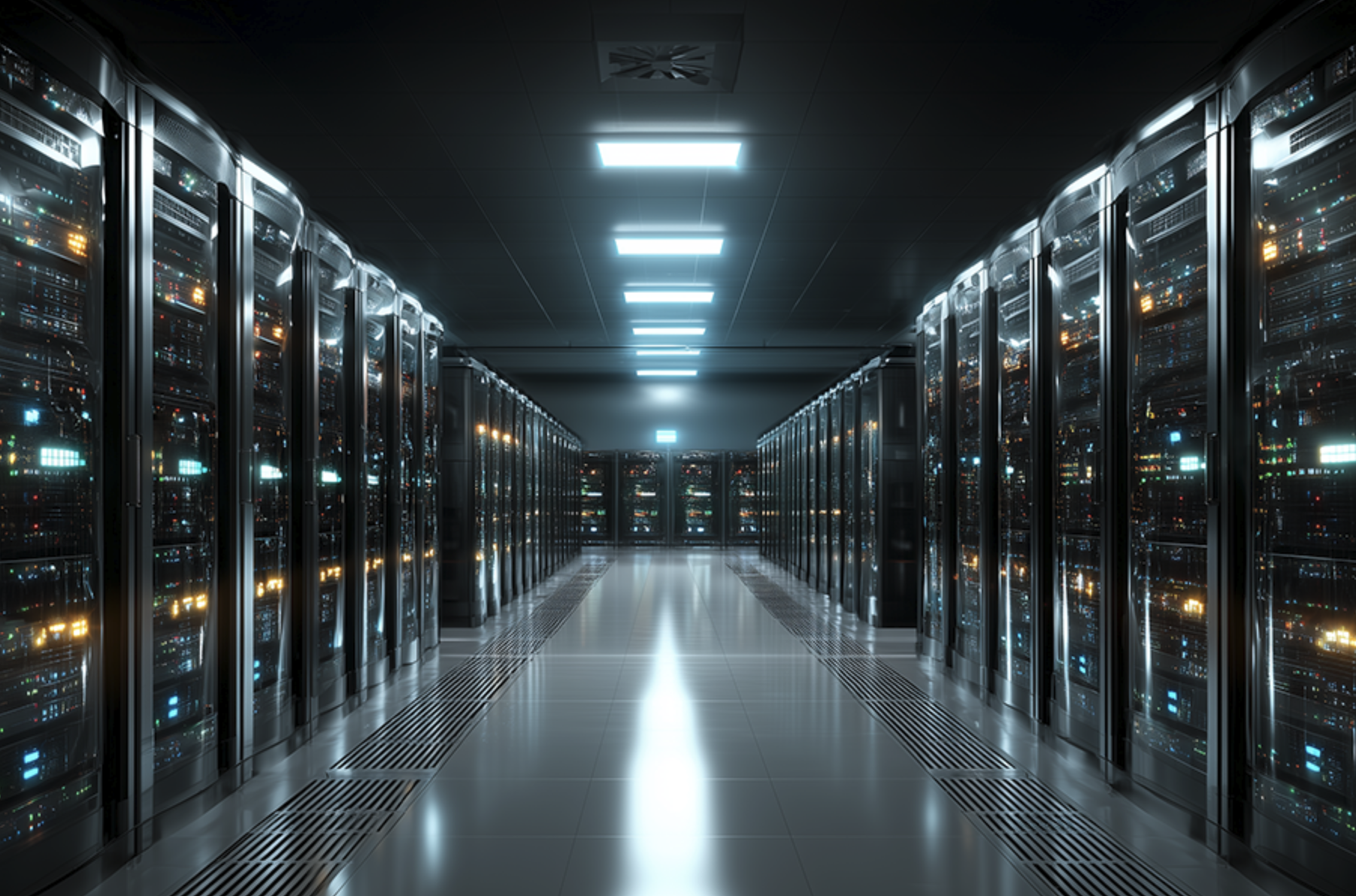
Every time you send a message, stream a video, upload a photo, visit a website, or save a file online, a huge amount of technology may be working behind the scenes.
You might imagine your data simply floating somewhere in the cloud. In reality, the “cloud” is made up of physical computers, storage systems, networking equipment, power infrastructure, and buildings.
These facilities are called data centers.
A data center is a specialized facility designed to house computer systems and the infrastructure needed to keep those systems running reliably. Companies use data centers to operate websites, applications, databases, cloud services, online stores, streaming platforms, artificial intelligence systems, and countless other digital services.
But how does a data center actually work?
In this guide, you’ll learn what a data center is, what equipment it contains, how information moves through it, how these facilities stay powered and cool, and why they are so important to the modern internet.
What Is a Data Center?
A data center is a physical facility that contains computing, storage, networking, power, cooling, and security systems used to operate digital services and store or process data.
A small data center might support one organization, while a large facility can contain thousands of servers and sophisticated infrastructure.
Data centers can be operated by:
- Cloud computing companies
- Internet service providers
- Technology companies
- Banks
- Governments
- Universities
- Telecommunications companies
- Hosting providers
- Large enterprises
Some businesses operate their own facilities, while others rent space or computing resources from specialized data center providers.
The basic purpose remains the same: keep computing systems available, secure, connected, and operational.
Why Are Data Centers Important?
Modern digital services depend heavily on data center infrastructure.
When you use an online service, the processing and storage may happen in one or more data centers.
For example, when you watch an online video, the service needs computers and storage systems to deliver that content to your device.
When you use online banking, servers process transactions and databases store information.
When you use cloud storage, your files are stored on physical storage systems inside data center facilities.
Data centers therefore support much of the digital economy.
Without them, many of the services people use every day would not function.
What Equipment Is Inside a Data Center?
A data center contains much more than computers.
Several major systems work together.
Servers
Servers are powerful computers designed to provide services or process information for other devices.
A server might:
- Host a website
- Run an application
- Process transactions
- Store databases
- Handle authentication
- Process AI workloads
- Deliver files
Large data centers may contain thousands of servers.
Storage Systems
Data centers require large amounts of storage.
Storage can include:
- Solid-state drives
- Hard disk drives
- Storage arrays
- Backup systems
- Distributed storage systems
Different types of storage are used depending on performance, capacity, reliability, and cost requirements.
Networking Equipment
Servers need to communicate with each other and with users.
Data centers therefore contain networking equipment such as:
- Switches
- Routers
- Firewalls
- Load balancers
- Network cables
- Fiber-optic connections
These systems move data between servers and external networks.
Racks
Servers and networking equipment are commonly installed inside standardized racks.
A rack allows equipment to be organized efficiently while making it easier for technicians to access and maintain hardware.
How Does a Data Center Work?
The basic process can be easier to understand through an example.
Imagine that you open a website on your phone.
Your request travels through the internet to the infrastructure hosting that website.
A data center may receive the request through its network infrastructure.
The appropriate server processes the request.
The server may retrieve information from a database or storage system.
The result is then sent back through the network to your device.
A simplified process looks like this:
Your device → Internet → Data center network → Server → Storage/database → Server → Internet → Your device
Modern systems can be much more complicated, but this basic model shows how different components work together.
How Do Data Centers Stay Powered?
Electricity is one of the most important parts of data center operations.
Servers and networking equipment need continuous power, and even a short interruption can cause problems.
For this reason, data centers commonly use multiple layers of power protection.
Utility Power
The facility normally receives electricity from the local power grid.
Some facilities may have connections designed to improve resilience.
Uninterruptible Power Supplies
UPS systems provide temporary backup power when the main electrical supply is interrupted.
They can help keep equipment running while backup generators start or until another power source becomes available.
Backup Generators
Many data centers have generators that can provide electricity during longer power outages.
Fuel storage and generator maintenance are important parts of the overall backup system.
Redundant Power Systems
Critical facilities may have multiple power paths so that the failure of one component doesn’t necessarily bring down the entire system.
The exact design depends on the facility’s reliability requirements.
How Do Data Centers Stay Cool?
Computers produce heat while operating.
A large data center can generate an enormous amount of heat, so cooling is essential.
Without appropriate cooling, equipment can overheat and become damaged or automatically shut down.
Traditional data centers often use air-based cooling systems.
Cold air is delivered to equipment, while warmer air is collected and removed.
Many facilities arrange server racks in specific configurations to improve airflow.
Liquid Cooling
As computing becomes more demanding, particularly with AI and high-performance computing, some data centers are increasingly using liquid cooling technologies.
Liquid can transfer heat more efficiently than air in certain applications.
Different approaches include direct-to-chip cooling and other specialized systems.
Cooling technology continues to evolve as server power densities increase.
What Is Data Center Networking?
Networking allows computers inside the facility to communicate with one another and with external users.
A data center may contain multiple layers of networking infrastructure.
Switches connect devices within networks.
Routers help move traffic between different networks.
Firewalls can help control and filter network traffic.
Load balancers can distribute requests across multiple servers.
This distribution is important because a popular website may receive thousands or millions of requests.
Instead of sending every request to one server, the system can distribute the workload across many servers.
How Is Data Stored in a Data Center?
Data can be stored in many different ways.
A basic system might store information on local drives inside a server.
Larger environments often use centralized or distributed storage systems.
Distributed storage can spread information across multiple physical devices or locations.
This approach can improve:
- Reliability
- Availability
- Scalability
- Performance
Data may also be copied across multiple systems to protect against hardware failures.
For important information, organizations commonly maintain backups and recovery systems.
How Are Data Centers Protected?
Data center security involves both physical and digital protection.
Physical Security
Facilities may use:
- Security cameras
- Access cards
- Biometric authentication
- Security personnel
- Locked server areas
- Perimeter controls
- Visitor management systems
Access is typically restricted to authorized personnel.
Cybersecurity
The computing systems themselves also need protection.
Organizations may use:
- Firewalls
- Encryption
- Intrusion detection
- Access controls
- Network segmentation
- Security monitoring
- Authentication systems
Security practices vary depending on the type of data and services being hosted.
What Is Redundancy in a Data Center?
Redundancy means having backup components or systems available so that one failure doesn’t necessarily interrupt the service.
For example, a facility might have multiple:
- Power supplies
- Cooling systems
- Network connections
- Servers
- Storage devices
- Internet connections
If one component fails, another can continue operating.
Redundancy is especially important for services that need high availability.
The goal isn’t simply to prevent every failure. Hardware will eventually fail.
The goal is to design the environment so that individual failures don’t automatically become major outages.
What Are Data Center Tiers?
You may have heard data centers described using “Tier” classifications.
The Uptime Institute’s Tier Classification System is one commonly referenced framework for data center infrastructure.
It ranges from Tier I through Tier IV, with increasing levels of infrastructure redundancy and fault tolerance.
In simple terms:
- Tier I: Basic infrastructure
- Tier II: Some redundant capacity components
- Tier III: More maintainable and redundant infrastructure
- Tier IV: Highly fault-tolerant infrastructure
These classifications relate primarily to infrastructure design and availability characteristics.
A higher tier doesn’t automatically mean a facility is better for every business. The appropriate design depends on the organization’s requirements and budget.
What Is a Cloud Data Center?
A cloud data center is a facility used to provide cloud computing services.
Cloud providers operate large data center infrastructures containing computing, storage, networking, and other resources.
Instead of purchasing physical servers, customers can rent computing resources through cloud platforms.
Examples of cloud services include:
- Virtual machines
- Cloud storage
- Databases
- Container platforms
- AI computing
- Networking services
From the customer’s perspective, the infrastructure can feel virtual.
Behind the scenes, however, physical servers and networking equipment make those services possible.
Data Centers and Artificial Intelligence
Artificial intelligence is increasing demand for powerful computing infrastructure.
Modern AI systems can require large numbers of high-performance processors and accelerators.
These systems generate significant amounts of heat and consume substantial amounts of electricity.
As AI workloads grow, data centers are adapting with:
- High-density computing
- Advanced cooling
- Specialized processors
- High-speed networking
- Larger power systems
- Advanced storage
This is one reason data center design is becoming increasingly important to the development of modern AI services.
Are Data Centers Environmentally Friendly?
Data centers require significant amounts of electricity and water in some cooling systems.
Their environmental impact therefore depends on factors such as:
- Energy source
- Facility efficiency
- Cooling technology
- Hardware utilization
- Water usage
- Location
Some operators are investing in renewable electricity, more efficient servers, advanced cooling systems, and improved power management to reduce environmental impact.
However, there is no single solution.
As demand for cloud computing and AI grows, improving data center efficiency will remain an important challenge.
What Happens When a Data Center Goes Down?
If a major data center experiences an outage, online services hosted there can become unavailable.
The consequences depend on how the service is designed.
A simple application hosted entirely in one location may go offline.
A more resilient service might automatically redirect users to another facility or region.
This is why organizations with critical applications often use:
- Multiple data centers
- Geographic redundancy
- Backups
- Disaster recovery systems
- Automated failover
Good infrastructure planning assumes that failures can happen and prepares for them.
Why Are Data Centers Often Built in Specific Locations?
Location matters.
Operators consider factors such as:
- Access to electricity
- Network connectivity
- Land availability
- Climate
- Natural disaster risks
- Water availability
- Government regulations
- Proximity to users
A facility located closer to users can potentially reduce network latency.
However, large cloud providers often operate facilities across multiple geographic regions to provide resilience and serve customers around the world.
Data Center vs Server Room
A server room and a data center are not necessarily the same thing.
A small business might have a server room containing a handful of servers and networking equipment.
A data center is typically designed around specialized infrastructure, reliability, security, cooling, power, and connectivity requirements.
The scale can vary dramatically.
A small data center might support a specific organization, while a hyperscale facility operated by a major technology company can contain enormous amounts of computing infrastructure.
The Future of Data Centers
Data centers will become even more important as the world relies increasingly on digital services.
Several trends are shaping their future.
Artificial Intelligence
AI workloads require high-performance computing and advanced cooling.
Renewable Energy
Operators are exploring ways to power facilities with lower-carbon electricity.
Advanced Cooling
New cooling technologies are being developed to handle increasingly powerful processors.
Edge Computing
Some computing resources are moving closer to users and connected devices to reduce latency.
Automation
Software can increasingly monitor infrastructure, predict equipment problems, and optimize energy use.
These developments are changing what modern data centers look like and how they operate.
Final Thoughts
A data center is essentially the physical foundation behind many of the digital services you use every day.
When you stream a video, save a file in the cloud, visit a website, use an online banking service, or interact with an AI application, the work may depend on servers and infrastructure inside one or more data centers.
These facilities combine servers, storage, networking, power, cooling, physical security, and cybersecurity into carefully designed environments.
The most impressive part isn’t any individual server. It’s the way thousands of components can work together while backup systems, monitoring tools, networking equipment, and cooling infrastructure keep everything operating.
As cloud computing, AI, streaming, online services, and connected devices continue to grow, data centers will become even more important.
The next time you hear someone say that their files or applications are “in the cloud,” remember that the cloud isn’t somewhere mysterious. It ultimately depends on physical machines operating inside real facilities around the world.
Frequently Asked Questions
1. What is a data center in simple terms?
A data center is a specialized facility that houses servers, storage systems, networking equipment, power systems, cooling infrastructure, and security systems used to operate digital services.
2. What is inside a data center?
A data center can contain servers, storage systems, network switches, routers, firewalls, power equipment, cooling systems, backup generators, racks, monitoring systems, and security infrastructure.
3. How does a data center work?
A data center receives and processes digital requests through its network infrastructure. Servers perform computing tasks, storage systems hold data, and networking equipment transfers information between systems and users.
4. Why do data centers need so much cooling?
Servers and other electronic equipment produce heat while operating. Cooling systems remove that heat and maintain appropriate operating conditions so equipment can continue working reliably.
5. Are data centers the same as the cloud?
No. Cloud computing is a way of delivering computing resources and services over a network. Physical data centers contain the servers, storage, and networking infrastructure that make many cloud services possible.
6. Why are data centers important?
Data centers provide the physical infrastructure behind websites, cloud platforms, online applications, streaming services, databases, artificial intelligence systems, and many other digital services used every day.