

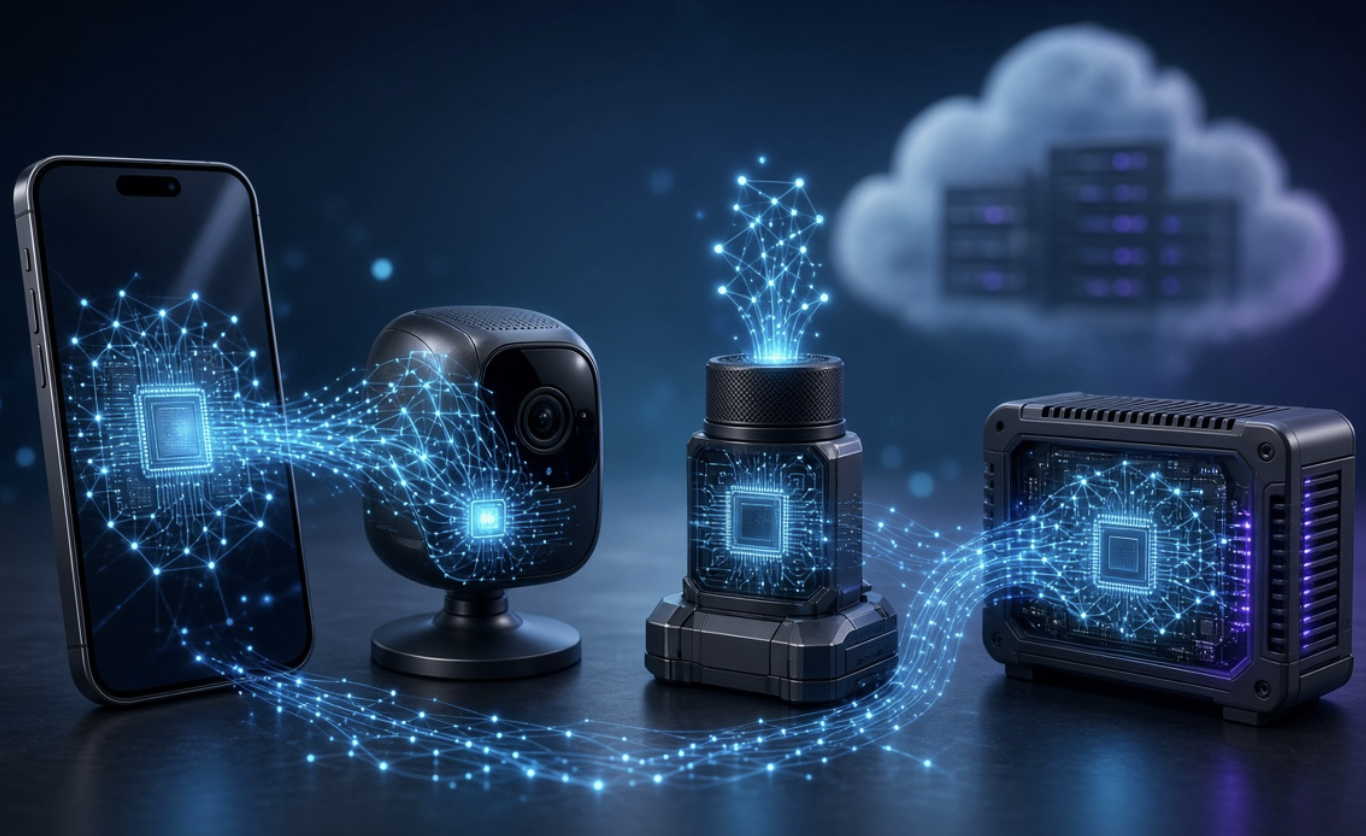
When a Tesla camera spots a pedestrian half a second before a human driver would react, the decision isn’t made in a data center hundreds of miles away it happens on a chip inside the car. That split-second inference is edge AI in action: a machine learning model running directly on a phone, a security camera, a factory sensor, or a car, rather than sending data to the cloud and waiting for a response.
Apple’s Neural Engine inside every iPhone, Google’s Coral development boards, and NVIDIA’s Jetson modules have turned what used to be a research curiosity into a mainstream engineering choice, and it’s reshaping how companies think about latency, privacy, and cost.
How Edge AI Works
Edge AI takes a trained machine learning model, typically built and trained in the cloud using massive datasets and powerful GPUs, and compresses it so it can run on a much smaller, less powerful chip located physically close to where data is generated. The training phase still happens centrally, but inference the act of applying the model to new data and producing a prediction happens locally, on the device itself.
This requires a pipeline of optimization steps that shrink a model without destroying its accuracy. Techniques like quantization (reducing the precision of numbers the model uses, from 32-bit floating point down to 8-bit integers), pruning (removing neural network connections that contribute little to the output), and knowledge distillation (training a smaller “student” model to mimic a larger “teacher” model) are standard tools in this process. Frameworks such as TensorFlow Lite, PyTorch Mobile, and ONNX Runtime exist specifically to convert cloud-trained models into edge-friendly formats.
The hardware side matters just as much as the software. Specialized chips called neural processing units (NPUs) or AI accelerators are purpose-built to execute the matrix multiplications that neural networks depend on, far more efficiently than a general-purpose CPU could manage. Several categories of hardware now dominate this space:
- Mobile NPUs: Apple’s Neural Engine and Qualcomm’s Hexagon processor handle on-device tasks like Face ID, photo processing, and voice recognition inside smartphones.
- Dedicated edge boards: Google Coral and NVIDIA Jetson Nano/Orin modules are built for developers embedding AI into robots, cameras, and industrial equipment.
- Microcontroller AI: Arm Cortex-M chips running TinyML models can run tiny models on devices as small as a wearable sensor, using milliwatts of power.
- Edge servers: Local gateways or on-premises servers process AI workloads for an entire factory floor or retail store without touching the public internet.
Once deployed, the model receives a live input a camera frame, a microphone signal, a sensor reading and produces an output in milliseconds, without a round trip to any remote server.
Benefits of Running Models Locally
The appeal of edge AI comes down to a few concrete advantages that cloud-only inference simply cannot match. Latency is the most obvious one: a self-driving car cannot afford the 100-plus milliseconds a round trip to a cloud server might add when deciding whether to brake. Local inference cuts that delay to single-digit milliseconds.
Privacy is another major driver. When a smart speaker or health wearable processes voice or biometric data on-device, that sensitive information never has to leave the hardware, which reduces exposure to breaches and simplifies compliance with regulations like GDPR and HIPAA.
Several other benefits push adoption forward:
- Reduced bandwidth costs: A factory with hundreds of cameras doesn’t need to stream raw video to the cloud continuously; only relevant events or metadata get transmitted.
- Offline reliability: Devices keep functioning even when internet connectivity drops, which matters for agriculture sensors, remote industrial sites, or in-flight systems.
- Lower cloud compute bills: Running inference locally avoids per-query charges from cloud AI providers, which can add up fast at scale.
- Improved responsiveness: Real-time applications like augmented reality filters or voice assistants feel instant rather than laggy.
- Energy efficiency at scale: Purpose-built NPUs often consume far less power per inference than routing the same task through a data center GPU.
Together, these advantages explain why companies from Amazon (Alexa’s on-device wake-word detection) to John Deere (crop and weed detection in tractors) have pushed AI workloads out to the edge rather than keeping everything centralized.
Trade-offs and Limits of On-Device Inference
Edge AI isn’t a free upgrade it comes with real constraints that engineering teams have to navigate carefully. The most fundamental limitation is compute power. Edge devices, by definition, have far less processing capability than a cloud GPU cluster, which means models must be simplified, and simpler models can lose accuracy compared to their full-sized cloud counterparts.
Memory and storage are equally constrained. A large language model with billions of parameters simply cannot fit on a smartphone or a microcontroller without aggressive compression, and even compressed versions may need gigabytes of space that budget devices don’t have.
Other trade-offs worth weighing before committing to an edge deployment include:
- Update complexity: Pushing a new model version to thousands of distributed devices is harder than updating a single cloud endpoint, and some devices may never receive updates at all.
- Fragmented hardware: Different chips (Apple Neural Engine, Qualcomm Hexagon, Google Edge TPU) require different optimization toolchains, multiplying engineering effort.
- Battery drain: Continuous inference on a mobile or wearable device can shorten battery life if not carefully managed.
- Thermal limits: Sustained AI workloads generate heat, which can throttle performance on fanless devices.
- Debugging difficulty: Diagnosing a model failure on a device in the field is harder than inspecting logs from a centralized cloud service.
There’s also an accuracy-versus-efficiency tension baked into every edge deployment. Teams often have to accept a small drop in precision to hit the latency, memory, and power targets a device demands. For safety-critical systems like autonomous vehicles, that trade-off requires extensive testing to confirm the compressed model still performs reliably across edge cases, not just average conditions.
Vendor and toolchain fragmentation compounds these constraints further. A model optimized for Apple’s Core ML runtime won’t run directly on a Qualcomm Hexagon chip, and one tuned for NVIDIA’s Jetson platform needs separate work to run efficiently on a Google Coral board. Teams targeting multiple hardware platforms often end up maintaining several parallel optimization pipelines, which adds real engineering overhead that a cloud-only deployment simply never has to deal with.
Comparing Edge AI Hardware Options
Choosing hardware for an edge AI project depends heavily on the use case, budget, and required performance. NVIDIA’s Jetson line (Nano, Orin, and Xavier variants) targets robotics and industrial applications that need serious GPU-class compute in a compact form factor, and it comes with strong software support through NVIDIA’s JetPack SDK. Google Coral, built around Google’s Edge TPU, is popular for lightweight computer vision tasks and prototyping, offering a lower price point but less raw power than Jetson boards.
Apple’s Neural Engine, embedded in every modern iPhone and iPad, is not sold as standalone hardware but is deeply integrated with Core ML, making it the default choice for any developer building AI features into an iOS app. Qualcomm’s Snapdragon chips, with their Hexagon NPU, play a similar role across the Android ecosystem and are widely used in AI-enabled smartphones and AR/VR headsets.
For extremely constrained environments, Arm Cortex-M microcontrollers running TinyML frameworks like TensorFlow Lite for Microcontrollers can run tiny classification models keyword spotting, simple gesture recognition using a fraction of a watt, which makes them suitable for battery-powered sensors that need to last years on a single charge.
Cloud providers have entered this space too. AWS offers Panorama and Greengrass for edge AI deployment, while Microsoft’s Azure Percept and Azure IoT Edge extend cloud AI tooling to on-premises hardware, letting teams train in the cloud and deploy at the edge without switching ecosystems entirely. The right choice usually comes down to how much compute the task demands, how tightly the deployment needs to integrate with an existing cloud platform, and how much control the team wants over the underlying silicon.
Common Mistakes in Edge AI Deployment
Teams new to edge AI tend to repeat the same set of avoidable errors. The most frequent one is treating model compression as an afterthought rather than a core design decision building and training a model in the cloud first, then discovering too late that it simply won’t fit or run fast enough on the target hardware.
Underestimating the diversity of real-world conditions is another common trap. A vision model trained on well-lit, high-resolution lab images can fail badly on a low-quality camera in poor lighting on a factory floor, and teams that skip field testing often find this out only after deployment.
A few other mistakes show up repeatedly across edge AI projects:
- Ignoring the update pipeline: Deploying a model without a plan for monitoring drift or pushing corrections leaves devices running stale, degrading models indefinitely.
- Overlooking power budgets: Selecting hardware based on compute specs alone, without checking whether the target device can sustain that power draw.
- Skipping edge-specific testing: Validating a model only in a simulator or on developer hardware, never on the actual production device.
- Neglecting security: Assuming a device is “just running a model” and skipping encryption or secure boot, leaving it vulnerable to tampering or model theft.
- Over-engineering for scale: Building complex fleet-management infrastructure for a pilot project of ten devices, when a simpler manual process would suffice at that stage.
Cross-functional friction is a subtler but common issue too. Data scientists optimize for accuracy, while embedded engineers optimize for memory and power, and without close collaboration between the two groups, projects can stall in a loop of retraining and re-testing that never converges on a shippable model.
Real-World Applications Across Industries
Edge AI has moved well past smartphones and into nearly every sector that generates data at the point of action. In manufacturing, companies use camera-equipped edge devices for real-time defect detection on assembly lines, catching flaws that a human inspector might miss, without sending every frame of video to the cloud. In agriculture, John Deere’s See and Spray technology uses onboard cameras and edge inference to distinguish crops from weeds and apply herbicide only where needed, cutting chemical use.
Retailers use edge AI for shelf-monitoring cameras that detect out-of-stock items and checkout systems that recognize products without barcodes. In healthcare, wearable devices and portable diagnostic tools run models locally to flag irregular heart rhythms or fall risks, sending alerts without exposing raw patient data to third-party servers.
A few standout categories illustrate the breadth of adoption:
- Autonomous vehicles: Tesla and Waymo rely on onboard chips for split-second object detection and path planning.
- Smart home devices: Amazon Echo and Google Nest process wake-word detection locally before streaming audio to the cloud.
- Industrial IoT: Siemens and Bosch deploy edge AI for predictive maintenance, catching equipment failures before they cause downtime.
- Security and surveillance: Camera systems from companies like Axis Communications run person and vehicle detection directly on the camera hardware.
- Wearables and hearables: Devices from Oura and Bose use on-device processing for health metrics and adaptive noise cancellation.
The common thread across every example is the same: edge AI shows up wherever a decision needs to happen faster, more privately, or more reliably than a cloud round trip allows.
Practical Guidance for an Edge AI Strategy
Teams evaluating edge AI for the first time should start by asking whether the use case requires local inference, rather than defaulting to it because it’s trendy. If latency tolerance is measured in seconds and connectivity is reliable, cloud inference may still be the simpler and cheaper path.
Once a real need is established, prototype early on the actual target hardware rather than a developer workstation, since performance characteristics on constrained chips rarely match expectations set on a laptop GPU. Building a small pilot with a handful of devices before committing to a fleet-wide rollout also surfaces problems connectivity gaps, thermal issues, update failures while the cost of fixing them is still low.
A practical rollout plan typically includes these steps:
- Define hard constraints first: Latency budget, power envelope, memory ceiling, and cost per unit should shape model selection from day one.
- Choose a toolchain aligned with the hardware: Core ML for Apple devices, TensorFlow Lite or ONNX Runtime for cross-platform deployment.
- Build a monitoring plan: Track model performance in the field, not just accuracy metrics from the training set.
- Design for over-the-air updates: Assume models will need retraining and redeployment as conditions change.
- Budget for edge-specific testing: Field conditions rarely match lab conditions, so allocate time for real-world validation.
Finally, treat edge AI as a systems engineering problem, not just a machine learning problem. Success depends as much on hardware selection, power management, and deployment logistics as it does on model architecture, and teams that staff for all three disciplines tend to ship far more reliable products than those who treat it purely as a data science exercise.
Final Thoughts
Edge AI has shifted from a niche engineering trick to a default architectural choice for any application that depends on speed, privacy, or reliability at the point of data generation. The hardware ecosystem, spanning Apple’s Neural Engine, Google Coral, NVIDIA Jetson, and countless microcontrollers, has matured to the point where deploying a compressed, capable model on a small device is a well-supported and increasingly routine engineering task.
The trade-offs reduced accuracy, fragmented tooling, harder updates are real, but they’re manageable with careful planning. For any team building products that need to react instantly, work offline, or keep sensitive data local, edge AI isn’t a future consideration; it’s already the standard.
Frequently Asked Questions
1. Does edge AI replace cloud AI entirely?
No. Most production systems use a hybrid approach, running lightweight inference at the edge for time-sensitive decisions while sending aggregated data to the cloud for retraining, analytics, and heavier processing. The edge and the cloud typically complement each other rather than compete.
2. How much does edge AI hardware cost?
Costs vary widely, from a few dollars for a microcontroller running a TinyML model to several hundred dollars for an NVIDIA Jetson Orin module. The right budget depends entirely on the compute demands of the task and the volume of devices being deployed.
3. Can edge AI models be updated after deployment?
Yes, most systems support over-the-air updates, similar to how smartphone apps get patched. The challenge is coordinating updates across potentially thousands of distributed devices, some of which may have unreliable connectivity or limited storage for new model versions.
4. Is edge AI more secure than cloud AI?
It can reduce certain risks, since sensitive data never leaves the device, but it introduces new ones, including the risk of physical tampering or model extraction from an unsecured device. Security has to be designed in at both the hardware and software layers.
5. What programming skills does edge AI development require?
Teams typically need machine learning expertise for model training, plus embedded systems or mobile development skills for deployment. Frameworks like TensorFlow Lite and Core ML lower the barrier, but production-grade edge AI still benefits from close collaboration between data scientists and hardware engineers.
6. Which industries are adopting edge AI fastest?
Manufacturing, automotive, retail, and healthcare currently show the strongest adoption, driven by clear latency and privacy requirements. Consumer electronics, especially smartphones and wearables, remain the largest deployment surface by device count.