


There’s a frustrating pattern that a lot of website owners run into. They publish blog post after blog post, each one targeting a different keyword, each one sitting in isolation, and after six months of effort, they’re still stuck on page three of Google. Traffic barely moves. The articles don’t seem to talk to each other. And the site as a whole just doesn’t feel authoritative to search engines, even if the individual posts are well-written.
Sound familiar?
The problem usually isn’t the quality of the writing. It’s the structure. More specifically, it’s the absence of a content cluster strategy.
Content clusters are one of the most effective frameworks in modern SEO, not because they’re a clever trick, but because they reflect how people actually search and how Google actually evaluates websites. Once you understand the logic behind them, a lot of the confusion around why some sites rank faster than others starts to make sense.
The Old Way of Thinking About Content (And Why It Broke Down)
For years, content strategy was simple: pick a keyword, write an article targeting that keyword, repeat. Every post was its own island. If you wanted to rank for twenty different terms, you wrote twenty disconnected articles.
This worked reasonably well when Google’s algorithm was less sophisticated. Keywords matched to queries, and the more content you had, the more chances you had to rank. But Google has gotten dramatically better at understanding topics, context, and relationships between pages. It doesn’t just look at whether your page contains a keyword, it tries to understand whether your site genuinely knows what it’s talking about.
That shift is exactly where content clusters come in.
What Is a Content Cluster?
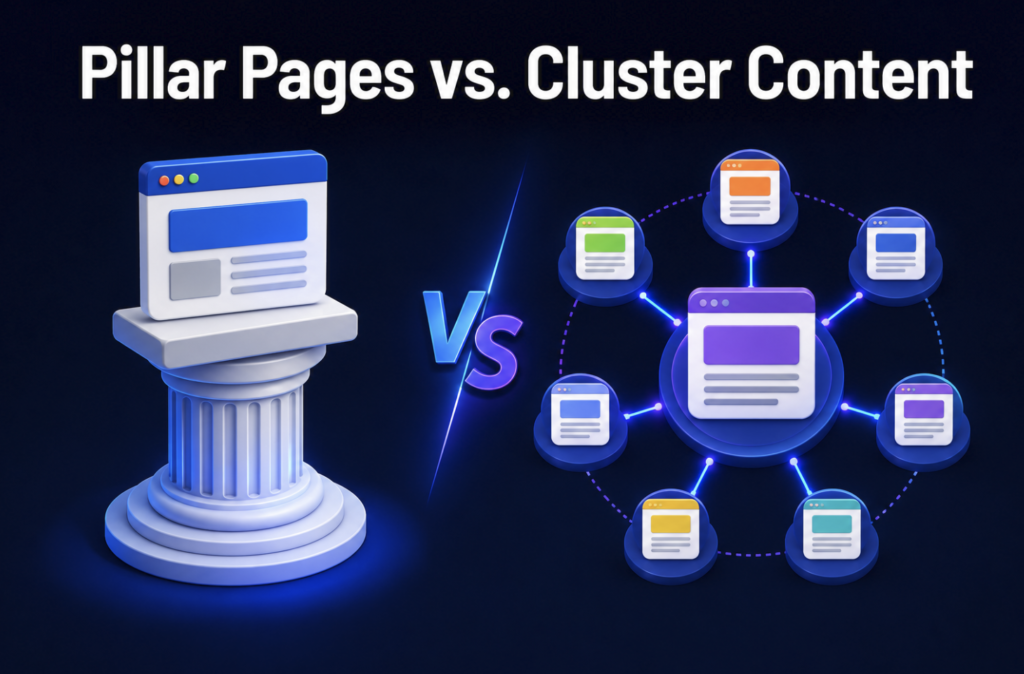
A content cluster is a group of interlinked content pieces that all revolve around a single, broad topic. Instead of writing twenty unrelated articles, you write one comprehensive piece on the main topic (called a pillar page) and then create multiple supporting articles (called cluster content) that each explore a specific subtopic in depth. Every cluster article links back to the pillar, and the pillar links out to the cluster articles.
Think of it like a wheel. The pillar page is the hub. The cluster articles are the spokes.
For example, imagine a company that sells project management software. Instead of writing scattered posts like “how to run a standup meeting” and “what is agile methodology” and “tips for remote teams” with no connection between them, they’d build a cluster around “project management” as the central topic. The pillar page gives a thorough overview of project management, what it is, why it matters, the major approaches. Then cluster articles dive into specific angles: agile methodology in depth, how to run standups, tools for remote teams, how to create a project timeline, and so on. Each of those supporting articles is internally linked to the pillar.
This structure tells Google something important: this website has serious, organized depth on the topic of project management. It’s not just a collection of loosely related posts, it’s a resource.
Why This Approach Works So Well for SEO
There are a few mechanics at play here, and it’s worth understanding each one clearly.
Topical authority is the big one. Google has been moving toward rewarding sites that demonstrate comprehensive expertise on a subject rather than sites that just happen to contain a keyword somewhere on a page. When you build a content cluster, you’re essentially proving to Google that your site covers a topic from multiple angles, at multiple levels of depth. That builds what’s called topical authority, and once you have it, ranking for new articles within that topic becomes significantly easier because Google already trusts you on the subject.
Internal linking distributes ranking signals. Every time one of your cluster articles gets a backlink from another site, that link equity flows through your internal link structure. Because your cluster articles link to the pillar, and the pillar links back to them, the authority gets distributed across the whole cluster rather than sitting in one isolated page. The rising tide lifts all boats.
It matches how people actually search. Nobody searches for just one thing. Someone exploring a topic like “home brewing beer” might start with “how to brew beer at home,” then search “what equipment do I need,” then “best yeast for IPAs,” then “how long does fermentation take.” If your content cluster covers all of those angles and they’re well-connected, you have a chance to capture that person at multiple stages of their search journey, and Google notices when users keep ending up on your site throughout a research process.
You avoid keyword cannibalization. One underappreciated benefit of clusters is that they force you to think clearly about which article should own which keyword. Without a cluster structure, it’s easy to accidentally write two articles targeting the same search intent, which confuses Google about which page to rank. A cluster model gives every piece a distinct purpose.
Pillar Pages vs. Cluster Content: Understanding the Difference
The distinction matters more than people realize.
A pillar page is meant to be comprehensive but not exhaustive. It should cover the full scope of a topic, every major question someone new to the subject might have, but it doesn’t need to go six thousand words deep on each subtopic. Its job is to serve as the authoritative hub that establishes the full picture. A good pillar page is typically long (often 3,000 to 5,000 words or more, depending on the topic), well-organized, and written with the assumption that someone might be encountering the topic for the first time.
Cluster content, on the other hand, is where you go deep. Each cluster article picks one narrow slice of the broader topic and covers it thoroughly, the kind of depth that would actually satisfy someone who specifically searched for that subtopic. These articles can vary in length depending on complexity, but the key is that they each serve a distinct search intent.
Here’s a real-world scenario that illustrates this well. Say you run a nutrition coaching website and you want to build a cluster around “intermittent fasting.” Your pillar page covers everything at a high level: what intermittent fasting is, the main protocols (16:8, 5:2, OMAD), who it’s for, what the research says, common questions. Then your cluster articles might include: a detailed breakdown of the 16:8 method, a guide to intermittent fasting for women specifically, a piece on combining fasting with exercise, one on common mistakes beginners make, another on what breaks a fast, and one on fasting and blood sugar for people with diabetes concerns. Each of those articles links back to the pillar. The pillar links to each of them.
Someone searching “does coffee break a fast” finds your cluster article, gets a detailed answer, sees a link to your comprehensive pillar on intermittent fasting, and suddenly they’re reading two or three pages on your site instead of one. That’s the behavior Google interprets as a quality signal.
How to Build a Content Cluster: A Practical Walkthrough
Step: 1
Choose your core topic. This should be a broad subject that’s central to your business or website purpose, something with enough depth to support at least eight to fifteen supporting articles. “Marketing” is too broad. “Email marketing” is probably the right level. “Email subject lines” is too narrow to be a pillar.
Step: 2
Audit what you already have. Before creating anything new, check if you’ve already written articles that could become part of the cluster. Many sites discover they already have the raw material for two or three clusters, it just isn’t organized or linked properly.
Step: 3
Create (or update) your pillar page. This is the most important piece. If you already have a relevant article, consider expanding it into a proper pillar. If you’re starting fresh, write something comprehensive enough to serve as the authoritative resource on the topic. Don’t try to rank for every keyword here, focus on covering the topic well.
Step: 4
Map out your cluster articles. Brainstorm every specific question, subtopic, or angle that someone interested in your main topic might search for. These become your cluster article topics. Tools like Google’s “People Also Ask” boxes, Answer the Public, or even just a solid keyword tool can help you identify what people are actually searching for within your topic area.
Step: 5
Build the internal link structure. Every cluster article should include at least one contextual link back to the pillar page, using anchor text that makes topical sense. The pillar page should include links to each cluster article. Don’t stuff the links in unnaturally, they should fit logically within the content.
Step: 6
Publish consistently and give it time. This is where most people underestimate the process. Content clusters don’t produce overnight results. You’re building authority, and authority accumulates gradually. A realistic timeline for seeing meaningful ranking movement from a cluster strategy is three to six months, sometimes longer in competitive niches.
Common Mistakes That Undermine the Whole Strategy
Building a content cluster isn’t complicated in concept, but there are a few places where people routinely go wrong.
The most common mistake is creating cluster articles that are too similar to each other. If you have three articles that all basically address the same search intent with slightly different titles, Google gets confused about which one to rank. Each cluster piece needs to serve a clearly distinct purpose and target a distinct query.
Another frequent error is writing a pillar page that’s essentially just a table of contents with thin content on each point. The pillar needs to be genuinely useful on its own, not just a list of links to your cluster articles. If someone reads only the pillar, they should still come away with real value and a solid understanding of the topic.
Some people also forget to promote their cluster content externally. Internal links are powerful, but you still need some external links pointing to your content, especially to the pillar page, to really accelerate the authority-building process. Getting even a handful of quality backlinks to a pillar page can dramatically speed up how quickly the whole cluster gains traction.
Finally, there’s a structural mistake of building a cluster and then never updating it. Topical authority isn’t a one-time achievement. As your niche evolves, you’ll need to add new cluster articles covering emerging questions, update older ones with fresh information, and occasionally revise the pillar page itself.
A Mini Case Study: How HubSpot Used This to Dominate Search
HubSpot is probably the most widely cited example of content clustering done at scale, and for good reason, they were one of the early adopters of this model and saw remarkable results from it.
Before restructuring their content strategy, HubSpot had hundreds of blog posts sitting in silos. Traffic was growing, but the growth was inconsistent, and their position in competitive categories wasn’t as strong as they wanted for a company their size.
When they shifted to a topic cluster model, building comprehensive pillar pages around core topics like “Instagram marketing,” “sales enablement,” and “email marketing,” then creating and linking clusters of supporting content around each, they saw a significant improvement in organic traffic for those topics within months. The pillar pages started ranking for head terms they’d struggled to capture before, and the cluster articles began ranking for long-tail variations that collectively drove substantial volume.
The key insight from HubSpot’s experience is that the strategy works best when you’re willing to do the messy work of cleaning up old content, redirecting outdated posts, consolidating duplicate content, and genuinely organizing what you have rather than just adding new material on top of a disorganized foundation.
How Long Before You See Results?
Honestly? It depends on your domain authority, the competitiveness of your niche, and how good your content actually is. For a newer site with limited backlinks, building a content cluster in a competitive niche might take six to twelve months before you see significant ranking movement. For an established site with existing authority, a well-built cluster can start showing results in two to three months.
What tends to happen with a well-executed cluster is that results come in waves. You might publish your pillar and five cluster articles and see limited movement for the first couple of months. Then one or two cluster articles start to rank for their specific queries. That brings more traffic to those pages, which sends positive signals to Google. Then the pillar page starts climbing. Then the other cluster articles benefit from the increased authority of the whole cluster. It’s a compounding effect, which is why people who stick with the strategy tend to see disproportionate growth over time.
For a good resource on search intent and how Google evaluates content quality, Google’s own Search Quality Evaluator Guidelines (publicly available) are worth reading if you want to understand the signals that actually matter.
Practical Takeaways
If you’re ready to start implementing this, here’s where to focus first:
Start with one cluster, not five. Pick the topic that’s most central to your business and most directly tied to what your audience searches for. Build that cluster well before moving to the next one.
Make your pillar page something you’d be proud to share. It should be the definitive resource on that topic from your site’s perspective, something that genuinely covers the ground.
Use your cluster articles to answer specific questions, not to repeat the pillar. If someone lands on a cluster article, they should feel like they went deep on that particular angle, not like they’re reading a shorter version of the same thing.
Check your internal links regularly. It’s easy to write new content and forget to add it to the cluster structure. Make internal linking a habit, not an afterthought.
Be patient. Content clusters work, but they work on a timeline that requires some faith in the process. The compounding effect takes time to kick in.
Conclusion
Content clusters represent a fundamental shift in how to think about building a website’s authority, away from a collection of disconnected posts and toward an organized, interconnected body of knowledge on specific topics. The reason they rank entire websites faster isn’t magic. It’s because they match the way search engines evaluate expertise and the way real people research topics.
The strategy isn’t new, but it’s still underused by the majority of content creators who are still thinking one article at a time. If you take the time to build even a single well-structured cluster on a topic that matters to your audience, the results tend to speak for themselves in a way that isolated posts rarely do.
Frequently Asked Questions
1. What’s the difference between a content cluster and a silo structure?
Both organize content around topics, but a silo structure often keeps content strictly separated between categories with limited cross-linking. Content clusters are more interconnected, the focus is on linking related pieces together, with the pillar page as the hub. Silos are more of a navigation concept; clusters are an authority-building and SEO strategy.
2. How many articles do you need?
Five to eight cluster articles is a solid starting point. Competitive topics may need fifteen or more over time. Quality always beats quantity.
3. Can a blog post serve as both a pillar and a cluster article?
No. A pillar covers a broad topic comprehensively; a cluster article goes deep on one subtopic. Mixing the two roles means doing neither well.
4. Do content clusters work for small or new websites?
Yes, and they’re especially valuable early on. They give Google clear signals about what your site is about from the start, which is harder to establish with scattered, unrelated posts.
5. How often should you update a content cluster?
he pillar page should be reviewed at least once or twice a year to ensure it reflects current information and links to all relevant cluster articles. Cluster articles should be updated whenever the information becomes outdated or when new search patterns emerge around the subtopic. Set a calendar reminder, letting cluster content go stale is one of the easiest ways to let a competitor overtake you.
6. What tools help with building content clusters?
For keyword and topic research, tools like Ahrefs, SEMrush, or Moz are commonly used. For mapping out cluster structures visually, even a simple spreadsheet or a tool like Notion can work. The actual quality of your cluster matters more than which tool you use to plan it.
7. Can you have multiple content clusters on one website?
Yes, most established sites eventually build several. Just finish one cluster properly before starting the next.