

Google Cloud Platform (GCP) has established itself as one of the top cloud infrastructure providers accessible to organizations across the globe. Understanding what Google Cloud Platform is, how it works, and how it compares with alternatives like Amazon Web Services (AWS) and Microsoft Azure helps organizations make smarter technology decisions in 2026.
From startups building their first applications to global enterprises managing large-scale workloads, GCP provides tools for computing, storage, databases, artificial intelligence, analytics, networking, and application development.
Unlike some cloud providers that grew primarily around infrastructure hosting, Google Cloud has built much of its reputation around areas where Google has decades of experience: search technology, distributed systems, data processing, and artificial intelligence.
What Is Google Cloud Platform, Exactly?
Google Cloud Platform is a collection of cloud computing services that allows businesses and developers to build, deploy, and manage applications using Google’s global infrastructure.
The platform runs on many of the same technologies that support Google’s own services, including Google Search, Gmail, YouTube, and Google Maps. However, GCP customers access these capabilities through dedicated cloud products rather than Google’s consumer applications.
Google launched App Engine in 2008 as its first major public cloud product. Since then, the platform has expanded into hundreds of services covering:
- Compute infrastructure
- Cloud storage
- Managed databases
- Artificial intelligence and machine learning
- Data analytics
- Networking
- Security tools
- Developer platforms
According to industry research firms such as Synergy Research Group, Google Cloud remains one of the largest global cloud providers, competing primarily with AWS and Azure. While AWS and Microsoft Azure continue to lead in overall market share, Google Cloud has developed strong positions in areas such as data analytics, Kubernetes, and AI workloads.
Suggested external citation: Add a link here to Synergy Research Group’s latest cloud infrastructure market report for updated market share data.
How Google Cloud Platform Works
At a high level, GCP provides businesses with access to Google’s computing resources through a pay-as-you-use model.
Instead of purchasing physical servers and maintaining private data centers, companies can rent computing power, storage, and software services from Google’s infrastructure.
The platform is organized around several core concepts:
Regions and Zones
Google Cloud operates through geographic regions and availability zones. A region represents a specific geographic area, while zones are isolated locations within that region.
This structure helps businesses design applications that are:
- More reliable
- Faster for users in different locations
- Better protected against infrastructure failures
For example, a company serving customers across North America may deploy applications across multiple regions to reduce latency and improve availability.
Core Services That Define Google Cloud Platform
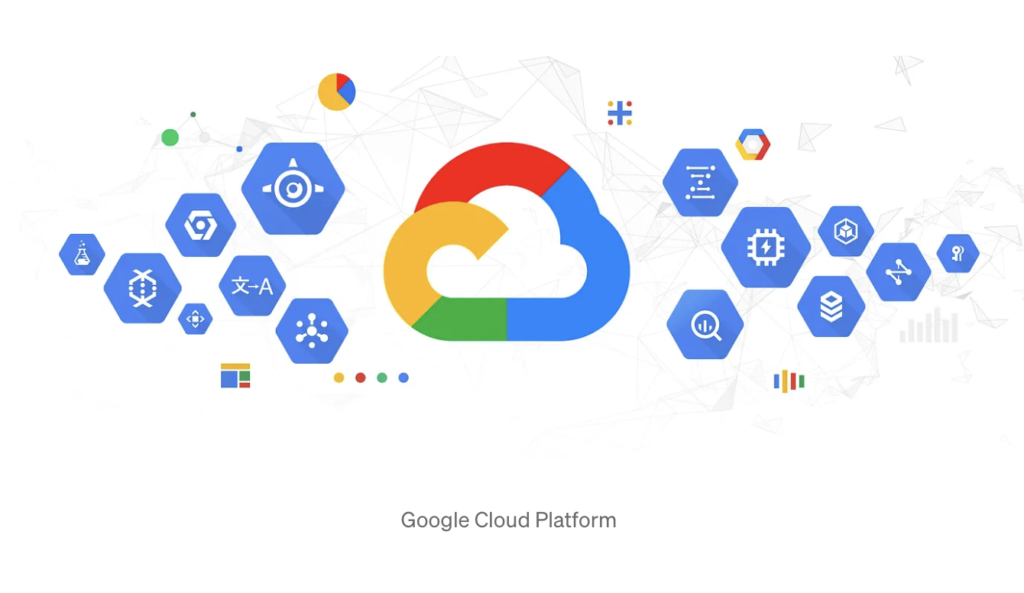
Compute and Storage
Google Compute Engine allows organizations to run virtual machines on Google’s infrastructure, similar to Amazon EC2 and Azure Virtual Machines.
Businesses can customize:
- CPU and memory configurations
- Operating systems
- Storage options
- Networking settings
For container-based applications, Google Kubernetes Engine (GKE) is one of GCP’s most recognized services.
Kubernetes originally came from Google engineering teams before being released as an open-source project in 2014. Because of this background, GKE has deep integration with Kubernetes management features.
However, AWS Elastic Kubernetes Service (EKS) and Azure Kubernetes Service (AKS) are also mature alternatives, and the best choice depends on existing infrastructure, team expertise, and operational requirements.
Google Cloud storage products include:
- Cloud Storage for object storage
- Cloud SQL for managed relational databases
- Firestore for document databases
- Bigtable for large-scale NoSQL workloads
- Spanner for globally distributed relational databases
Cloud Spanner is particularly notable because it combines relational database features with horizontal scalability and strong consistency. It is designed for applications that need high availability across multiple locations.
Data Analytics and Artificial Intelligence
One of Google’s strongest areas in cloud computing is data analytics.
BigQuery
BigQuery is Google’s fully managed cloud data warehouse designed for analyzing extremely large datasets using SQL.
Organizations use it for:
- Business intelligence dashboards
- Customer analytics
- Machine learning data preparation
- Real-time reporting
BigQuery separates storage and computing resources, allowing organizations to scale analytics workloads without managing traditional database infrastructure.
Pricing depends on usage models, including options based on data processed or dedicated computing capacity.
Vertex AI
Vertex AI provides tools for developing and deploying machine learning applications.
It supports:
- Model training
- Model deployment
- Generative AI applications
- Machine learning pipelines
- AI model management
Google’s research in artificial intelligence has contributed technologies such as transformer-based models and large-scale machine learning systems. Through Vertex AI, businesses can access Google’s AI infrastructure without building every component from scratch.
However, AI performance depends on factors such as data quality, model selection, and implementation strategy. Cloud AI services are powerful tools, but they still require proper planning and expertise.
How Google Cloud Differs From AWS and Azure
Choosing between cloud providers is not simply about finding the “best” platform. Each provider has strengths depending on the workload.
Learn more about Microsoft Azure and how it compares with AWS in our detailed guide.
Network Infrastructure
Google Cloud is known for its global private network infrastructure.
Instead of relying entirely on the public internet, many Google Cloud services use Google’s private backbone network to move data between locations.
This can provide advantages for organizations running:
- Global applications
- Large analytics workloads
- Latency-sensitive services
AWS and Azure also operate extensive private networks, so actual performance differences depend on architecture, region selection, and application design.
New to AWS? Explore our beginner’s guide to Amazon Web Services (AWS) and its core cloud services.
Pricing and Cost Management
Google Cloud introduced several pricing approaches designed to simplify cloud billing.
Examples include:
- Sustained use discounts for certain compute workloads
- Per-second billing for eligible services
- Committed use discounts for predictable workloads
However, cloud pricing comparisons can be complex. The cheapest provider depends on workload size, data transfer requirements, storage needs, and existing agreements.
A company running large AI workloads may have different cost considerations than a startup hosting a simple website.
Developer Experience and Open Source Support
Google has played a major role in open-source technology.
Projects associated with Google engineering include:
- Kubernetes
- TensorFlow
- Apache Beam
This history has helped GCP develop strong relationships with developers building cloud-native applications.
When I evaluated Google Cloud environments for technical projects, I found that teams already familiar with containers and modern DevOps practices usually adapted quickly to services like Kubernetes Engine and Cloud Run. The biggest learning curve was often not the platform itself, but understanding cost management and choosing the right architecture.
Security and Compliance
Google Cloud follows a shared responsibility security model.
Google manages security of the underlying infrastructure, while customers remain responsible for securing their applications, configurations, identities, and data.
Important GCP security features include:
- Identity and Access Management (IAM)
- Encryption by default
- Security Command Center
- BeyondCorp zero-trust security approach
Google Cloud supports compliance requirements used in industries such as:
- Healthcare
- Finance
- Government
Organizations should still verify specific compliance requirements before moving regulated workloads.
Suggested external citation: Add Google Cloud compliance documentation here.
For detailed technical information about Google Cloud products, security features, and best practices, refer to the official Google Cloud documentation.
Practical Advice for Businesses Evaluating Google Cloud
Before choosing a cloud provider, businesses should evaluate:
- Current technology stack
- Team expertise
- Application requirements
- Security obligations
- Long-term costs
Organizations focused heavily on analytics, artificial intelligence, or Kubernetes-based development may find Google Cloud especially attractive.
Companies already using Google Workspace may also benefit from smoother identity and collaboration integrations.
Google Cloud offers free trial credits and free usage options that allow teams to test services before committing significant resources.
When I helped review cloud architecture decisions for business projects, I found that small proof-of-concept deployments were often more valuable than comparing feature lists alone. Running a real workload usually reveals cost, performance, and operational challenges that are difficult to predict on paper.
The Bottom Line
Understanding what Google Cloud Platform is means looking beyond its position in the cloud market rankings.
GCP stands out because of its strengths in:
- Data analytics
- Artificial intelligence
- Kubernetes
- Global networking
- Open-source technologies
For businesses evaluating cloud solutions in 2026, the best choice is not always the largest provider. The right platform depends on matching business goals, technical requirements, security needs, and budget considerations with each provider’s strengths.
Google Cloud Platform is a strong option for organizations that want advanced data capabilities and modern cloud infrastructure, but careful planning remains essential before making a long-term technology decision.
Frequently Asked Questions
1. What is Google Cloud Platform used for?
Google Cloud Platform is used for hosting applications, storing data, running analytics workloads, building artificial intelligence systems, and managing enterprise infrastructure. Businesses use GCP for websites, mobile applications, machine learning projects, data warehouses, and large-scale software systems.
2. Is Google Cloud better than AWS?
Google Cloud is not universally better than AWS. GCP is often preferred for workloads involving analytics, Kubernetes, artificial intelligence, and Google’s networking infrastructure. AWS has a larger service portfolio and market share. The right choice depends on business requirements, technical skills, and budget.
3. Is Google Cloud Platform free?
Google Cloud provides free usage options and trial credits for new customers. These options allow developers and businesses to test selected services. However, production workloads generally require paid resources, and costs depend on usage.
4. What companies use Google Cloud?
Many organizations use Google Cloud for analytics, application hosting, and AI workloads. Companies across industries use GCP, although specific customer examples and services vary depending on publicly available case studies.
5. Should a small business use Google Cloud?
Small businesses can use Google Cloud, especially when they need scalable infrastructure without managing physical servers. However, smaller teams should carefully plan architecture and monitor spending because cloud costs can increase as usage grows.