

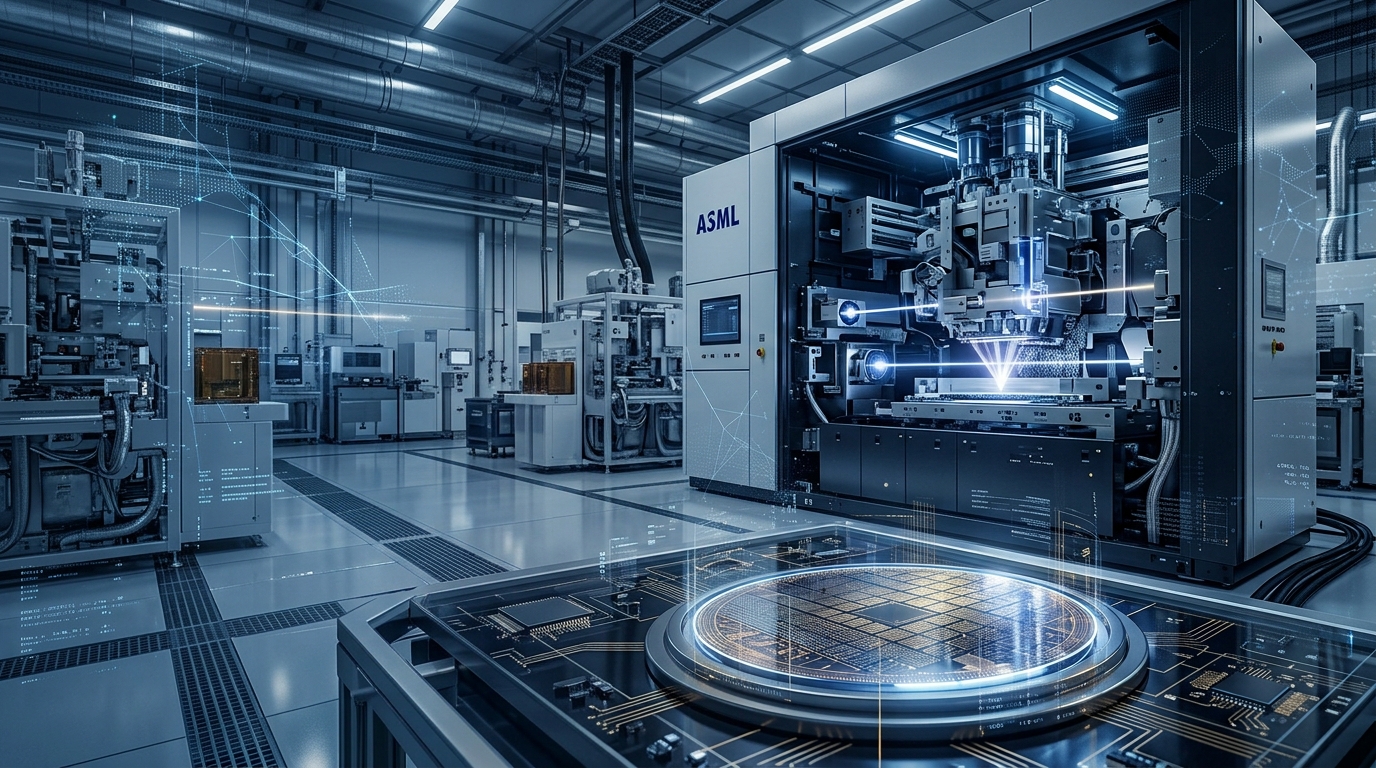
ASML delivered strong third-quarter results, with revenue reaching €11.66 billion. The semiconductor equipment maker also raised its full-year guidance. This performance highlights continued demand for advanced chip manufacturing technology.
The company is an important participant in the worldwide chip industry. Its machines help manufacturers produce increasingly powerful and efficient chips. Consequently, ASML benefits from investments in artificial intelligence, data centers, and advanced computing.
However, revenue growth alone does not explain the company’s latest performance. Customer demand, production capacity, and future chip investments also matter. These factors help explain why ASML remains important to the technology sector.
ASML Q3 Revenue Reaches €11.66 Billion
ASML’s reported third-quarter revenue of €11.66 billion reflects substantial activity across the semiconductor equipment market. The company supplies advanced lithography systems to leading chip manufacturers.
These systems help print extremely small circuit patterns onto silicon wafers. Manufacturers need this technology to develop processors, memory chips, and other advanced components.
Moreover, chipmakers continue investing in production technologies that support demanding computing workloads. Artificial intelligence has increased interest in high-performance processors and advanced manufacturing capabilities.
ASML’s position in this market gives it access to major industry investment cycles. Nevertheless, quarterly revenue can fluctuate depending on equipment deliveries, customer schedules, and order timing.
Artificial Intelligence Supports Semiconductor Equipment Demand
Artificial intelligence has become a major driver of semiconductor investment. Companies are building data centers that require powerful processors, specialized accelerators, and high-bandwidth memory.
These components depend on sophisticated manufacturing processes. Therefore, semiconductor manufacturers must invest in equipment that supports smaller and more complex chip designs.
ASML benefits from this demand through its lithography systems. Its extreme ultraviolet, or EUV, technology supports the production of some of the industry’s most advanced chips.
Additionally, manufacturers are expanding capacity to serve future computing needs. These investments can create opportunities for equipment suppliers, although spending decisions vary across customers and market conditions.
Why ASML Raised Its Full-Year Guidance
Raising full-year guidance signals that management expects stronger performance than previously anticipated. Such revisions can reflect improved demand, delivery expectations, or better visibility into customer investment plans.
For ASML, the outlook depends on semiconductor manufacturers’ capital expenditure decisions. When customers expand production capacity, they may require additional lithography equipment.
Furthermore, demand for advanced chips can encourage investment in newer manufacturing technologies. This trend supports ASML’s long-term business opportunities.
However, investors should examine the company’s official earnings release to understand the precise reasons behind its revised outlook. Revenue figures alone cannot establish whether higher expectations result from stronger demand, shipment timing, or other factors.
EUV Lithography Gives ASML a Competitive Advantage
ASML holds a distinctive position in advanced semiconductor manufacturing. Its EUV lithography systems enable chipmakers to produce intricate circuit patterns at extremely small scales.
Developing these machines requires advanced engineering, specialized components, and extensive technical expertise. Consequently, competing with ASML in EUV technology presents significant challenges.
The company’s technology helps manufacturers pursue better performance and efficiency. At the same time, chipmakers must balance equipment costs against expected production benefits.
ASML also supplies deep ultraviolet, or DUV, lithography systems. These machines remain important for manufacturing numerous semiconductor products and supporting different production stages.
Therefore, ASML’s business extends beyond a single technology category. Its equipment portfolio connects the company to several parts of the semiconductor manufacturing ecosystem.
What ASML’s Results Mean for the Semiconductor Industry
ASML’s financial performance provides useful insight into investment across the semiconductor supply chain. Equipment suppliers often benefit when chipmakers increase spending on manufacturing capacity.
For example, stronger demand for AI accelerators can encourage manufacturers to expand advanced production. Those expansions may require new equipment, facility upgrades, and supporting infrastructure.
Moreover, semiconductor demand affects suppliers, chip designers, and data center operators. ASML’s results can therefore help investors assess broader industry conditions.
Nevertheless, one quarter cannot establish a permanent growth trend. Semiconductor markets experience cycles, and customer investment plans can change quickly.
Inventory adjustments, economic uncertainty, export restrictions, and production delays may also affect equipment demand. Investors should consider these risks alongside revenue growth and management guidance.
Risks Investors Should Watch
Despite strong reported revenue, ASML faces several challenges. Semiconductor manufacturing requires substantial capital, and customers may postpone purchases when market conditions weaken.
Geopolitical tensions can also affect international equipment sales. Export controls may restrict access to certain markets or technologies.
Additionally, the timing of equipment deliveries can influence quarterly financial results. A shift in customer schedules may change reported revenue without indicating an equivalent change in long-term demand.
Competition and technological complexity create further considerations. ASML must continue investing in research, engineering, and manufacturing capabilities to maintain its technological leadership.
Therefore, investors should monitor order intake, backlog, gross margin, and management’s forward-looking comments. These indicators provide more context than revenue alone.
ASML’s Outlook: What Comes Next?
ASML’s €11.66 billion third-quarter revenue and higher full-year guidance highlight its importance in the semiconductor equipment market. Artificial intelligence and advanced computing continue creating incentives for manufacturers to improve chip production.
Meanwhile, ASML’s specialized lithography technology positions it to serve important manufacturing needs. Its future performance will depend on customer investment, technology development, and global market conditions.
Investors should review the company’s latest financial statements and guidance details before making decisions. Strong results can indicate favorable business momentum, but they do not guarantee future growth or higher stock prices.
Ultimately, ASML remains a key company to watch as the semiconductor industry develops. Its results offer valuable clues about the investments supporting the next generation of computing technology.