

Understanding what a multi-cloud strategy is and why companies are switching to it has become essential for enterprise IT leaders in 2026. Cloud computing now powers nearly every digital operation, and organizations are no longer asking whether to adopt cloud, but how to design it for resilience, performance, and long-term flexibility.
Hybrid cloud combines the strengths of both private and public cloud models. To understand these foundations better, you can read our guides on What Is Public Cloud and How It Works and What Is Private Cloud and Why Big Companies Use It.
How Growing Cloud Dependence Is Reshaping Enterprise IT
According to Gartner, global cloud spending is projected to exceed $1 trillion by 2027. Enterprises increasingly rely on cloud platforms for AI workloads, data analytics, and real-time systems. This shift has made cloud architecture a core business decision rather than just an IT concern.
Why Businesses Are Moving Beyond a Single Provider
High-profile outages, such as AWS’s us-east-1 disruption, exposed the risks of depending on a single provider. Even short downtime events can impact revenue, customer trust, and operational continuity. As a result, organizations are actively diversifying across cloud platforms.
Multi-Cloud Adoption Trends in 2026
Industry reports such as Flexera’s State of the Cloud indicate that most enterprises now operate multi-cloud environments, often using multiple public clouds alongside private infrastructure. This reflects a broader shift toward distributed and resilient cloud architectures.
What Is a Multi-Cloud Strategy?
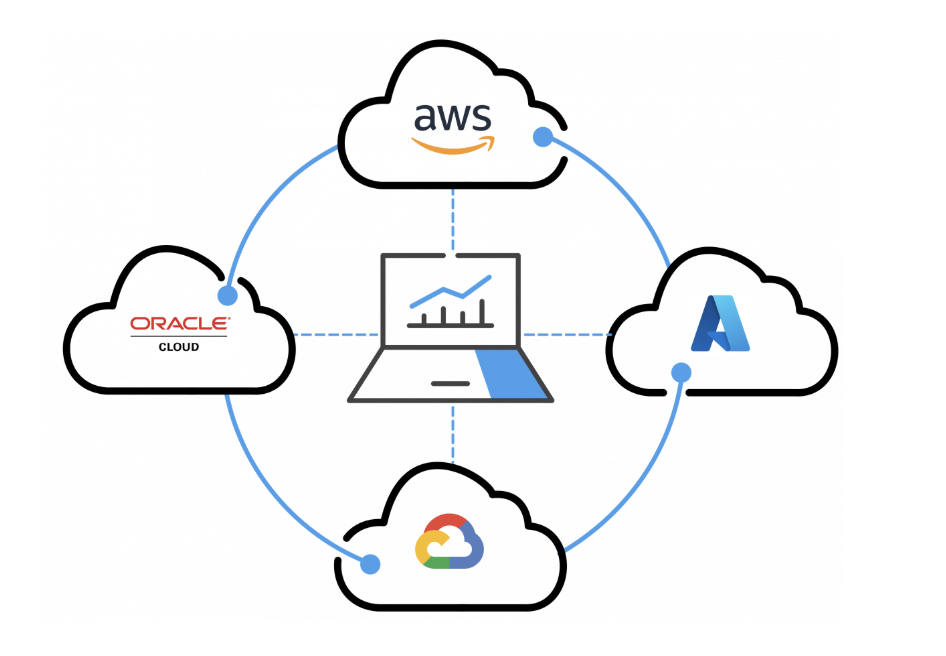
A multi-cloud strategy is the deliberate use of two or more public cloud providers, such as AWS, Microsoft Azure, Google Cloud, or Oracle Cloud, to run applications, store data, and deliver services.
Instead of relying on a single vendor, organizations distribute workloads based on performance, cost, compliance, and geographic requirements.
Multi-Cloud vs Hybrid Cloud
Multi-cloud focuses on using multiple public cloud providers. Hybrid cloud combines public cloud with private infrastructure or on-premises systems.
In practice, many enterprises use both simultaneously, forming hybrid multi-cloud environments that maximize flexibility and control.
How a Multi-Cloud Environment Works
In real-world enterprise setups, workloads are assigned based on provider strengths:
- AI workloads on Google Cloud
- Enterprise systems on Azure
- High-performance computing on AWS
Data and Application Distribution
Modern multi-cloud systems rely on:
- Kubernetes for workload portability
- Docker containers for standardization
- API gateways for interoperability
- Distributed databases like CockroachDB or Google Spanner
Orchestration Tools
Key platforms include:
- Terraform for Infrastructure as Code
- Red Hat OpenShift for container orchestration
- VMware Aria for cost and governance management
In real deployments, the biggest challenge is rarely deployment itself, it is maintaining consistent identity, networking, and security policies across environments. Once organizations centralize IAM and standardize orchestration, stability improves significantly.
Why Companies Are Switching to Multi-Cloud
Avoiding Vendor Lock-In
Multi-cloud reduces dependency on a single provider’s ecosystem, giving organizations flexibility in pricing, services, and architecture decisions.
Improving Reliability and Availability
Distributing workloads across providers reduces the impact of outages. If one cloud region fails, traffic can be rerouted using failover systems or global load balancers.
Cost Optimization
With FinOps practices, companies can place workloads where pricing is most efficient. However, savings depend heavily on governance and workload design.
Access to Best-of-Breed Services
Each provider has strengths:
- AWS: global infrastructure
- Azure: enterprise integration
- Google Cloud: AI/ML leadership
- Oracle Cloud: database optimization
According to the NIST definition of cloud computing, cloud models are designed around on-demand access to shared computing resources that can be rapidly provisioned and released with minimal management effort.
Compliance and Data Residency
Multi-cloud helps organizations meet regulations like GDPR and HIPAA by controlling where data is stored and processed.
In many real-world cases, private cloud is not used alone but combined with public cloud in a Hybrid Cloud architecture to balance control and flexibility.
Business Continuity
Cross-cloud backup strategies improve resilience against outages, cyberattacks, and regional disruptions.
Key Benefits of Multi-Cloud Strategy
Flexibility and Agility
Teams can adopt new services without being constrained by a single provider.
Higher Resilience
No single point of failure improves uptime and disaster recovery readiness.
Performance Optimization
Workloads can be placed closer to users or specialized infrastructure.
Faster Innovation
Access to multiple AI, analytics, and edge services accelerates product development.
Stronger Negotiation Power
Enterprises can negotiate better pricing by maintaining provider flexibility.
Common Challenges of Multi-Cloud
Increased Complexity
Managing multiple platforms increases operational overhead and requires stronger governance.
Security Consistency
Organizations must enforce unified policies using CSPM tools like Wiz or Prisma Cloud.
Cost Management
Without FinOps discipline, cloud spending can become fragmented and unpredictable.
Skills Gap
Teams need expertise across multiple platforms, increasing training requirements.
Data Integration Issues
Cross-cloud data transfer introduces latency and egress costs that must be carefully managed.
Multi-Cloud vs Hybrid Cloud (Simplified View)
| Aspect | Multi-Cloud | Hybrid Cloud |
| Structure | Multiple public clouds | Public + private cloud |
| Focus | Provider diversity | Infrastructure integration |
| Use Case | Flexibility and redundancy | Legacy modernization |
| Tools | Kubernetes, Terraform | VPNs, private connectivity |
Best Practices for Multi-Cloud Strategy
- Define business-driven cloud goals
- Standardize security policies across providers
- Use Infrastructure as Code (Terraform, Pulumi)
- Adopt Kubernetes for portability
- Implement FinOps cost tracking
- Automate governance and monitoring
Industries Benefiting from Multi-Cloud
Financial Services
Banks use multi-cloud to improve resilience and meet regulatory requirements.
Healthcare
Hospitals and health systems use it for data residency compliance and secure patient data handling.
E-Commerce
Retail platforms scale across clouds during peak demand periods.
Government
Public sector organizations use sovereign cloud strategies for compliance.
Telecommunications
Telcos use multi-cloud for edge computing and distributed workloads.
Future of Multi-Cloud in 2026 and Beyond
AI-Driven Cloud Management
AIOps tools are increasingly automating workload optimization and anomaly detection.
Growth of Cloud-Native Applications
Microservices and containers make multi-cloud deployment more practical.
Rising Data Sovereignty Rules
Governments are enforcing stricter data localization requirements worldwide.
Expansion of Cloud Security Platforms
Unified security tools are becoming essential for enterprise governance.
Frequently Asked Questions
1. What is the difference between multi-cloud and hybrid cloud?
Multi-cloud uses multiple public cloud providers, while hybrid cloud combines public and private infrastructure. Many organizations use both together for greater flexibility and resilience.
2. Is multi-cloud more expensive than single cloud?
Not necessarily. While it increases complexity, proper FinOps practices can reduce overall costs through workload optimization and pricing leverage.
3. Which companies use multi-cloud?
Many large enterprises, including global tech firms and financial institutions, use multi-cloud strategies to improve resilience and performance.
4. What are the biggest risks of multi-cloud?
Key risks include complexity, inconsistent security, data transfer costs, and skills gaps. These can be managed through governance and automation.